Home Blog Page 497

20 Brands In 20 Days: Ashley Wilson, 96.9 The Kat, Charlotte

Charlotte, North Carolina, is one of the fastest-growing metros in the country. Adding new residents at the rate of 100 per day. The market is as diverse as being a Southeast banking powerhouse to the home of NASCAR.

96.9 The KAT is the area’s heritage Country station and is today’s featured brand.

Director of Programming & Brand Strategy Ashley Wilson is steering the ship, or perhaps in this case, the NASCAR, with the goal of staying rooted in the community, being nimble with music, and being visible where Country fans gather.

The Morning Show: Local Voices That Matter

The KAT’s building blocks start with a local morning show.

“We have live and local mornings with Graham B and Sarah Lee. Then we have a lot of talent with strong connections to the market—from Angie Ward to me to Eddie Foxx. All of us love Carolina. This station borders North and South Carolina, so we have a lot of listenership in both states. We’ve been a heritage station here for many, many years.”

Morning show host Paul Schadt set the expectation of a live and local morning show.

“We had a long-time morning show with Paul Schadt for 27 years, and he just retired at the beginning of this year. He’s still an ambassador with the station. Everybody loves Paul, and he’s still very much a fabric of the station.” (BMM 3/10)

“Graham B and Sarah Lee are huge Country music fans. Sarah Lee’s husband is the mayor of one of the small-town communities just outside of Charlotte, so she is extremely involved in community affairs. Graham relocated back to North Carolina after being away for quite some time. He’s from Raleigh originally. We’re really thrilled that we’ve got two people who were born and bred in North Carolina and are representative of the people who live here.”

Community at the Core

Community connection is an integral part of The KAT’s DNA.

“When I think KAT Country, I think connection and community. We are very active in the community, hosting events such as fundraisers, as well as supporting the Carolina Panthers and NASCAR. This is the home of NASCAR here in Charlotte, so we are highly integrated with what they do there. We have a ton of race fans in this community.”

“Charlotte has over 100 people moving here daily. Charlotte is the banking center of the Southeast. So, there’s a lot of diversity in this market.”

All Are Welcome

Charlotte is home to many Country music fans, and The KAT welcomes all.

“You don’t necessarily have to be from North Carolina or from the country to be a Country fan. The stigma about Country music has dissolved quite a bit in the last few years. Country is for everybody. We’ve got a ton of Country fans here in the Charlotte Metro. We just had a Country Club open up down the street from our offices in a high-density area. We have bars here that host country nights. Country is for everybody.”

The station positions itself as “Charlotte’s #1 for New Country,” but that doesn’t necessarily exclude the legends.

“We are new Country-focused, but we also want to honor where we came from. It’s very important that we stay established with the core of Country music and what this station was built around while also looking forward to what’s next.”

Balancing Tradition and New Country

Framing the gold library as event programming allows The KAT to capitalize on emotion without compromising its current hit identity.

“We do have some very strong titles that we play from the ’90s. And we’ll do throwback weekends around occasions—holiday weekends, things like that. We want to have that party atmosphere and sound fun, especially when people are kicking off summer or having that last vacation of the summer.”

How does Wilson feel about the blurring of genre lines with crossovers?

“We want everybody to feel welcome when they come to our station. We also want to identify as a Country station. I think we should always be curious about anything that is Country‑influenced. And if it is something that our audience wants to hear, then that’s something we should play. At the very least, a lot of the things that have come to the surface over the last few years that are Country‑influenced or Country‑driven are well worth highlighting.”

Contesting and Accessibility

Contesting and concert ticket giveaways are tune-in tactics and leverage points.

“We’ve got three major concerts coming up in August, so a lot of our summer has been focused on highlighting those shows. One of the reasons radio will always be a thing is its accessibility. Many of the people who engage with us are simply trying to get through their lives. Some people are living paycheck to paycheck, and going to a concert is not necessarily an accessible experience. We want to be a part of connecting those fans to those experiences. It’s a big part of the fabric of the station.”

Wilson with Kelsea Ballerini – Photo Facebook

Giving Back

Wilson is proud of the station’s community engagement efforts and its ability to respond quickly in times of crisis.

“St. Jude. We do a radiothon every year. We are highly engaged with several nonprofits in our community, including foster care agencies. The hurricane that came through last year. I’m extremely proud we were able to mobilize so quickly to respond to the immediate needs in Western North Carolina. We took the power of radio and our brands and collected tons of supplies that were immediately flown into Western North Carolina. That’s the power of radio and community and connection.”

Being A Friend

Besides the music and community engagement, it’s about companionship.

“Graham B and Sarah Lee get so many calls every day that they’re not even able to answer all of them. People just want to be heard, and they want to connect. We’re living in a world where people are becoming increasingly isolated. Social media has made us more and more isolated.”

“With their show, they’re able to bring together people every morning to have fun and get their mind off whatever is going on. They’re companions to people on their way to work or school. A great way to get the day started on a positive foot.”

“Graham came to us with a lot of relationships with artists. I look at him as the artist’s best friend. He’s so accessible. He and Sarah Lee just hit it off. They’re having a ton of fun.”

“If you listen to the show, you can tell they’re enjoying themselves. We want to provide escapism for people while also being right there with them. We have the same struggles as everybody else. So, we want to provide escapism and let people know we’re right there in it with them.”

Listen to 96.9 The KAT here.

Barrett Media produces daily content on the music, news, and sports media industries. To stay updated, sign up for our newsletters and get the latest information delivered straight to your inbox.

How Morning Radio Mirrored the ‘History of Sitcoms’

0

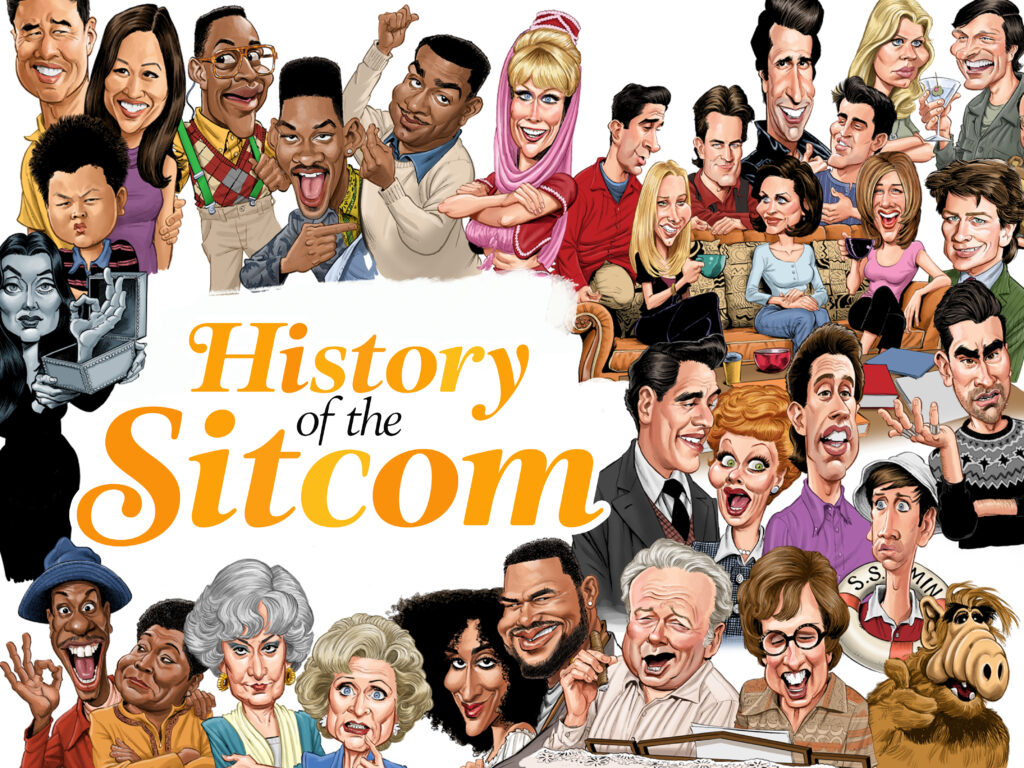
If you have yet to watch HBO MAX’s eight-part series on the “History of the Sitcom,” you’re in for a real treat. The documentary is an insightful, entertaining, and very nostalgic look at what has proved to be one of TV’s most enduring types of shows. My wife and I watched it this past weekend, but it debuted in 2021. It’s a deep dive into the evolution of the sitcom, from its black-and-white beginnings to the edgy and bold genres of today.  

The episodes each chronicle the cultural, social, and political conversations in American life through the eyes of sitcoms. They often reflected and even shaped the mores of the times. It dawned on me while watching the series that morning radio evolved through the decades much the same way. They too took on the social issues of the time or mirrored the national and local culture and communities.  

For History of the Sitcom, CNN’s documentary team produced and designed it to be more than just a highlight reel of outtakes and laugh tracks. It’s truly a comprehensive exploration of how the genre changed with the times and, in turn, had a huge impact on society.

The series begins by regaling the sitcom’s golden age, featuring classics like I Love Lucy, The Honeymooners, and The Dick Van Dyke Show. These shows and their respective writers created the template for this genre through family dynamics, workplace shenanigans, and a focus on character-driven humor. Who can forget Lucille Ball’s comedic timing and the groundbreaking she did for women in entertainment?  It was timely shows like All in the Family and The Jeffersons that first used humor to tackle difficult, serious issues like racism, sexism, and politics; much of which would likely never pass muster today.

The show perfectly weaves various scenes from Leave It to Beaver with others from Modern Family or Black-ish. Underscoring how sitcoms have grown to include a much wider range of voices, experiences, and characters to build cultural representation across race and ethnicity.

The 8 episodes are each packed with interviews from actors, writers, creators, and critics.

If you’re old enough, you’ll recognize creative people like Norman Lear, Tina Fey, and Kenan Thompson. Who all offer firsthand accounts into the creative process and social impact of various shows and/or genres. They each provide wonderful insight into the power of sitcoms, which reflect everyday life, often pushing the limits well beyond any boundaries of the times.

The series also breaks down specific themes across episodes that focus on friend-centered sitcoms like Friends, Living Single, and How I Met Your Mother, as well as Family Matters, which examines the evolving nature of family on television. These thematic episodes give viewers a chance to reflect on how their favorite shows fit into a larger cultural framework.

I found the shifting of values through the decades and generations especially fascinating, going back to radio shows like Amos & Andy in the ’50s that used white actors using blackface to play the main characters. That would later be changed on television. I also had not realized that Good Times was the first African American, two-parent sitcom, debuting in 1974.  

What sets History of the Sitcom apart from a simple retrospective documentary is its recognition that sitcoms are more than just a source of entertainment. They are a mirror of changing values. Charting our country’s exploration through civil rights, war, gender roles, identity, sexual preference, feminism, abortion, and family structure. Who can forget the national sparring between Vice President Dan Quail and TV’s Murphy Brown in the 90s?  

By showcasing both well-known series and underrated gems, the series explains how the sitcom continues to evolve in the age of streaming, social media, and shifting audience desires and expectations. You’ll see conversations and analysis of shows like Cheers, MASH, Maude, Three’s Company, Laverne & Shirley, Welcome Back Kotter, and Mary Tyler Moore, along with Friends, Seinfeld, and dozens of others.  

History of the Sitcom is a must-watch for TV lovers, culture buffs, and anyone curious about how 30-minute comedies have shaped and will continue to shape our world. It’s creative, compelling, intelligent, and nostalgic. And surprisingly emotional tribute to scores of shows that have made us laugh, cry, and think for generations.

Barrett Media produces daily content on the music, news, and sports media industries. To stay updated, sign up for our newsletters and get the latest information delivered straight to your inbox.
Short‑Deck and Fast‑Fold: Why New Poker Formats Are Gaining Popularity

Over the past few years, the poker landscape has witnessed the rapid ascent of two particularly dynamic formats: Short‑Deck (also known as Six‑Plus Hold’em) and Fast‑Fold (branded variously as Zoom, Rush & Cash, and others). These variants have attracted attention both online and in high‑stakes live settings, challenging the dominance of traditional no‑limit Texas Hold’em. Their rise appears to stem from a combination of faster gameplay, heightened action, and evolving player preferences. Yet the long‑term place of these formats remains open to debate, as factors such as variance, learning curves, and operator support continue to evolve. In what follows, we explore what sets these formats apart, why they may appeal to modern players, and what uncertainties remain about their future.

Poker formats

Format Descriptions and Appeal

Short‑Deck reshapes the familiar Hold’em experience by removing all cards below six, creating a 36‑card deck. This alteration impacts the frequency of strong hands, often leading to larger pots and more showdowns. Commonly, a flush outranks a full house, though some games adopt “traditional” rankings; in certain rooms, three‑of‑a‑kind may even best a straight. The ante structure also shifts: instead of conventional blinds, everyone posts an ante and the dealer button contributes a higher ante.

These rule tweaks can seem jarring at first, and newcomers often face a learning curve as they adjust hand ranges and probabilities. Nevertheless, the faster resolution of hands and more aggressive preflop play can make sessions feel more thrilling, particularly for players who enjoy high‑variance situations.

Fast‑Fold, in contrast, retains the standard 52‑card deck and traditional no‑limit rules but transforms the table‑seating dynamic. When a player folds, they are whisked away to a fresh table and dealt a new hand immediately, eliminating downtime spent waiting for the action on other tables. This model allows significantly higher hand volumes, sometimes exceeding a thousand hands per hour, compared to the 60–100 hands typical at a fixed table. The ability to fold poor hands and instantly receive another encourages more aggressive decision‑making and can reduce the frustration of being dealt multiple unplayable hands in succession. For players focused on volume and steady learning, Fast‑Fold provides a streamlined environment, though it may diminish the opportunity to read opponents over time.

Both formats have benefited from operator incentives, such as leaderboard challenges and rakeback offers, which may partly explain their swift uptake. High‑profile endorsements by professional players in televised high‑roller events and streaming channels have further increased visibility, enticing recreational players to sample these new ways to play. For those interested in exploring these formats, many options can be found in our curated list of sites featuring top-rated online casino rooms offering Short-Deck and Fast-Fold tables.

Strategic Considerations

The strategic landscape in Short‑Deck differs markedly from standard Hold’em. With fewer low cards, the probability of hitting high‑value hands increases: trips and better become more common, and draws complete more frequently. As a result, hand equities compress, for instance, a hand that might be a 70% favorite in Hold’em could drop closer to 60% in Short‑Deck depending on board texture. This compression tends to amplify variance, meaning bankroll swings can be substantial.

Players must adjust by playing more cautiously when drawing and being prepared for larger bluffs and raises in both preflop and postflop scenarios. Learning to interpret the altered hand rankings and calibrate aggression accordingly is crucial, and many recommend using specialized equity calculators or training tools tailored to Short‑Deck before jumping into real‑money games.

In Fast‑Fold environments, the primary strategic shift lies in volume management and range balancing. Because players never face the same opponents on consecutive hands, reading individual tendencies becomes challenging. Success instead relies on a solid understanding of game theory optimal (GTO) ranges and the ability to exploit minor leaks in a mechanically efficient way. Tightening up excessively can reduce play opportunities, while overly loose play risks extended losing streaks without the comfort of familiar reads. Many experienced grinders view Fast‑Fold as a test of technical consistency rather than psychological warfare, rewarding those who can maintain focus and adhere to balanced strategies over thousands of hands.

Both formats thus demand different mixes of skills. Short‑Deck often appeals to those who relish high‑stakes thrill and complex postflop dynamics, whereas Fast‑Fold suits volume‑oriented grinders seeking steady hourly gains. Each carries its own set of uncertainties: Short‑Deck’s long‑term appeal may hinge on standardizing rules and broadening low‑stake offerings, while Fast‑Fold must balance the desire for speed with ensuring a healthy ecosystem where recreational players remain engaged.

Comparative Overview

The following table summarizes key distinctions between Short‑Deck and Fast‑Fold formats, highlighting features that may influence a player’s choice:

FeatureShort‑Deck (Six‑Plus Hold’em)Fast‑Fold (Zoom, Rush & Cash)
Deck composition36 cards (2 through 5 removed)52 cards (standard deck)
Hand ranking alterationsFlush outranks full house; sometimes trips outrank straightStandard no‑limit Hold’em ranking
Preflop strategyLooser ranges; increased limping and three‑bettingSimilar to regular ranges; focus on opening frequencies
Postflop equity dynamicsTighter equities; higher varianceUnchanged; but more hands per session
Player readsPossible over multiple hands at same tableLimited; new opponents each hand
Session tempoFaster hand resolution; more all‑in and big potsHigh volume; minimal downtime
Bankroll implicationsLarger swings; requires deeper rollSteady gains possible; variance per hour may be lower
Ideal audienceHigh‑stakes enthusiasts; variance seekersVolume grinders; technical strategists

Community Insights and Uncertainties

Players in online forums often remark that Short‑Deck feels like “Hold’em on steroids,” with more frequent big hands and bolder lines. Yet some caution that without widely accepted standard rules, variance in house policies, such as differing hand rankings, may confuse newcomers. The creation of unified rulebooks or widely used software tools could mitigate this, but it remains a work in progress.

Fast‑Fold’s biggest advocates point to the satisfying pace and uninterrupted action as key virtues, especially for those balancing poker with other commitments. Others note a potential downside: with no opportunity to play exploitatively against weaker regulars whose mistakes one might otherwise isolate, Fast‑Fold may eventually become a tougher game as more skilled grinders dominate. This raises questions about its sustainability for casual players, who might drift away if win‑rates decline.

Academic or long‑term data on both variants is sparse. Most statistics derive from operator leaderboards or anecdotal reports, meaning that comprehensive insights into win‑rate distributions, rake impact, and player retention are still emerging. Additional research, potentially through hand history aggregation and third‑party analyses, would shed light on the viability of these formats for both high‑ and low‑stakes communities.

Broader Implications and Future Directions

The rise of Short‑Deck and Fast‑Fold may reflect a broader shift toward faster, more engaging entertainment formats in online gaming. As attention spans evolve and competition from other digital activities intensifies, poker operators may feel pressure to innovate or risk stagnation. We might see hybrid formats that combine elements of both Short‑Deck and Fast‑Fold, or entirely new variants designed to capitalize on emerging technologies such as real‑time analytics and immersive live streaming.

However, it is also possible that these formats remain niche attractions, appreciated by a segment of the poker population but never supplanting standard Hold’em. Traditional tournaments and cash games continue to draw large fields and high prize pools, underscoring the enduring appeal of the classic model. Any long‑term shift will likely require operators to balance innovation with preserving the fundamentals that made poker a global phenomenon.

For individual players, the key may be diversification: sampling Short‑Deck and Fast‑Fold for variety and learning, while continuing to hone core skills in traditional no‑limit games. This balanced approach allows one to benefit from the excitement and rapid feedback of new formats, without over‑committing before fully understanding the nuances and risks involved.

Bottom Line

Short‑Deck and Fast‑Fold represent two compelling responses to modern poker’s demands for speed and excitement. By altering deck composition and table dynamics, they offer fresh challenges for both recreational and professional players. Yet questions remain about rule standardization, player retention, and the ultimate shape of the poker ecosystem. Those intrigued by these formats would do well to approach them with curiosity tempered by caution, investing in study, managing their bankrolls prudently, and remaining open to evolving strategies as new data emerges. In doing so, they can experience the cutting edge of poker innovation while safeguarding against the uncertainties inherent in any emerging trend.

NBCUniversal Reportedly Considering Launching Sports Cable Network

0

NBCUniversal is reportedly in early discussions to launch a new sports-focused cable network. The potential debut could take place as early as this fall. According to a report from The Wall Street Journal, the prospective channel would primarily feature content currently available on the company’s streaming service, Peacock.

Sources familiar with the matter say the channel would be offered to cable and satellite providers as part of more narrowly targeted specialty bundles, rather than traditional broad-based cable packages. While no final decision has been made, the internal talks underscore NBCU’s continued belief in the value of live sports — even as more consumers pivot away from cable toward streaming.

NBCUniversal, which is owned by Comcast, is making a substantial investment in live sports programming beginning this year. The company agreed to a new deal with the NBA valued at $2.5 billion annually last year. It goes into effect this coming season. Executives are hoping the league’s arrival will help grow Peacock, which currently has about 41 million subscribers. That number trails rivals in the crowded streaming space.

NBCUniversal, like many legacy media companies, is navigating the realities of cord-cutting while simultaneously investing heavily in streaming. In fact, most of its cable channels are in the process of being spun off into a new entity called Versant.

However, sports remains one of the most profitable and durable genres on linear television. NBCU executives appear interested in capturing revenue from fans still loyal to the pay-TV bundle.

To prepare for the influx of sports content, Peacock recently raised subscription prices. The ad-supported tier jumped $3 to $10.99 per month, while the ad-free option now costs $16.99. Despite the tiers, all live sports content on Peacock includes advertisements.

In addition to its future NBA content, Peacock’s current sports lineup includes Sunday Night Football simulcasts, an exclusive NFL regular season game, the Olympics, WNBA, Premier League Soccer, golf, and college football.

According to the report NBCU does not plan to place the new cable sports network into traditional bundles that feature major competitors like ESPN or FS1. Instead, the network would be reserved for genre-based packages offered by distributors like Charter’s Spectrum or DirecTV.

NBCUniversal has operated NBC Sports Network, but it hasn’t produced the same level of impact as other mainstream sports outlets. The network’s biggest marquee events have been featured on USA Network, which is also set to become part of Versant.

NBCUniversal has not confirmed the report by The Wall Street Journal.

Barrett Media produces daily content on the music, news, and sports media industries. To stay updated, sign up for our newsletters and get the latest information delivered straight to your inbox.

Newsmax Files Objection to FCC Proposal to Eliminate National TV Ownership Limits

0

Newsmax has filed a formal objection with the FCC, calling on the agency to preserve the national television ownership cap. In a detailed 33-page filing, the independent media company strongly opposed any move to relax or eliminate the Horizontal Ownership Cap, warning such changes would harm local journalism and reduce viewpoint diversity.

The FCC is currently reviewing the rule, which bars a single broadcaster from reaching more than 39% of U.S. households. The agency opened the door for public comment last month as part of a broader media ownership review. Newsmax’s response is one of the most forceful yet.

“Americans of every political persuasion, demographic, and location would be harmed by any weakening of the national ownership limit,” the filing reads. Newsmax insists the cap is essential to maintaining competition, localism, and a diversity of voices in broadcasting.

CEO Christopher Ruddy signed the filing personally, warning that raising or removing the cap would allow major players like CBS, NBC, and ABC to dominate even more local markets — pushing out smaller, independent outlets. Ruddy argued this could create “less incentive to produce programming that reflects the values of local communities.”

The filing cites the rule’s history, noting it was originally set under President Reagan and codified by Congress in 2004. Newsmax claims the FCC lacks the legal authority to alter the cap without legislative action, invoking the Supreme Court’s “Major Questions Doctrine.”

“There could be no greater ‘basic and fundamental change’ to a limit set by Congress than abolishing it altogether,” the company wrote.

Newsmax also took direct aim at Fox Corporation and Nexstar Media Group, accusing both of leveraging market dominance to suppress rivals. It claims Fox pressured pay-TV providers to drop Newsmax, while Nexstar allegedly used its station reach to boost its struggling NewsNation brand.

The filing ends with a stark warning: “The FCC must reject any proposal to raise or remove the cap — not just to honor congressional law, but to defend America’s media landscape from monopolization and political manipulation.”

Ask ChatGPT

Barrett Media produces daily content on the music, news, and sports media industries. To stay updated, sign up for our newsletters and get the latest information delivered straight to your inbox.

Pat McAfee Apologizes for His Role in Spreading False Story About Mary Kate Cornett

4

Pat McAfee took time on his nationally syndicated ESPN program this week to issue a heartfelt and direct apology to Mary Kate Cornett and her family, acknowledging his show’s role in amplifying a false internet rumor earlier this year. Back on February 26, during coverage of the NFL Draft Combine, The Pat McAfee Show discussed a story that had gone viral involving a Mississippi college student. That story, later proven false, involved Cornett and circulated widely on social media platforms.

McAfee, speaking candidly, said that he had the opportunity to meet Cornett and her family to apologize in person. He admitted that his team “had no personal knowledge” of Cornett or her life, and that they relied entirely on online speculation and prior media coverage without verifying the facts.

“I have since learned that the story was not true and that my show played a role in the anguish caused to a great family—especially to a young woman, Mary Kate Cornett,” McAfee said. “As a girl dad, I also was very thankful for the opportunity to let Mr. Cornett know that I was wildly regretful for the part that our show played in his daughter Mary Kate’s pain.”

The former NFL punter turned sports media star explained that his delay in publicly addressing the matter was intentional. He said he prioritized speaking privately with the Cornett family before making any public statement.

“The most important element on the timing is—I personally, a decision that I made—wanted to talk to the family first before addressing it publicly,” McAfee said. “I can now say that I had the opportunity to meet them, chat with them. They’re wonderful people, and I’m very thankful they gave me the opportunity to tell them how sorry I was.”

McAfee stressed that his program’s intent has always been to entertain and uplift—not to harm.

“I deeply regret the pain that was caused. I hated watching what our show was a part of,” McAfee said. “And my hope is that this can be something we all learn from going forward. I know we certainly have.”

While McAfee did not detail whether legal action had ever been considered or threatened, his tone made clear that the emotional damage done to the Cornett family was not taken lightly. His apology closed with gratitude and a call for growth.

“Our goal with this show is to make the world a happier place, a better place, to celebrate life and sports and to unify folks,” he added. “I and we don’t always get it right, but we’ll never stop trying.”

The apology Wednesday is the first time McAfee has referenced the show’s remarks since the ‘Big Night Aht’ event in April.

Barrett Media produces daily content on the music, news, and sports media industries. To stay updated, sign up for our newsletters and get the latest information delivered straight to your inbox.

Bari Weiss Seeking More Than $200 Million in Potential Sale of The Free Press to Incoming Buyer of CBS

0

Bari Weiss, the founder of The Free Press, is looking to sell her digital outlet to David Ellison, the incoming buyer of CBS, as part of a multi-million dollar deal.

According to a report from The Financial Times, Weiss has met with Ellison about selling the business she founded nearly four years ago to the Skydance studio set to purchase Paramount, the parent company of CBS.

According to the report, Weiss, who founded the digital outlet after departing The New York Times, is looking for a valuation between $200 and $250 million for the startup.

The attempt to sell the business comes after Weiss conducted a round of fundraising of more than $15 million last year, which — at the time — valued the company at $100 million.

To put the desired valuation from Weiss into perspective, Amazon founder Jeff Bezos purchased The Washington Post for $250 million in 2013.

Weiss launched the digital outlet as a Substack newsletter in 2021. She later earned investments from the likes of Marc Andreessen and David Sacks, who were also in the news Wednesday for investing in Substack itself.

It remains to be seen what or how Skydance would utilize The Free Press, and if it would be in conjunction with CBS News.

Barrett Media produces daily content on the music, news, and sports media industries. To stay updated, sign up for our newsletters and get the latest information delivered straight to your inbox.

Time Spent Listening to Podcasts Has Grown By 355% Since 2015, New Edison Research Data Shows

0

Listening to podcasts has never been more en vogue. But new data from Edison Research shows just how big the jump from the past decade has been.

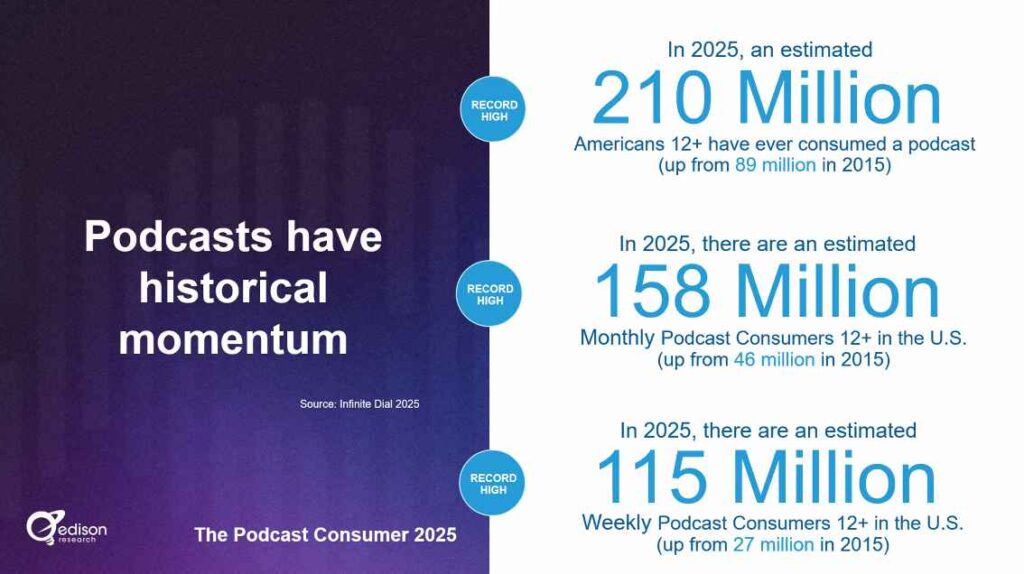
In the findings from The Podcast Consumer 2025, data from Edison Research shows that overall time spent listening to podcasts has grown a whopping 355% since 2015.

In 2015, the company shared that roughly 170 million hours per week were spent listening to podcasts.

That figure grew to 770 million hours per week, or an increase of 603 million hours per week over the past decade.

Edison Research Vice President Megan Lazovick shared that the jump is a natural one for the medium. Only 46 million users labeled themselves as monthly podcast consumers in 2015. In 2025, that number has increased to 115 million.

“I had trouble wrapping my head around this one at first, but think about it: since 2015, the number of people listening to podcasts has increased by millions, and we also know that those who do listen to podcasts are spending more time doing so,” said Lazovick. “So if you consider that, more people and more time, you see a massive increase in the total number of hours spent listening to podcasts per week among Americans. Podcasts have historical momentum.”

Furthermore, in 2015, only 27 million Americans called themselves weekly podcast consumers. In 2025, that figure has risen to 115 million, according to Edison Research.

Barrett Media produces daily content on the music, news, and sports media industries. To stay updated, sign up for our newsletters and get the latest information delivered straight to your inbox.

Greenville’s Classic Rock 101.1 Becomes ‘Ozzy 101.1’

0

Classic Rock 101.1 WROQ-FM in Greenville, SC, is honoring the life and legacy of Ozzy Osbourne today with a special station takeover. The station will rebrand as “Ozzy 101.1,” dedicating five hours of programming to one of rock’s most legendary voices.

The tribute will be hosted by longtime station personality and Brand Manager, The Stoneman, who has been playing Osbourne’s music for more than four decades. The broadcast will feature a mix of chart-topping hits and fan favorites spanning Osbourne’s career, both as a solo artist and frontman of Black Sabbath.

“Ozzy didn’t just shape rock music—he helped shape Classic Rock 101.1 and the lives of our listeners,” The Stoneman said. “His raw energy, fearless creativity, and unforgettable voice became part of the soundtrack of our station and our audience’s lives. Today, we celebrate the man, the myth, and the music that will live forever. Rest in power, Ozzy. You were one of a kind.”

Listeners can expect to hear everything from Black Sabbath classics to iconic solo tracks like “Crazy Train,” “Mama, I’m Coming Home,” and “No More Tears.” The station says the temporary rebrand is a heartfelt salute to “The Prince of Darkness,” a symbol of rock’s enduring spirit.

Barrett Media produces daily content on the music, news, and sports media industries. To stay updated, sign up for our newsletters and get the latest information delivered straight to your inbox.

95.9 WOVU-FM to Air Shows from Rock & Roll Hall of Fame

0

Urban Alternative 95.9 WOVU-FM Cleveland is preparing to make history this August as it teams up with the Rock & Roll Hall of Fame for a series of live broadcasts produced directly from the museum’s on-site recording studio. The collaboration marks a significant milestone for the city’s first Urban Alternative station.

Select episodes of WOVU’s flagship shows, including The DJ Kristyles Show, The Majestic Mix with DJ Black Unicorn, DJ Rockville, and The DJ Lily Jade Show, will originate from the Rock Hall. Offering listeners a fusion of Cleveland’s rich music heritage with the station’s genre-crossing Urban Alternative sound.

“This partnership with the Rock Hall is a defining moment for both WOVU and Cleveland,” said Darvio Morrow, CEO of the FCB Radio Network and WOVU’s Operations Manager. “The Rock Hall represents the roots of modern music, and our DJs reflect the future. Broadcasting from that space connects both worlds.”

The move also honors Cleveland’s historic role in modern music, including the legacy of Alan Freed, who popularized the term “rock and roll” while working in the city.

WOVU adopted the Urban Alternative format in March 2025. The station blends alternative hip-hop, neo-soul, Afrobeats, R&B, and inspirational tracks.

The first broadcast from the Rock Hall is scheduled for August, with additional episodes planned throughout the season.

WOVU content is available on 95.9 FM in Cleveland, as well as via iHeartRadio, Audacy, and the station’s social channels, where behind-the-scenes clips will complement the live programming.

Barrett Media produces daily content on the music, news, and sports media industries. To stay updated, sign up for our newsletters and get the latest information delivered straight to your inbox.