President Donald Trump addressed a joint session of Congress on Tuesday evening, and millions watched the event on a variety of television networks.
In total, an average 36.6 million viewers tuned into the speech that wasn’t technically the State of the Union address. 15 separate networks — including ABC, CBS, CNN, FOX, MSNBC, Newsmax, and NewsNation, among others — televised the joint address from 9:15-11 PM ET.
Viewership peaked between 9:45-10 PM ET with 38 million viewers.
The 36 million viewers is up 13% compared to the State of the Union address last year delivered by President Joe Biden. It was also the highest average audience since the 2022 speech from Biden.
Of the 2025 audience, 70.7% were from the 55+ demographic, with just under 26 million tuning into the address from President Donald Trump. 20.5% were in the Adults 35-54 demographic, with 7.5 million viewers coming from that sector. Only 5.7% of viewers — 2.1 million — were from the 18-34 demographic.
The average of 36.6 million viewers is down from the previous similar speeches Trump gave during his first term in office. The speeches from 2017 to 2020 averaged 44.3 million viewers, peaking at 47 million in 2017, which was also not technically a State of the Union Address put rather an Address to a Joint Session of Congress.
Barrett Media produces daily content on the music, news, and sports media industries. To stay updated, sign up for our newsletters and get the latest information delivered straight to your inbox.
For the first time since 2010, consumers can watch select St. Louis Cardinals games on free, over-the-air television. At least 10 live game broadcasts throughout the 2025 regular season will be airing on KMOV-TV and Matrix Midwest in St. Louis or other Gary-owned or syndicated third-party television outlets across eight different states. These games will reach approximately 7.5 million television households and will also be simulcast on the regional FanDuel Sports Network outlet as well.
The first game under this new partnership will take place on Friday, April 11 at 7:15 p.m. CST when the St. Louis Cardinals face the Philadelphia Phillies from Busch Stadium. Through the first six games that have been announced under this partnership, contests are evenly distributed in April, May and June with all of these matchups airing on Matrix Midwest and three contests on KMOV-TV as well. The Cardinals will be revealing more games within this schedule at a later date.
“We are excited that, for the first time in 15 years, fans can watch our games across Cardinals Nation for free and over-the-air, bringing the Cardinals into more homes than ever before,” Anuk Karunaratne, senior vice president of business operations for the St. Louis Cardinals, said in a statement. “This expanded reach means more families, communities, and lifelong fans can share in the excitement of Cardinals baseball and cheer on our hometown team throughout the season.”
The Cardinals are following a similar model adopted by the St. Louis Blues in early January, which has been airing a series of games on over-the-air television throughout the stretch run of the NHL season. Two more Blues games are slated to air on Matrix Midwest for the remainder of the season, including the upcoming Saturday contest against the Los Angeles Kings. Cardinals games under the deal will be available to view on stations in Missouri, Illinois, Tennessee, Arkansas, Iowa, Indiana, Kentucky and Oklahoma. The team is looking to qualify for the MLB Postseason for the first time since 2022 with a roster of established veterans and young stars.
“KMOV and Matrix Midwest are proud to serve our viewers in St. Louis and across the region, by bringing iconic Cardinals baseball back to free, over-the-air broadcasts,” J.D. Sosnoff, general manager of KMOV-TV and Matrix Midwest, said in a statement. “Along with our market-leading co-owned television stations across Cardinals Country, we are ready to bring the excitement from Busch Stadium to the fans.”
Barrett Media produces daily content on the music, news, and sports media industries. To stay updated, sign up for our newsletters and get the latest information delivered straight to your inbox.
We are just two months away from hosting the 2025 BSM Summit presented by Point to Point Marketing in Chicago. This means it’s time to start ramping up speaker announcements, and today, we have a good one.
If you haven’t bought your ticket, you can do so by clicking here. Those in need of hotel accommodations can enjoy a reduced rate of $249.99 per night by clicking here. The Westin Michigan Avenue is this year’s hotel partner. For the full list of speakers we’ve announced for the show so far, go here.
Before I discuss today’s announcement, I want to thank ESPN Radio for continuing to support the BSM Summit After Party. This year’s day 1 post-event bash will take place at the Chicago Sports Museum. The Museum is connected to Harry Caray’s 7th Inning Stretch, and it is awesome. I’m sure folks will love what ESPN Radio has planned for giveaways at the party. Also, I’m pleased to share that both Jeff Smulyan and Mark Chernoff will be in attendance for the annual awards ceremony. I look forward to seeing them both.
Now for today’s special guest speaker announcement.
I’ve been fortunate over the years to welcome exceptional leaders to the Summit stage for Keynote Conversations. Jimmy Pitaro, Eric Shanks, John Skipper, Caroline Beasley, and Erika Ayers Badan have all been gracious enough to make time to speak and address their views on the industry’s modern day challenges and areas of opportunity. This year, I’m pleased to share that our day 1 Keynote Conversation will feature ESPN President of Content, Burke Magnus.
Burke was promoted to President of Content in March 2023. Since taking the reins he has restructured ESPN’s Content organization, and currently oversees all studio shows, live events, newsgathering, investigative journalism, original content/ESPN Films, the Talent Office, and audio, digital, and social media brands. If it impacts any part of ESPN’s programming, Burke is ultimately responsible.
A 28-year ESPN veteran, he is known as a relationship builder. He’s driven new, cross-platform (linear, direct-to-consumer, digital, social, etc.) agreements and/or extensions with the NFL, MLB, NHL, SEC, LaLiga and more. Additionally, he has managed rightsholder relationships, content strategy, and cross-platform programming rights acquisition/scheduling on a global basis. Burke was also a key driver in launching ESPN+.
The New Jersey native joined ESPN in 1995, initially working as a program associate before being promoted a year later to program planner. His lengthy run with ESPN has afforded him a front row seat and key voice in the company’s growth process. Given where the brand sits today as one of the most powerful forces in all of media, and considering how rapidly the media climate continues to change, I’m looking forward to picking his brain on a variety of key industry issues.
The Keynote Conversation with Burke Magnus will take place inside the MCA on Thursday May 8, 2025 from 11:40a-12:15p. Our full event schedule will be released closer to the event. To learn more about the man leading ESPN’s programming charge, check out his recent appearance on the SI Podcast with Jimmy Traina.
If you’ve ever been on a cruise, one of the more harmless ways to find enjoyment as you away your ship to depart a port is by watching the “pier runners.” They’re the people who so horribly miscalculate their time, and are now sprinting to get on their ship before it leaves without them. It certainly appears as if iHeartMedia is on the verge of being a “pier runner” in the video podcasting space — chasing after a massive ship that’s ready to leave port without the company — if Bob Pittman is to be believed.
“There’s a lot of talk about video podcasting,” Pittman said. “Clearly, YouTube would love everything to be video podcasting. When you look at the research, it looks like about 10% of podcast users would prefer video … But most people — the overwhelming majority — actually want it to be audio. They are using podcasting because it’s a great experience for them because they don’t want to use their eyes — they’re cooking, they’re driving, they’re running, they’re doing other activities where they can listen but they can’t watch.”
Bob Pittman added that video podcasting works because it isn’t “TV-style production”, noting that “Casual is what people prefer.”
Not to question where the CEO of a major company gets his data from, but literally every other researcher I’ve spoken with in recent months talks about YouTube being a giant in the podcasting space and how users demand the content to be placed there. That flies in the face of “10% of podcast users would prefer video”, but maybe that’s a real number researched by iHeart.
Alternatively, if “casual is what people prefer” in the video podcasting space doesn’t that help iHeartMedia? If that’s the case, the company doesn’t need to invest in million-dollar studios, dozens of video editors, dedicated graphic designers, or anyone else specifically for its podcast efforts. It can just purchase cameras — which are insanely inexpensive — turn them on, record the podcast, do even the slightest editing and be done with it. Wouldn’t that make it a more enticing and easier platform to adopt?
In the latest Edison Research data from its Share of Ear Study, it found that 67% of podcast listening happens at home. And sure, that means that consumers are listening while they’re cooking, they’re running, and “doing other activities where they can listen but they can’t watch” it also means that they aren’t as reliant on their mobile devices as they are in other settings.
That isn’t just a gut feeling, either. Other data from Edison Research shows that at-home listening dropped in 2024. Just like it dropped in 2023.
Oh, and Harker Bos Group and Crowd React Media data shows that more than half of podcast audiences are watching podcasts, while more than 33% prefer video podcasts.
The 2023 edition of Podcast Movement had just one session dedicated to video podcasting. In 2024, it rose to 15 sessions with a tract dedicated explicitly to video podcasting.
Just recently, YouTube has revealed data that alone should change Bob Pittman’s stance. The company now sees more than 1 billion monthly users consuming podcasts on its platform. Additionally, more than 1 billion hours of content on YouTube is consumed daily on televisions. TV sets, not laptops, desktops, tablets, or mobile phones, are the biggest preferred method of use for consumers.
That means people are parked in front of their giant TV screens, looking for content, to the tune of 1 billion hours of content every day. I genuinely don’t understand how — if you work in the content space — someone can see those figures and think “We don’t really need to be there.”
The game is changing. Strike that. The game has already changed. So why is Bob Pittman dragging his feet? Is it the cost of investment? It hasn’t ever been easier and more affordable to build out a digital video entity. Is it the commitment to the audio and podcast space? Because, while noble, the terms “podcast” and “YouTube show” are now indistinguishable to users. Don’t just take my word for it. 75% of respondents in a Coleman Insights study identified podcasts as both audio and video. Only 22% shared that they believe the term “podcast” means audio-only.
This means what I’ve said in this space time and time again: If you create a podcast and it isn’t on YouTube, you simply do not exist to a large portion of your potential audience. YouTube is the second-largest search engine in the world. If someone said to you that they don’t put a lot of emphasis on showing up well in Google search results, you’d look at them like they had three heads.
But here we are, discussing a content company — a major one, at that — saying that being in a space that is now completely ubiquitous to users and is somehow still on the way up just isn’t really a priority right now.
Some of the biggest issues with the podcast industry in 2025 relate to discovery. It is still difficult to find new podcasts. But there are ways around it. If you look at the list of the biggest movers in podcast rankings last year, they were all helped by digital video efforts on YouTube or TikTok. It just can’t be ignored.
To his credit, Bob Pittman said iHeartMedia will look at the video podcast space if they can make money doing it. That’s the correct sentiment to have. But waiting to dive into video podcasting in 2025 sort of feels like planning to have a baby: if you wait until you’re ready, you’re never going to be ready.
I’m wholly aware that it’s easy to spend someone else’s money and talk about what companies should and shouldn’t be doing. And I admit to hating the word “should”. I can’t decide what anyone other than me “should” do.
But I don’t think this should even be a discussion for major players. Not only should all of iHeartMedia’s biggest and best podcasts be available in video form already, but its local and national sports and news/talk shows and stations should feature digital video simulcast options, too. And not just because the consumer demands it, but because the potential revenue-generating options are too great to ignore, too.
My fear doesn’t simply rest with iHeartMedia. As the giant in the industry, it serves as the bellwether for other companies who can justify their feet-dragging by saying “If iHeart isn’t investing in the space, should we?”
Ultimately, I worry that iHeartMedia doesn’t even make it onto the pier to see the video podcasting ship pulling up its anchor and leaving the port. It’ll still be in the taxi asking where they should stop for dinner before leisurely strolling down the dock before realizing that the ship is already gone, full of others who have completely monetized and dominated the space.
Barrett Media produces daily content on the music, news, and sports media industries. To stay updated, sign up for our newsletters and get the latest information delivered straight to your inbox.
“With the 8th pick in the 1982 NBA Draft, the Indiana Pacers select, Clark Kellogg, forward from Ohio State.” That announcement got the ball rolling for Kellogg and his professional basketball career.
He had a standout first season. Selected as a member of the NBA All-Rookie Team, one of only a few rookies to average 20 points and 10 rebounds a game. He was the runner up to Terry Cummings as the NBA Rookie of the year. Kellogg was thought to be the next breakout NBA superstar. Converse signed him to an endorsement deal, to release his own Converse “Special K” sneaker.
It seemed to be all systems go for the young man from East Cleveland, Ohio. However, chronic knee issues held him to only three full seasons and portions of two others. He was forced to retire from the game he loved so much.
The personable Kellogg would not be out of the game long, starting a broadcasting career, that has lasted the test of time. It’s gotten him to one of the biggest stages in college sports and he shows no signs of slowing down.
HIS ROAD TO THE FINAL FOUR
Just a couple of years after his retirement, he joined ESPN as a basketball analyst. At the same time, he worked for the Big East Network and Prime Sports.
Kellogg served as a television analyst for Indiana Pacers road games on local (WTTV-TV) and cable (FSN-Indianapolis) television in Indianapolis.
His big broadcasting break came in 1993 when he served as a game analyst for CBS Sports’ coverage of the NCAA Tournament. He moved to the studio side from 1994 to 1997, where he would co-host for the early round coverage of the tournament.
In 1997 CBS hired Kellogg full-time as a studio/game analyst for college basketball coverage. He was one of three in-studio hosts for March Madness along with Greg Gumbel and Sports Illustrated’s Seth Davis.
In 2008, Kellogg had the daunting task of replacing Billy Packer as CBS’ lead basketball game analyst. He called the 2009 NCAA men’s basketball championship with Jim Nantz. He also worked games at the beginning of the season with Verne Lundquist when Nantz was on other CBS Sports duties.
In 2014, Kellogg returned to his previous role as a studio analyst. Greg Anthony who was in the studio as an analyst took over as the lead in-game commentator.
Kellogg’s hard work in media has paid off. He was recently named the winner the Curt Gowdy Media Award. The recognition of the award will take place along with the 2025 Basketball Hall of Fame class during the weekend of September 5th and 6th.
WHY IS HE SO GOOD?
Kellogg is packed with credibility. Having played at a high level in college at Ohio State, then bursting on the scene in an albeit too short NBA career, he knows the game.
Kellogg’s role in the CBS studio during the NCAA Tournament is usually more of a serious analyst. He provides the basketball insight and knowledge of the teams that are playing. His expertise is needed on the desk, because his Inside the NBA colleagues, understandably are not as familiar with the college game and players. Kellogg plays the straight man well, laughing when one of his teammates, Kenny Smith, Shaquille O’Neal or Charles Barkley says something remotely funny.
Last year during a Sweet 16 halftime show, Kellogg showed a different side. Not that he doesn’t have it in him, a funny side.
Duke played Houston and the Blue Devils had a slim 23-22 at the half. It was a tight, low-scoring game. To demonstrate that point, Kellogg, with a smile coming to his face, used a simile that illustrated the closeness of the game.
“You know what that’s like, Ernie?” Kellogg asked co-host Ernie Johnson. “The score, that tight. It’s like me in one of those airplane bathrooms — trying to figure out how to make it happen.”
“Thanks for the imagery,” Johnson replied, while everyone else laughed.
“Let me write that down,” said Smith. “To never use that analogy.”
Kellogg fits in with the guys from Inside the NBA well. They already have chemistry from their years of working together. Kellogg’s ability to pick and choose his spots makes him the perfect guy to sit in the chair with that crew.
Barkley of course is the wildcard in the group. You never know what you might get. Sometimes Sir Charles may in fact step out of line, by saying something outlandish. Kellogg seems to have a ‘paternal’ relationship with Barkley, that allows him to convey a message with just a look.
“I kind of just look over there at him — and he kind of knows if he stepped out of the line, but I’m going to accept him with love and grace regardless of when he colors outside the lines, as we’re all inclined to do; me included.” Kellogg told The Dan Patrick Show last year.
Kellogg and Barkley are only a year apart in age, and even though they are unique personalities, both accept the other.
“We’ve established a mutual friendship and relationship around what we do as analysts now,” he told Patrick.
That’s the kind of comradery that’s needed on the set. Panelists need to let each other be themselves to make the telecast look and feel real.
Kellogg can play the game well, and is a versatile member of the panel. He can play the father figure, professor and kid all in the same halftime show. Kellogg is a valuable member of the crew and is very good at what he does.
DID YOU KNOW?
Kellogg is a busy man during Final Four weekend. He does double-duty serving as a studio analyst for CBS Sports and Turner Sports television coverage and as the lead analyst for the game broadcast on Westwood One. Immediately following the pregame show broadcast on the TV set, Kellogg makes his way courtside to the Westwood One radio broadcast. Then rejoins TV for halftime, before repeating the process in the second half and postgame.
In March 2010, Kellogg played a game of H.O.R.S.E. against U.S. President Barack Obama. The game, called “P.O.T.U.S.” for the occasion, was won by Obama, who had P.O.T.U. to Kellogg’s P.O.T.U.S.
He is known for using the phrase “spurtability” as a reference to a team’s ability to score points in quick succession.
Barrett Media produces daily content on the music, news, and sports media industries. To stay updated, sign up for our newsletters and get the latest information delivered straight to your inbox.
I shouldn’t be, but I was surprised how many messages I received from folks saying they were upset I was attacking the Trump administration in my last column. Others rejoiced that I had pointed out another of their deplorable acts.
I did neither. As a broadcaster who wants to see radio revenue rise and radio content sparkle, I shared concern about the aggressive stance that the FCC is taking at the administration’s behest, including moves on Freedom of the Press, Payola, and executive influence.
I don’t care if George Washington is President. If the policy is antagonistic toward broadcasters beyond normal regulation and procedure, I’m with the broadcasters, not the Commission.
But we live in polarized times. I’ve seen a few articles from several programmers, including one this week from consultant Kevin Robinson, in this very space warning, if not, bellowing to all hosts not specifically doing a political talk radio show to avoid any and all political talk like the plague.
The argument being (as I experienced this week) people are so dug in that they hear what they want to. Few are willing to hear anything but an echo chamber of the group think of their way of thinking. The vocal minority make it a mission to destroy anyone who takes a side against theirs, particularly when they aren’t doing a politically dedicated show. I agree, and I don’t.
The key to success in media, and politics too, is authenticity. I’d argue that part of the disparity between podcasters and terrestrial radio is authenticity. A lot of radio, especially music radio, is over consulted, over produced, over analyzed, prerecorded, mass exported, pandering, schmaltzy faux white noise.
THAT is what listeners mean when they say, “I don’t like DJs that talk too much.” They don’t like inauthentic babble. Real, genuine conversation from real, genuine personalities can click when communicated effectively.
If there is a major political story or event, should it be addressed? Yes. If talent makes a true connection with the audience, and on a nonpolitical show, politics comes up because it’s the zeitgeist moment. It’s inauthentic not to.
Suddenly going from a funny and fun show to a serious, attack dog show is also inauthentic. Viewers are annoyed by actors forcing politics into acceptance speeches because it’s phony, and it’s preaching. It’s because they can, and it’s virtue signaling, even if they do believe what they are saying.
No one tunes in to hear politics on a show celebrating movies. It’s just not the same on a live daily radio show. But have a take and not an attack, and reason to discuss as humans might in everyday conversation. “Did you see Elon Musk on TV? What is with that guy and the chainsaw?”
It’s topical, it’s everywhere, and listeners are coming to terrestrial radio shows for their chosen hosts’ comments on the day, whether it’s long-form content or a song ramp talk-up. Talent needs to know their lane and establish their character role or version of themselves with the listener. To ignore a major part of life though is a mistake. It’s inauthentic.
A caveat? It’s inauthentic not to comment on and poke fun at both sides because they both do absurd things all the time. The talking heads consistently repeat mindless talking points of one side or the other. Once again, you guessed it, inauthentic.
The bottom line is that while few want to hear complaining that Trump is an unqualified threat or God’s savior to America, ignoring his speech Tuesday night to tease which actress might star in a Hulu series is really lame, and well, you know.
We ought to be able to talk about sex, religion, and politics without upsetting each other. When there is trust between host and listener, and there is between friends, it happens and it should.
Barrett Media produces daily content on the music, news, and sports media industries. To stay updated, sign up for our newsletters and get the latest information delivered straight to your inbox.
Meet The Podcasters is a special 9-week series created in partnership with Point to Point Marketing. Our first feature is on Hubbard Radio VP of Digital Strategy, Jeremy Sinon. Follow along with the series, and revisit former conversations by checking out the entire category.
Jeremy Sinon is one of the brightest minds in all of digital broadcasting. Starting from a humble background in graphic and website design, Sinon has elevated himself from the mind behind the “Rube Chat” with Clear Channel to overseeing Hubbard Radio’s continued digital transformation as an industry leader.
As we kick off our ‘Meet The Podcasters’ series, we dove into the strategy of how Sinon guided several success stories for Hubbard Radio’s transition to a more digital approach. Jeremy also discussed the challenges of attaching revenue to podcasts that many radio brands still face. He also shares where he sees podcasting’s growth potential in the video space.
Jeremy Sinon is the 2022 winner of the National Association of Broadcasting’s Digital Leadership Award. He spoke with Barrett Media from his office in Minnesota.
*Editor’s Note: Answers have been edited for clarity and length.*
John Mamola: You have a background in graphic design, so speak about your journey, how you started, and to where you’re at now with Hubbard.
Jeremy Sinon: I’m a creative guy. That’s where I started, drawing and sketching. Eventually computers and designing on computers. I came out of the digital agency world in Minneapolis, before I was in radio. Just designing websites and digital solutions for companies. I ended up at Clear Channel and was doing work on their websites for I think three or four years I was there, and then eventually ended up at Hubbard.
I never thought I’d be in radio as long as I have been. I’ve been at Hubbard almost 20 years now, which is crazy. The evolution went from designing interfaces and caring about how they looked (UI) to really caring about how they worked (UX) to eventually caring about how these products were making a difference for the business holistically. It’s crazy to think that I’ve been in the industry this long, but it’s been an awesome ride.
John Mamola: Speaking of your time at Clear Channel. I used to work for Clear Channel (now iHeart) for 13 years, and KFAN was always kind of like the beacon when it comes to digital traffic, digital growth. Chad Abbott (program director) still runs a really good ship up there. The way I was actually introduced to you was through the origins of ‘Rube Chat’, which was as you know for the company a really big deal.
It was the standard for what everyone should be aiming for as far as driving traffic, getting that listener interaction going on an owned website. Obviously times have changed, and since ‘Rube Chat,’ in my opinion radio stations have lost that opportunity to interact on homegrown real estate.
Jeremy Sinon: For sure.
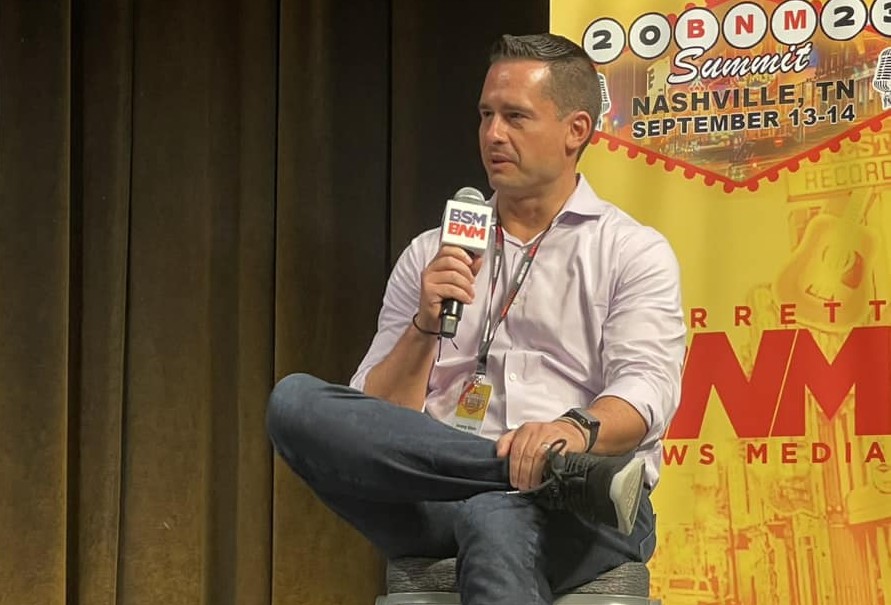
Jeremy Sinon speaking at the 2023 BNM Summit in Nashville
John Mamola: I think it plays to the social space now. So what is something as it relates to podcasting, that creators can learn from that ‘Rube Chat’ model that maybe traditional radio stations, traditional radio talent, have either forgotten or just haven’t grasped yet.
Jeremy Sinon: There’s a lot there. I mean, you’ve got to remember the ‘Rube Chat’ days were before Facebook. That was before social media.
The quick story of what made me create that when I was there was there.
When I came into radio, I didn’t know anything about radio. I would listen to KFAN throughout the day, and I would hear these callers call in and they’d have these weird monikers. They’d have these made up nicknames that they would use on the air. It would remind me of message boards. At the time I was using message boards like Deviant Art, a popular design message board, and I thought, we should have a message board for KFAN.
I went to my boss one day and said, I want to create a message board for KFAN. And she asked, What’s that? Eventually, they were like, if you want to build it, then you’re in charge of it.
That was before social media, and I think that’s when everything changed. You know that it was a magical minute there before Facebook came along, where you could build a direct relationship with the user—literally a direct connection with no middleman.
All that activity was on our website. We had first-party data before we even knew what first-party data was. People were creating accounts and giving us their email addresses, and we didn’t even realize how valuable it was. We were just thrilled with the page views—getting tons of them. Looking back now, all the registered users, all the interaction and all of the first-party data we had—was incredibly valuable.
Then social comes along and it’s the classic tale in the tech world that we live in, where you have big tech companies that create solutions that sit in the middle between us and the consumer. That’s what social turned into. It’s like, ‘Well, everybody’s on Facebook. Let’s just do it on Facebook. Let’s just talk to them there. We’ll talk to them on Twitter or whatever it is’.
The magic of podcasting—and why I’m so drawn to it—is that you have that direct connection. There’s no middleman getting in the way between you and the listener. They just subscribe to an RSS feed. That’s it. They might listen on Apple Podcasts or Spotify, but that direct connection is still there.
And that’s the magic, right? If we sell advertising in our podcast, we keep all the money. There’s no middleman blocking us off, no ad tech getting in the way. No algorithm throttling our reach. That’s the magic.
John Mamola: I was a programmer for 13 years, and one of the difficulties that I always had was getting old dogs to do new tricks. In your estimation, what are some top-of-mind approaches that traditional radio broadcasters should have when it comes to crafting podcasts for a new way that people and consumers are consuming content?
Jeremy Sinon: The simple answer is, just do it. You know, Nike. We just have to be there, right? If you’re not doing the low-hanging fruit—taking content from on-air and putting it online—that’s almost criminal. We create these great moments on the air, and if they are heard once, just disappear, and there’s never another chance for people to consume them on demand. That’s crazy.
Podcasting provides the potential to be more niche—to package conversations into topics, buckets, and themes. That’s the real draw of podcasting. When you go to listen to a podcast, you’re usually looking for a specific topic.
In radio, we have these two-to-three-hour chat shows, where we talk about sports, but it’s all spread across that window. That’s harder for a consumer online. It’s hard to pick up a two- or three-hour podcast and dig around for the content they you care about.
That’s the opportunity. That’s what we’ve done so well with SKOR North—packaging conversations into team-centric content. That opportunity extends beyond sports—literally any topic under the sun has an audience.
John Mamola: It’s an interesting thing that Hubbard has done with SKOR, because as I look at it from afar SKOR is more of a podcast success story as opposed to a traditional radio broadcast story.
But when you’re working with sales people, it’s the education on how to get them to put focus on this area where the dollar is going, right?. How would you say sales teams, at least in your experience, have transitioned from the traditional way to the more digital route with revenue?
Jeremy Sinon: I’d say it’s all over the board. I mean, it’s like any team. You’ve got players that have totally figured it out, and are succeeding and doing really well with it. There are others that are still figuring it out, and there’s everything in between.
Education doesn’t end with just the sales people either. I hear from our sales teams all the time how hard it is to educate the clients. Obviously the agencies have long figured it out, but the local small to medium sized business, there is an education process there. You have to teach them and show them the value of a podcast audience. What a CPM is sometimes.
So I think it’s across the board. Every year that goes by, the closer we get to everybody kind of gets this and it starts to get wind in its sails, and we start to move. It’s a good thing that we’ve been doing it for as long as we have, because you kind of inch along in that education process.
John Mamola: As far as the growth of SKOR North, is it more about doing social right? Is it about doing SEO right? Is it more about how you just market it with the personalities? It’s kind of an all-in equation, but just talk maybe the focus on SEO and search. For podcasts, how does that weigh with everything else, and how you optimize for discoverability?
Jeremy Sinon: It’s all of the above, obviously. Social is very important. Search is very important. Titling and thumbnails and descriptions are very important. Taking advantage of the flamethrower radio stations, we have is very important. That audience that is consuming live, make sure they know that you have podcasts. You can say the reverse for people that are consuming podcasts. Make sure that they know they can listen to you live.
You need to be really good at taking advantage of all the tools that are out there and marketing when you can, when you have a budget. Social media can be incredibly powerful if you get it right, though it’s not always easy.
SKOR has done a great job in that arena. Honestly, the biggest thing that propelled them was their focus on YouTube. Purple Daily was a podcast before there was SKOR North. Back in the old 1500 ESPN days, Phil Mackey and team were doing the same daily Vikings podcast. It was doing well and it was growing. But it was not growing astronomically, it was just it was doing well.
Shortly after we rebranded as SKOR, the pandemic hit, and we suffered some setbacks. Trying to figure out how keep this thing going that we believed in, Phil and the team kind of looked at each other and said “if we had to go all in on something, what would it be?” And they picked YouTube.
They decided that instead of just putting some stuff on YouTube like we had been doing, to instead go all in. They started creating the content for YouTube first, and then using the audio for the pure podcast, and then started going live to YouTube. People that consume on YouTube really appreciate content that is created for YouTube.
You ask about all these tools. You kind of have to play the game everywhere. But these discovery engines like YouTube and now TikTok, are really important if you can do it right.
John Mamola: YouTube put out that they had one billion monthly podcast users a couple of weeks ago. All these broadcast companies, they got their own apps. They’re pushing their apps because they want to get people to listen there. Do you see a day where maybe video consumption, as far as podcast, just completely outweighs the demand for maybe an audio product?
Jeremy Sinon: I don’t know if I do see that day. I think audio is always going to have its place, and I think video is always going to have its place. Think of your own consumption habits – there are times when I just want to put my earbuds in and go for a walk, or listen to audio in my car. But there are times you want to sit down on your computer or curl up on the couch and watch a screen.
So I think video is always going to have its place, and audio is always going to have its place. So I think the best approach, if you can, when you create content is to create it for both.
It’s not up to us to choose how the consumer consumes us. We just need to create the content and make it available in all of the places and forms that it can be consumed.
The trick is trying to figure out how to monetize it. Like I said, part of the magic of podcasting is there’s no middleman in the monetization efforts. You can do direct sales, place the ads on your product and keep the revenue. You don’t have to share revenue with Google or whoever.
But when you’re doing video on YouTube, you’re putting a middleman between you and the consumer. YouTube dictates how ads get served, and you are just beholden to their monetization.
To me, YouTube is a double-edged sword. It’s a blessing and a curse. The blessing is that pretty much the entire world is there. For that reason, you should probably be there. It’s maybe the best discovery tool in the world. But, it’s also a curse because the danger is if you actually get consumed there, you’re giving up a lot of that control for how you monetize your product.
John Mamola: You’re standing next to somebody in the subway and they’re asking you what is podcasting? How would you define it today to somebody that’s never tried it? And secondly as a person in your position, what’s the one thing that concerns you about podcast growth today?
Jeremy Sinon: If I’m standing next to a person they asked me what a podcast is. Simple answer is it’s a radio show on the internet, but I guess it doesn’t necessarily have to be a radio show.
It’s just a show on the internet, because it’s either audio or video, right?
I think the funny thing about those YouTube numbers that you shared is that there’s a lot of smoke and mirrors there. And I think a lot of it comes from people not knowing how to define a podcast. A lot of people call a YouTube show a podcast. There’s a lot of creators that we talk to that create YouTube content, and they don’t create audio content. But they call their show a podcast. And I’m always like ‘where’s the actual podcast’?
So, the lines are blurring completely and there’s a lot opportunity for people that produce audio to start producing video, and people that produce video to produce audio.
I think my biggest worry in this space is that there’s just so much content. There’s only so much time in the day that everybody has to consume audio or video, and so the numbers get smaller as consumption is spread thin across all of this content. I think eventually that’ll bounce back, because then people will jump out if it’s doesn’t work for them.
That’s my biggest concern, there’s so much competition. That kind of brings us back to the ‘Rube Chat’ conversation.
I think it’s so important to create community around this content. It’s not enough to just produce a show and release it and that’s it. I think you’ve got to connect with your consumers and have a relationship with them. Provide listener interaction, chat boards, events, social groups, etc. Have some sort of way to create community around your content. I think if you can do that, I don’t know how you lose.
As long as we have super fans, we’ll always be successful. We’ve used these techniques in radio for ages and frankly we should be better at it than content creators that are just starting to figure it out. If we lean on our strengths and continue to do those community building tactics in the podcast space, I think we’ll be just fine.
John Mamola: Last question for you. Tell me about Hubbard’s newest addition John Goforth, new VP/GM of Podcasts. What has his addition meant for you guys in this space? Can you share anything about what you’re building there?
Jeremy Sinon: John has been such a fantastic addition for us. He’s somebody who’s been in the industry a long time, has built podcast networks, and has been there, and done that in terms of everything that goes into monetizing them.
John and I became friends through different industry events like Podcast Movement. When the opportunity to bring him in became available I’m just so thankful for Ginny and Dave for seeing the same potential that I did and for embracing the opportunity.
Working alongside him has been a treat as we both share a strong vision of where we can go and what’s possible. It’s been 6 months and we’ve already got some really interesting things cooking behind the scenes. I’m excited to be able to show the world what we’ve been working on soon.
To learn more about Point-To-Point Marketing’s Podcast and Broadcast Audience Development Marketing strategies, contact Tim Bronsil at tim@ptpmarketing.com or 513-702-5072.
Lisa Worden is the Program Director of Alt 98.7 Los Angeles and the SVP Alternative and Rock for iHeartMedia. Programming and industry executives recently voted her second in Barrett Media’s Top 20 Alternative Program Directors of 2024 list.
Something that Worden said was a nice start to her day. “I was honored to even be in the top 10. Anytime something like that happens, I’m always very grateful. It was a nice start to my day that morning.”
I wanted to jump in and pick Worden’s brain about Alternative music and how things have changed with the distribution of new artists and the shrinking profile of record label promo staff. How does an Alternative PD go about finding new music?
“I find myself discovering new music on Spotify. I find myself discovering new music on social media. And then honestly, word of mouth. A lot of my friends circle, and even my family, they’re all big music fans. And we talk about music all the time.”
“When somebody turns me on to something I wasn’t aware of, usually they’re spot on because they know me and we know each other. I’m on Instagram, and I do find things that way. I also host a show on Alt 98.7 on Friday nights, called ‘She is the Voice.’ It’s where I play an hour of female artists and Alternative music.
“I’ve been doing this now for four years, and artists send me their music all the time. So that’s been really cool. The show has developed a nice following and a lot of young female artists listen. They send me their music. It’s great. There are a lot of ways to find new music.”
In a format predominantly composed of male artists and groups, Worden is known as an advocate for female artists.
“I have always loved female musicians, artists, and singers my whole life. And going back to my earlier days, Deborah Harry and Blondie is one of my favorite artists.
“But then you get into artists like the Yeah Yeah Yeahs and Florence and the Machine. St. Vincent, I could go on and on about all the female artists I love. And you are not wrong in that a lot of male bands or singers make up a lot of our playlists.
“And by the way, I want to go on record. That is fine, because many of my favorite bands either have male singers or are all dudes. And that’s totally cool. The Cure is my favorite band of all time. But I think there’s a lot of great music by women, and I want an avenue to expose it.”
So once you discover something that you like, is there a vetting process before it gets on the air in a major market like Los Angeles?
“There are ways to expose it. We do a new music discovery feature every week where we highlight a song. Then, I have a music meeting with my staff every week. We listen to probably 30 songs every week, grade them, and rate them. That’s another way where we kind of narrow it down. So, even though it’s Los Angeles, I do find ways to expose new music. Music Discovery is a big initiative for Alt 98.7.”
Alt 98.7 is the flagship station for “The Woody Show,” which is heard nationally across Alternative and Rock formats. So, what’s it like managing them?
“Woody is one of the most talented, smart and driven personalities I have ever had the pleasure of working with. No one works harder than him. And then his cast, Menace, Gina Grad and Greg Gory, all of them are so passionate about that show.”
“I actually had to tell them, please quit coming in at two in the morning. So, they now come in, I think, at four. Because all of us were so concerned about their health and the hours that we were like, guys, please we know how committed you are.”
This and more makes Worden proud to have them in Los Angeles.
“I honestly feel so lucky to have that show as my morning show in L.A. I take tremendous pride in the fact that Alt 98.7 is the home station for the Woody show. And I love them. They’re amazing.”
I asked about a video they posted where they read and responded on air to listener complaints.
“I actually find it one of the funniest features that they do. That was hilarious. And then Greg Gory does his immature replies to text messages. And again, it’s hilarious. I like the edge unless they’re going to get us in trouble legally. I’m OK with them pushing the boundaries and the listeners are too. That’s the thing. It’s like all of this is done in jest and the listeners are along for the ride. They love it.”
Has there been a time where she had to tell them they crossed the line?
“When they, quote unquote, deported people to Mexico a few weeks ago. I kind of looked at them and said are we doing this? But again, this is where the intelligence of the show really shines through.”
“If you read past the headline and look at the fine print, they’re sending people to an all-inclusive resort in Cabo, a five-star resort. If you can get past them saying we’re deporting you to Mexico, what you’re getting is being sent on a trip or two. That’s probably a five thousand dollar trip to this amazing resort in Mexico. So, yeah, that was one where he’s like, we’re doing it. I’m like, all right.”
As an SVP in Rock and Alternative, I asked if Worden had any early thoughts on the Nielsen 3-minute qualifier.
“I think it’s too soon for L.A. I’m seeing it in some of my other markets with our stations. But for L.A., we all met, and the cluster in general said this isn’t what we thought. I think in three months we’re going to see what we see. But in January, we didn’t see a lot of movement.”
So what is unique about programming Alternative?
“I think that it’s on us to be unique because we’re supposed to be an alternative to a pop station. It’s something you’re not going to get elsewhere. For iHeart, we’ve got a diverse portfolio of Alternative stations. The Buzz in Houston is nothing like Alt 98.7 in L.A. And then you have a station like KTCL in Denver. It does incredibly well. They are truly their own unique brand.”
“I love that about Alternative because I do weekly calls with all my PDs. And it’s so fun to be able to bounce station to station and adjust your mindset accordingly to whatever station I’m talking to. So, programming Alternative, it’s your job to be unique and be an alternative and then play the hits.”
Anything to add in closing?
“Just shout out to my team locally here and nationally. I love my Alternative programmers and this format. It feels really good to me.”
“I think that sometimes people have the tendency of like, oh, music’s not what it was or whatever. And I look at it and there’s so much music I love right now. So, yeah, I think it’s in a good place.”
Barrett Media produces daily content on the music, news, and sports media industries. To stay updated, sign up for our newsletters and get the latest information delivered straight to your inbox.
Does your station have a tchotchke budget? Typically, I have seen it budgeted for, and then it is the first thing cut each year when sales get tight.
I worked for a company that routinely allowed me to budget for t-shirts, staff clothing, etc. Then in March they would delete the line and take it back.
Of course, the outcome was that I had to plan the entire year and buy everything in January. Why that was better I’m still not sure.
What is the most asked question at a remote or an appearance? Most of the time it is, “Do you have any t-shirts?” Listeners have been conditioned to ask for them and expect you to have them.
Most of the time I hear talent say something to the effect, “All they do with them is sleep or mow the lawn in them.” That’s where it’s up to you to add some value. Instead of just blindly handing things out, what if you create a value proposition for wearing them.
WQMX in Akron, OH has the Blossom Music Center, a fantastic outdoor venue carved into the middle of the Cuyahoga Valley National Forest. Each summer, they present several Country concerts.
WQMX uses a different color of WQMX Take Me Backstage T-shirt each season. Sales sells remotes to distribute the shirts, which are a must-have for Country fans. Then, they wear them to the shows at Blossom for a chance to be seen and taken backstage.
It creates a value proposition for the shirt and eliminates the problem of people wanting them but never wearing them. The other good thing is that the shirts can most likely be traded or liquidated through the cost of the remotes.
One of the best tchotchkes I ever had was when I was the promotion director for Rocker KGGO, Des Moines. Rocker is the key word to this one. It’s not for an AC station, and given the changing climate since I did it, it comes with a word of caution.
We purchased condom keychains similar to the ones pictured, with the message “If You’re Gonna Rock, Roll This On” and the station logo. Not surprisingly, we had to order a second run, and they were very popular.
Fifteen Seconds of Fame
Here’s an idea to tap into the popularity of TikTok, Instagram, and local influencers: Offer listeners their “Fifteen Seconds of Fame.” Encourage listeners to send or upload videos of themselves, something from their life, their pets, or anything PG-rated.
It will drive web and social media traffic and likely raise awareness to people beyond your cume.
Cinco De Mayo
Fill a big tub with mayonnaise and put plastic eggs in it, with slips of paper inside designating a prize. Contestants have to dig around in the gooey mess to retrieve the plastic eggs. It’s messy and fun. It makes a good Cinco De Mayo bar promotion. It’s best executed when every contestant has to go at the same time. Be sure to put down plastic.
Pay Your Bills
There is nothing ground-breaking here, but with concerns over inflation, egg prices, and groceries in general, it may be time to bring this back. There are many ways to execute this. The only caution is to not make listeners jump through hoops.
This really goes for any promotion. Make it easy and, when possible, on demand so that people can enter and win while navigating their busy lives. Please don’t make this or any other contest caller number nine.
Gone are the days when you could force listeners to do anything. You are far better off dragging them along than pushing them where you want them.
If you are doing a Pay Your Bills type promotion, I would love to hear how you execute it and highlight your station. Email me jeff@barrettmedia.com.
Use that same email to send me any of your station promotions, and you might get them featured in an upcoming Promo Meeting column.
Barrett Media produces daily content on the music, news, and sports media industries. To stay updated, sign up for our newsletters and get the latest information delivered straight to your inbox.
He’s a master in the art of “peopling,” helped develop thousands into successful “suits,” and has one goal for you: “Get better. Move up. Lead well.” Ken Coleman has a new podcast with Ramsey Solutions, Front Row Seat, which pulls back the curtain, letting listeners ask some of your most pressing questions to top leaders.
“I want to remove that velvet rope and let people behind the scene and hang out with me,” Coleman said. “Because I’m blessed to sit and talk with some crazy talented and successful people.”
Working in media wasn’t always on the radar for Ken Coleman. But the idea of caring for people certainly was. He worked in politics and then in corporate leadership before taking the plunge with Dave Ramsey as co-host of The Ramsey Show at Ramsey Solutions.
“This idea of caring for people, and ‘what should you do with your life?’ There was just always a strong emphasis on that,” he said. “I always saw work through the lens of creation, not provision or contribution, not provision.”
The son of a pastor is a big believer in “connecting your heart to your work.” Inspired by his father’s hard work and dedication to their small parish, Coleman took the idea of caring for people, developed it outside of religious beliefs, and turned it into helping people “show [their] uniqueness and touch people in a unique way,” Coleman said. “That shaped my love of leaders becauseleaders have such a pivotal role in the workplace. And just this being in the workspace doing work for good.”
The Front Row Seat podcast from Ramsey Solutions is for emerging leaders in any field, looking to become better at taking charge and guiding their team. “This show is not a show for people who are just meandering through life. If you just are okay with average and just kind of you’re okay with life happening to you, you’re not going to enjoy this show,” Coleman quipped.
“If you’re a person who wants to happen to life, and you got some hunger and you want to make your unique contribution. This is for people who want to live a life they can reminisce on, not live a life that they regret.”
The podcast focuses on three specific areas — getting better as a person, moving up in the office, and leading. “We do it in those three specific areas. All of the guests and the conversations that I create with the guest are designed to help you get better as a person. Because when I get better personally, I bring a better version of me to the office. The better version of me in the office sets me up to actually advance [and one day be a leader].”
Ken Coleman noted if your home life is a “dumpster fire,” that’s coming to work with you, too. You can’t lead when your home is in shambles.
The three-time best-selling author claims his show style for Ramsey Solutions isn’t unique, but it is a format most haven’t seen in a while. “The show math is, Inside the Actors Studio, meets Masters Class, meets MTV Unplugged. From live audiences to Zoom interviews, Ken Coleman believes the show is about the consumer.
“I’m doing [this] not to use the audience as props, [but] because they actually are getting to learn alongside me and ask questions. They also represent a much larger audience, and I want to really promote the power of a question. Not just me asking it.”
While it’s important to always be improving yourself, Coleman made clear that not everyone can be a leader. Your ability to work hard and listen to every one of his podcasts does not mean you will be a great leader. You need to have talent. He gave two examples.
“My favorite sport growing up was basketball. I loved the game of basketball. I was decent, I could work harder than any other high schooler in America. And I could have logged more hours in the gym and I would have gotten better,” Coleman said. “The hard work would have made me better. But no amount of hard work would have made me a Division I basketball player for the simple reason: I didn’t have the talent.”
His second example, “I cannot become a Grammy, award-winning songwriter. No matter how hard I try to write songs. Why? Because I don’t have the tools. You cannot build a house without tools, right? Leadership is the same way. Leadership is a skill, just like singing is a skill, and playing a sport is a skill.”
Before the start of this podcast, Ken Coleman spoke with two of our country’s former leaders, Presidents Jimmy Carter and George W. Bush. Regardless of how you think of them politically, the ability to lead the American public, even for just one term, is an accomplishment. “I don’t care what somebody’s political status is, if you’re a former President of the United States you’re going to get respect from me. I was in a sense of awe in this way.”
“I’d done research, and found that (George W. Bush) had started becoming known for giving people nicknames as early as his college days at Yale,” Coleman continued. “I thought it was a fun question, so I teed him up on it, and I said, ‘Was that something that just came to you naturally, or was it intentional as a way of kind of connecting with people?’”
Without missing a beat President Bush said, ‘Well slick,’ “And the crowd just started laughing, and he did his little George W. shoulder shake. But really, really such a gentleman and so was President Carter.”
Three of the most important attributes Ken Coleman sees in leaders are self-awareness, desire to lead, and someone who is always learning and growing. “We all have blind spots, but the leadership blind spots create so much tension and dysfunction in the office,” he said. “So I want to see a leader who’s self-aware.”
The second is the desire to lead. “A lot of people want the position for the esteem, and they want the paycheck, but they don’t actually want to lead people. In other words, you have to serve people. Your number one job as a leader is to help everybody else on your team win at their job. If you don’t have that mindset, you’re not gonna be a good leader.”
Lastly? “A good leader is someone who’s always learning and growing. They want to continue to set the pace, as it relates to getting better personally and professionally.”
For those looking to follow in the footsteps of the Ramsey Solutions host in leadership, media, or even politics, he suggests, “Make sure you have the talent. You’ve got to have that core skill set. Do you have the talent of discernment — the ability to read people? Do you love people? In this business, in my opinion, to be successful and not just successful, but to sustain it [you need to love people].”
This even means putting people before yourself. Showing up when you don’t feel good and no one else being the wise. Ken Coleman also wants you to ask a question to attain your own personal goals.
“What’s the desired result? If I use what I do best, that’s the talent piece to do work I love,” said Coleman. “That’s the passion I’ve just been talking about to create a result that matters deeply to me. That’s the key, the last piece of advice. What is the result that you want?”
Barrett Media produces daily content on the music, news, and sports media industries. To stay updated, sign up for our newsletters and get the latest information delivered straight to your inbox.