Three of San Francisco sports radio’s most popular voices are reuniting. Former KNBR colleagues, Tom Tolbert, Paul McCaffrey, and John Lund, are partnering on the launch of a new podcast network, Bay Area Sports Collective. The network debuts today with The Tom Tolbert Show, Paulie Mac’s Particles and John Lund Unleashed as the first three podcasts to be broadcast live on YouTube and across all major audio podcasting platforms. Additional information about the company can be found on its website.
The new venture is co-founded and co-owned by former Bay Area sports radio programmer Jeremiah Crowe. Crowe previously programmed KNBR and served as Assistant PD at 95.7 The Game following a stint at ESPN Radio. He’ll direct business operations, marketing, and sales for the Bay Area sports podcast network.
In addition, former KNBR teammates Tony Rhein and Daniel Ogden will be involved both on and off the air. Rhein and Ogden were integral parts of Bay Area Sports radio programming for decades. They’ll help assure the content is well produced, and promoted.
Tom Tolbert said: “I am thrilled to join my partners Paul McCaffrey, John Lund, and Jeremiah Crowe to launch this exciting sports podcast network. I’ve wanted to do this for a long time, and I have a great deal of respect for everyone involved. Together, we will leverage our combined relationships, knowledge, and experience to offer sports fans the most entertaining and informative content, insights, and access to the biggest stories and people in sports today. I’m looking forward to sharing some good laughs again with my loyal audience, friends, and guests across the Bay Area Sports spectrum.”
Paul McCaffrey added: “You know that feeling of anticipation when Steph Curry launches a 3-point shot from downtown? Just waiting for the ‘nothing but net’ payoff? That’s how I’m feeling bringing Paulie Mac’s Particles to the Bay Area Sports Collective. The right people are in place and the timing is right. The best part is you’re all coming with me! The good times are just beginning.”
John Lund said: “Looking to the future after many successful years in sports radio working with some of the best talent out there to now teaming up with iconic guys like Tom and Paulie, plus the all-star team we’ve put in place at the Bay Area Sports Collective, it’s going to be special for me personally, our fans and our audience.”
Jeremiah Crowe noted: “This announcement marks the dawn of a new day for the underserved Bay Area Sports fan. They deserve better. We are thrilled to launch The Bay Area Sports Collective with three very influential, entertaining, and experienced hosts who all remain dedicated to their craft. We are open to additional shows and talent joining our network in the future and look forward to scaling our unique talent-friendly business model into additional markets.”
Crowe added: “Multiple professional sports franchises have already expressed strong interest in migrating programming to our network, and local blue-chip advertisers have also contacted our team. We are excited to open the floodgates and provide Bay Area Sports fans with a more convenient way of finding their favorite shows, whether live or on-demand. This is the future of sports entertainment.”
The network will feature The Tom Tolbert Show, three times per week. John Lund Unleashed and Paulie Mac’s Particles will broadcast each weekday. For more information, reach out to Jeremiah Crowe by email at jeremiah@bayareasc.com.
Dan Bongino is gone. You might be asking yourself: what’s next? My friends who work for Cumulus had to wait for what was next. The rest of us need to protect our brands.
There was no question that once President Trump was elected this past November Dan Bongino was on the shortlist. This should serve as a lesson. If you have hired hosts who have been politicians or political insiders, be prepared for them to leave.
I know a lot of people who are impacted by Bongino’s exit. These are wonderful people who have carried and supported Dan’s show. Some of those people are in the Westwood One sales department, Affiliate Relations, or on the Cumulus station side.
When a host is added to a station, radio station managers want someone who is committed for the long haul. I often recite this truth. It takes 18-24 months for a News Talk Host to be successful in ratings and revenue. I wish that it was quicker, but it is not.
Bongino built a successful formula for many stations. I remember after Rush Limbaugh passed away; it was an uphill battle to grow that audience. Some stations are still rebuilding those ratings. Bongino’s exit will create ratings and revenue headwinds for many in our industry. If you are hiring a new host, are they there for themselves or for the station? Are you prepared to lose an important team member to the political class?
News Talk stations have often based content and entertainment on politics alone. There are many reasons why this is a terrible idea. Take your local city council meeting for instance. Have you ever been to one? Is this a subject on your local shows? Attend one, you will find that very few people attend.
I have heard talk show hosts keeping it local focusing on events that no one in their community cares about. If your city is talking about tax increases and less than 30 people show up to complain, that should serve as an indication of community interest. Should people be mad as hell that their property taxes are going up? Absolutely. But do they care?
If you judge it by the 30 people who are complaining, the answer is no. I once lived in a community where one woman spoke to every meeting of the city council on the philosophies of Ayn Rand. The people who attend or show interest in city council meetings are outliers. If that is your station’s audience, you are in huge trouble.
Ok, let me get back to the subject of Dan Bongino. I don’t know him and have never met him. Bongino though has shown a lack of patience or focus on any of his careers. He was an FBI Agent. The vast majority of FBI agents work until retirement and start security companies after their career. Some agents join major corporations to serve in their personal expertise from the FBI.
Then Bongino was a Secret Service Agent. This is another career with great post career opportunities. Retired Secret Service Agents protect high value targets. Whether in business or celebrity, a former Secret Service Agent can make 7 figures following their government career. Bongino was not satisfied with that.
So, my concern and the concern of other programmers was about Bongino’s longevity. Not by his employers, but by Dan Bongino himself. I think that we all know of people who are focused on their next thing.
I have a friend who jumps from hobby to hobby. This is a terrific individual, but I can guarantee that his current interest will be discarded in a couple of years. This guy and I had a similar hobby. That is how I got to know him. He was all in and very enthusiastic about our mutual interest. As soon as he got bored, it was onto the next thing.
Bongino certainly has shown this. A friend of mine hired a host who had once been a city council member. This guy was all gung-ho on a media career. My friend didn’t know that this host was using his station to set the groundwork for his next political run. The host quit and ran for Congress and promptly lost. The host and failed political candidate came crawling back looking for a job. My buddy told him that the station had moved on.
Here is the lesson from Dan Bongino – I am sure that Dan’s employers were convinced that he was committed to the show for the next decade. Remember, I don’t know Bongino. I have a buddy who knows Dan well and says that Bongino is good people. But Bongino has also never had long term commitment in his professional life.
There are stations across the USA who are picking up the pieces. The Spring ratings period is essentially lost. There will be a new show in Bongino’s place hosted by Vince Coglianese. Bongino’s departure will be negative for many people across our industry. We certainly don’t need this as an industry.
As we look for what is next, will the new host on your station filling Bongino’s void be there in 5 or 10 years? This is an important consideration. Don’t add a show that will be gone in 2 years. With spoken word formats, consistency is essential.
Barrett Media produces daily content on the music, news, and sports media industries. To stay updated, sign up for our newsletters and get the latest information delivered straight to your inbox.
We talk a lot about change within our industry and how some just seem to adapt better than others. We’ve even seen friendly fire between the groups and how differently the generations respond to this change.
These days, it’s quite popular for Gen Xers to poke fun at Gen Z and vice versa. But without a doubt, baby boomers are the target of more ridicule and satirical humor than any others. Perhaps the most common expression used to playfully mock boomers is, “Ok Boomer,” which is a blatantly dismissive response to one’s opinions or comments that younger people perceive as out-of-touch.
The implication is that baby boomers are overly traditional or resistant to change. Ironically, that couldn’t be further from the truth, as the generation between 1946 and 1964 has experienced more significant societal, technological, political, and cultural shifts than any other at any time.
When it comes to the media and beyond, we “seasoned pro” boomers have experienced more change than a caterpillar in springtime.
From post-World War II optimism to the current digital age, baby boomers have witnessed and contributed to changes in politics, the economy, technology, family dynamics, and social values, which have shaped their personal and collective identity.
The technology we all use every day was, in truth, imagined, created, developed, and expanded upon by baby boomers. Need I even mention Steve Jobs and Bill Gates, both born in 1955, smack in the middle of the baby boomer era? These two giants literally changed the world.
Without sounding like my own parents, who “Walked to school every day, without shoes, in the snow, uphill—both ways,” I never once tracked a radio show. We were live every day—six days a week!
I didn’t grow up on automation, and “Wide Orbit” was a path the planets may take around the sun. As a boomer, though, I did participate and watch a total global transformation over my lifetime—we adapted!
Obviously, one of the most profound changes has been the amazingly rapid advancement of technology. In my early years, television and radio were the primary forms of mass communication, with only limited access to any global information.
In fact, TVs were all black & white when I was born, and AM radio dominated listenership. FM radio began to overtake AM in the late 70s and through the 80s when FM became standard in all vehicles, eventually adding SiriusXM to the dashboard decades later. Let us not forget the addition of CDs in cars after they replaced vinyl records. All this change was experienced and developed by Boomers.
As we reached adulthood, we saw the influx of personal computers and video games like Atari and Sega that advanced with lightning speed into Xbox and Play Stations. Color TV was perfected in the late 70s and 80s, and cable companies began to replace the 13 local and network OTA channels with scores of channels and premium choices like HBO.
Enter the VHS and Beta recorders that we all used to tape our favorite shows… until along came TiVo and DVRs that allowed us to pause and record live TV. Of course, now, “We don’t need no stinkin’ recorders!” It’s all recorded in the cloud.
In the late 1990s, DVDs and DVD players entered the marketplace. TVs shifted from large, heavy, and thick projection boxes into flatter plasma screens that cost thousands of dollars, giving way to today’s 80” flat LCD screens that cost as little as a few hundred dollars. Again, all this change was developed and adopted by Baby Boomers!
Lest we forget the internet and mobile phones, revolutionizing the way we interacted with the world. Enter the world of dial-up modems, AOL, and MySpace – our first entry into social media. Skype exploded on the scene, allowing us to enjoy video calls around the planet for free!
The internet soon became ubiquitous, giving rise to even faster online communication, e-commerce, and digital entertainment. Today, baby boomers are navigating the complexities of smartphones, social media, and artificial intelligence, all of which were inconceivable when they were growing up, yet many of whom not only adapted, adopted, and thrived but helped develop even more emerging technologies.
Politically, we baby boomers have lived through a number of key historical events that altered the course of history. From the civil rights movement in the 1960s to the end of the Cold War in the 1990s, boomers were at the heart of movements for social justice and reform. We were here to witness and participate from all sides of The Vietnam War, marking a time of great unrest and upheaval.
Economically, baby boomers have seen the transition from post-war prosperity to the challenges of a global economy. We experienced an economic boom, with strong growth, industrial expansion, and a burgeoning middle class. As we aged, we also saw the effects of economic recessions and a decline in manufacturing jobs. We witnessed the 2008 financial crisis, which reshaped retirement savings and pensions for many.
So, next time you talk to a boomer and feel the need to poke fun with the casual, “Ok Boomer,” – think about the only generation to witness an extraordinary range of changes, from the rise of digital technology to evolving social norms and economic conditions. Boomers have truly been at the forefront of major cultural, political, and technological revolutions.
We Boomers have experienced and influenced an unparalleled transformation in the world around us from Radio to TV and every other technology you have likely touched today. Instead of the typical jab to a boomer, how about next time trying… “Thank you Boomer!”
Barrett Media produces daily content on the music, news, and sports media industries. To stay updated, sign up for our newsletters and get the latest information delivered straight to your inbox.
I’ve always been a big believer in my time in radio and business in the power of positivity. Where a positive attitude gives you power over your circumstances instead of your circumstances having power over you. It goes without saying that the world needs more positivity—just a little more each and every day.
This week, while scrolling through my social media feeds, I found myself awestruck by the amount of positivity that flooded my timelines. It wasn’t birthday wishes or newfound career opportunities. Instead, it was a number of media brands celebrating great months, outstanding statistics, and sharing record metrics to showcase the hard work and results of their people.
The only negative about all the positivity? None of these brands were radio companies.
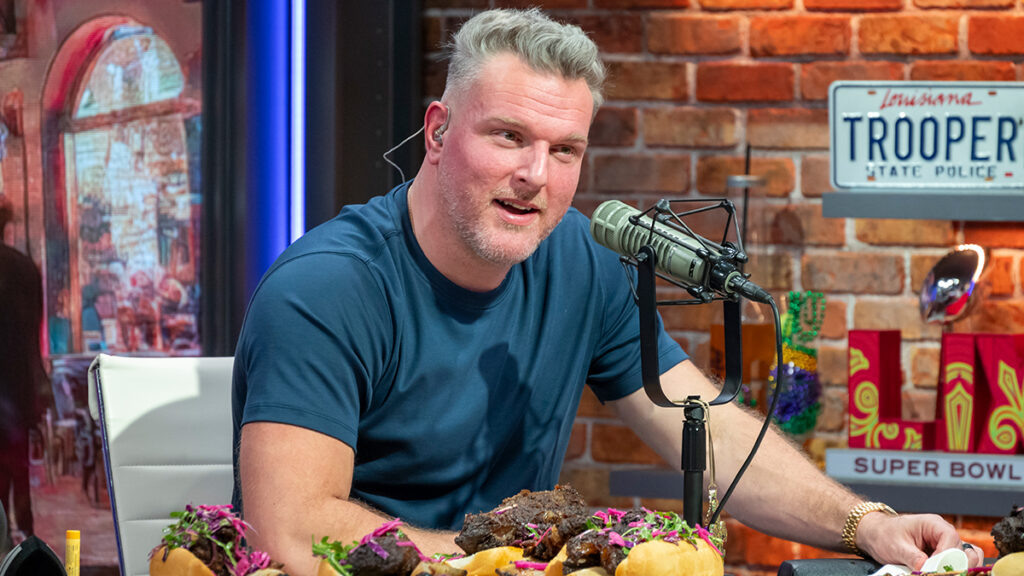
The Pat McAfee Show is one of the most celebrated sports programs in recent memory as it continues to set trends in sports media. It looks, feels, and sounds different than anything else you see, connect with, or hear on traditional sports radio. It’s a show that runs a disclaimer before every program to explain how the talent are a “bunch of stooges talking about the happenings in the sports world.”
It’s not the sports radio programming you grew up with, and they like it that way.
The show closes every day with Pat McAfee saying the following:
“Be a friend, tell a friend something nice. It might change their life. We’re in this thing together.”
Courtesy: Derek Futterman, Barrett Sports Media
Every show, every weekday ends with the power of positivity.
The Power Of Positivity: Social Media
Scouring my LinkedIn feed this weekend, I came across an infographic from the Locked On Podcast Network from a couple of weeks ago. A brand-styled infographic celebrated the network’s “biggest week ever”—over 9.9 million listens and views during the week of the Super Bowl, leading the brand to proclaim, “Locked On is the daily go-to source for passionate local sports fans to get the story behind the biggest moments in sports.”
Screengrab: Locked On Podcast Network LinkedIn
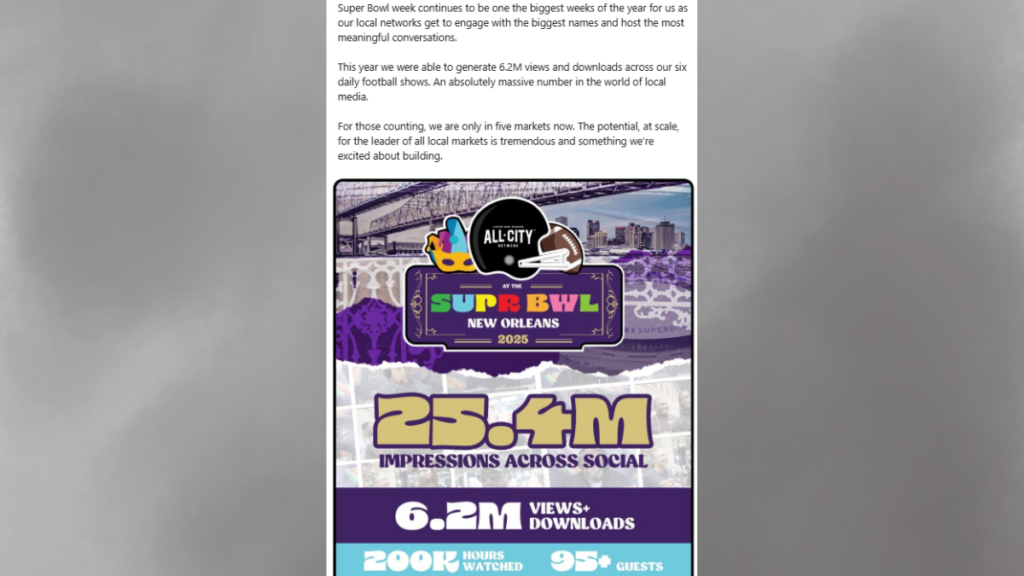
Scrolling down my feed, I came across another infographic. The CEO of ALLCITY Network, Brandon Spano, shared news that Super Bowl week was a massive win for the five markets where ALLCITY calls home—25.4 million impressions, 6.2 million views and downloads, and more than 200,000 hours of content watched for the ALLCITY brands during Super Bowl week.
Screengrab: Brandon Spano LinkedIn
“An absolutely massive number in the world of local media,” posted Spano. “For those counting, we are only in five markets now. The potential, at scale, for the leader of all local markets is tremendous and something we’re excited about building.”
There were over 150 media outlets in New Orleans for Super Bowl LIX, including ALLCITY, Locked On, and a number of traditional sports radio outlets.
Was there any positivity for sports radio to share?
Capitalizing On The Moment
The Super Bowl is the single biggest stage for professional sports in the United States. It draws the attention of every single type of fan, from passionate to casual, providing entertainment on the field, at halftime, and in the commercial breaks. It’s the pinnacle opportunity for sports brands to attach celebrity and build FOMO moments because of the access that the NFL has provided over many years.
FOX Sports celebrated their massive viewership numbers days after the Philadelphia Eagles won their second Super Bowl championship in franchise history. Apple Music celebrated record-setting viewership of the halftime show performance by Kendrick Lamar. Was there anything for sports radio to celebrate?
FOX Sports Radio can build a nice set on Media Row, but where’s the celebration of the wins for the week?
iHeartRadio has an exclusive partnership with the NFL Podcast Network. Were there any wins to share from the week that was in the Big Easy?
Courtesy: Derek Futterman, Barrett Sports Media
Controlling The Narrative In Radio
For as long as I’ve been involved with the radio business, I’ve always had to battle the narrative that the medium is “dying.” It’s not hard to see why that’s the narrative those outside of radio believe. Automakers are aiming to get rid of AM radio in electric vehicles, leading to Congress crafting legislation to save it. The continued success of podcasting has led many clients to think differently about their advertising dollars. Last week, YouTube announced one billion active monthly viewers of podcast content on the platform.
Where’s the positivity from radio? Where is radio celebrating the wins?
Are there wins for radio? I’m finding it harder to find them now more than ever.
This past Monday, I spent the evening watching my favorite television show, WWE Monday Night Raw. It’s no secret that WWE is a money-making juggernaut in the sports entertainment world. After every PLE (premium live event), WWE Chief Content Officer Paul Levesque holds a press conference streamed on YouTube to a watching cume that rivals some sports radio stations. The press conference always begins with the wins—the business figures.
Highest-grossing gate. Sponsorship records. Viewership figures. Attendance and merchandise sales.
Monday Night Raw on Netflix was no different. The brand celebrated their massive social media engagement from Saturday night’s Elimination Chamber event—record views on several social platforms, sharing headlines from online and print publications, and clipping creators in the internet wrestling community showing their emotional excitement to the happenings of John Cena turning heel for the first time in his career.
There isn’t a metric that WWE missed promoting in some way between the conclusion of Elimination Chamber on Saturday night to the conclusion of Raw on Monday night.
By telling the story, you control the narrative of how people view and are attracted to your product.
Radio Can Be Better | Radio MUST Be Better
Every radio programmer pulls data from ratings to digital engagement to tell a story to a sales staff, a management team, or the talent themselves. The job of the programmer is to always point out the positives for sales teams to equip sellers going into battle to earn more dollars for the brand. Constantly educating your sales staff is key to not being lost in the shuffle when dollars are on the line, and there’s no better data than celebrating a win.
Where radio programmers continue to miss the point is—why not share the wins with your consumers? The same people who, every day, give you and your advertisers the most valuable thing they own—their time. A radio station is only as successful as the story it tells to the people emotionally connected to it. Brand loyalty is the most valuable real estate any radio brand can own, and that loyalty should be celebrated when there’s a reason to celebrate.
Is there any downside to sharing a ratings win with a cool, station-themed static image that your staff can promote through a share on social media?
Is there any downside to sharing on social media that a brand’s digital metrics on YouTube continue to grow over time?
Is there any downside to sharing download data of an on-demand podcast channel that, since last year, has eclipsed a specific number of downloads?
Sounds all positive to me!
In a time when radio talent are constantly looking over their shoulder for the next round of layoffs and pressured to do more work for no additional pay, wouldn’t it make sense to take time to celebrate the positives more today than ever before and showcase the hard work of the people who make brands what they are?
If the power of positivity is good enough for everyone else, why not radio?
It just might change someone’s life.
Barrett Media produces daily content on the music, news, and sports media industries. To stay updated, sign up for our newsletters and get the latest information delivered straight to your inbox.
Welcome into the sales meeting this week where we are going to talk about how you have to start looking at this job, if you are not already doing so. We all know, a career in media sales is unlike a typical nine-to-five job. It doesn’t come with a guaranteed paycheck, a rigid career path, or even a safety net. Instead, it operates more like a business—a business where you are the CEO. Ultimately, if you want to thrive in media sales, you need to think of yourself as an entrepreneur, taking full ownership of your time, strategy, and success.
Just like we would recommend to any other business, you need a brand. In media sales, it just so happens that you are the brand. Your reputation, your relationships, and your expertise define your market value. Clients aren’t just buying ad space; they’re investing in your knowledge, credibility, problem-solving skills, and in the end – your ability to deliver results. As I often like to say, when the client asks for added value, remind them that you are part of that equation and possibly the biggest and best added value they can ever receive.
To build that brand, you must be intentional about how you present yourself. That means maintaining a professional presence (in person and elsewhere), consistently delivering value to your clients, and ensuring you’re known as a resource rather than just another salesperson. Stay engaged in industry conversations, share insights, and become the go-to person for solutions.
Again, just like for the businesses we work with, no successful business waits for customers to walk in the door; they actively seek out opportunities. The same applies to media sales. If you’re treating your career like a business, you should be constantly prospecting, generating leads, and growing relationships.
Be sure to leverage any and all channels to find and engage potential clients. You know what it takes, whether that is cold outreach, networking events, industry events, and using all various means of social media can be helpful as well. Don’t just chase numbers, focus on building real relationships. The strongest businesses aren’t transactional, they’re built on trust and long-term value.
The thing that can trip most people up is the lack of structure where you are not always told where to be and what you should be doing, you have to make those decisions each day. You are the boss, which means you need to manage your time wisely.
You have to set priorities, block time for the most important activities, and typically it’s best to stick to a routine. A wise manager once taught me each day to write down my list as an A list and a B list. The A list is things that have to get done during that workday. The B list are those things that can be done before or after work or just don’t need to be done right away.
In a ‘regular’ job, your compensation is dictated by someone else. In media sales, your earnings are a direct result of your effort and strategy. That means you have to think about your revenue like a business does and making sure you are not only set up for the now but set up for the future as well.
Media sellers can get in trouble if they rely too heavily on a few big clients. If one of those clients walks away for whatever reason, and we know sometimes the reasons are out of our control, your entire business could be blown up. That is a very risky way to go about a business so make sure there is plenty in the pipeline at all levels.
Look, the best business owners don’t just work hard, they also work smart. Whether it is balancing your time as mentioned before or investing in yourself (because we know the company isn’t going to do it) with education or tools to do your job better. And you have to stay up on what is happening in the business so that not only are you informed, but you can keep your clients informed as well.
Businesses that don’t adapt get left behind. The same goes for us. The way people consume media today isn’t the same as it was five years ago, and it will be different five years from now. You have to embrace change and be willing to dive in and really learn the new stuff. The best salespeople aren’t just following trends, they’re ahead of them.
At the end of the day, your success in media sales is completely up to you. There’s no one holding your hand, ensuring you hit your targets, or mapping out your future. Just like an entrepreneur, you have to be self-driven, strategic, and willing to put in the work.
If you treat your media sales career as just a job, you’ll likely struggle. But if you approach it as your own business—where you control the brand, strategy, revenue, and growth—you’ll set yourself up for long-term success. In this field, the ones who think like business owners are the ones who ultimately win.
Barrett Media produces daily content on the music, news, and sports media industries. To stay updated, sign up for our newsletters and get the latest information delivered straight to your inbox.
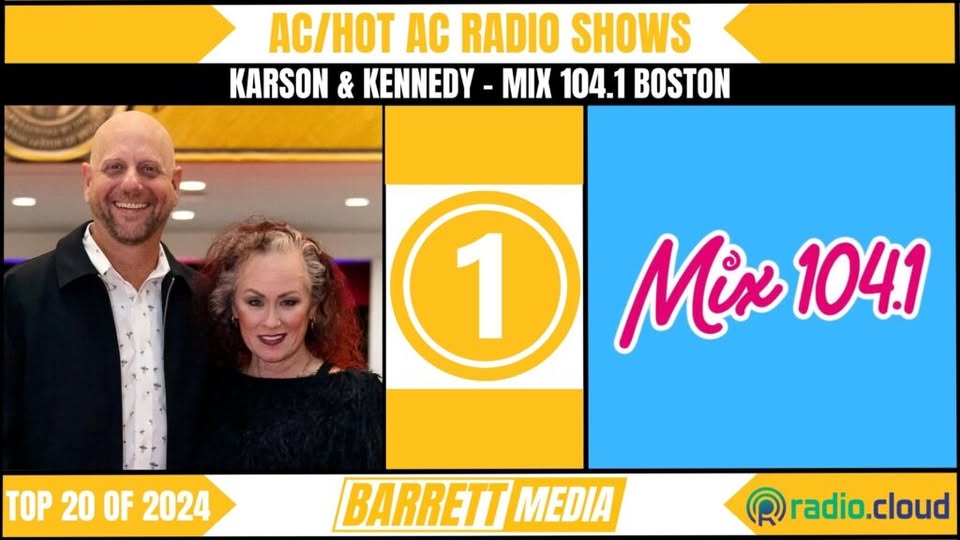
Karson and Kennedy host the morning show at Audacy’s Mix 104.1 WWBX Boston. As voted by its peers, the show was number one in the Barrett Media Top 20 AC/Hot AC Shows.
I asked the two how they felt when they saw they were number one.
“Karson explained to me what you were doing when you started this new initiative to talk about all the genres and all of the types of shows. And he had said the Hot AC is going to be on this day,” said Kennedy. “And by then I completely forgot about it. So, I will paint you this picture.”
“Karson is sitting at his desk on this side of this studio. And he’s going Kennedy, come here. I come around the corner, and he’s got it up. I look at our producer Dan and say, ‘Daniel, come here.’ And we just stood there staring at the computer for a long time. No, we were not anticipating any of that.”
Karson added, “I was like if we even cracked the top 20, that would be amazing. Sometimes I feel like we’re like the little show that could, and we just continue on and continue on.”
“It’s not really a show that you hear about much in the industry. We’re just kind of over here in our little world, doing our thing. And you hear about all these other big shows around the country and personalities. We’re just in Boston doing our thing. So, to get that acknowledgement, especially from our peers. Yeah, just wow.”
I shared with them that in a recent conversation with their Program Director, Steve Salhany, who finished third in the Top 20 Program Directors, he said, “I was really more excited about the ‘Karson & Kennedy’ win. I’ve been working with them for a long time, and they’ve come a long way. I’m really excited for them.”
The road to success has had a few bumps along the way.
Karson said, “It was a tumultuous beginning. We actually went to number one within the first year here. We went to number one 25-54, and it was a very big deal. They took us out to a fancy lunch with our names on the menu. Then, all of a sudden, they made a change in management, and it was like all these things were going on.”
Karson added that they were having problems with their relationship at the time. “We were having a tough time with our interpersonal relationship, and what was coming out on the air was not fun. And so, Sal took us out to lunch at Regina’s Pizzeria.”
“I thought oh, this is great. The new boss taking us out to lunch. And we ordered the pizza, and he’s like, I don’t know what’s going on with you two. I don’t know what’s going on with the show. I don’t know what anybody has instructed you to do with your show. But whatever’s coming out of the speakers, what I’m hearing right now is not fun.”
They were offered a 90-day contract, being told, “If you can’t figure it out in 90 days, we’re going to make a change. Wow. But I will tell you this. You need to do the show that you want to do.”
The show is known for sharing their personal lives, sometimes in great detail, which Kennedy believes is essential to authenticity.
“No one wants to have a conversation with somebody who’s just talking about themselves and the fancy things that they did or making up, or just reading off prep, right? The best conversations you have at parties, restaurants, or wherever you meet people are where you can go, oh, my God, me too.”
“Because we sit in front of a microphone and talk to however many people every 15 minutes or three minutes now and have a conversation about for me, mental health is a big thing for me. I’ve had multiple diagnoses we’ve talked about here on this show.”
Kennedy continued, “I got cancer last year, my dog died last week. We have talked about all of this stuff. But when you talk about these things, then people say, oh, so it’s okay for me to feel these things, too. You know that everybody is holding onto things so tightly. You can say it’s okay to let go, talk about it, and that you’re not alone, I’m just like you.”
Karson relates to the audience on a parenting level. “My wife and I are raising a 14-year-old boy. Having a job that’s out in the public, but then also having a child who’s trying to navigate what it’s like to be a teen and going through the things that he’s going through. The only way we know how to do it now, is to just share it.”
Adding, “I have found it, for me, cathartic, and it’s made my life a lot easier. I don’t feel like I’m leading two lives. Anybody that meets us will tell you exactly who we are talking to, that’s exactly who we are in the studio, who we are at the grocery store. And that’s kind of nice, because I have met a lot of people in this business, and what they are portraying on the air, is not who they are in real life, and that’s a lot. I don’t know. I couldn’t handle it. That would be too much on my shoulders”
Community involvement is a big part of the winning formula.
“You can make a connection with someone on the radio,” Kennedy said. “We do it all the time. You hear from people who have never met you, but when you can actually stand in front of them and speak with them and have a conversation, and maybe you’re hosting an event, and you all have had this common experience, or whatever the case might be, but to show that you’re not above anything.”
“I feel like there’s a lot of entitlement sometimes when it comes to radio, anything sort of in the public eye, really. [People saying] Well, I don’t do that anymore. I don’t get out of bed for less than this much money. Or someone charges for a charity event. What kind of monster are you?”
“We do a yearly toy drive called Karson and Kennedy 10,000 Toys for Girls and Boys, so we spend six weekends before Christmas in a mall. Two hours a day, Saturday, Sunday, every single one. Thanksgiving, it doesn’t matter, and we do that, and we’ve been doing that for a decade now, and so now you’ve got people who are coming who were dating, and now they’re married, and they have three kids, and the kids are coming to drop off their toys.
“I love that. You become part of a tradition for somebody else. What a gift. I can’t imagine anyone giving me a better gift than that.”
I asked what advice they might offer to an aspiring top ten market talent or show.
Karson said, “I would say the one thing that I learned along the way that was really hard for me was that you need people on your team. You need people on your side. I was battling against everybody. It was always us against the world. Every program director, every consultant, every record rep, every street teamer. No, you don’t understand. You don’t know You don’t know.”
“This is bringing me some PTSD,” laughed Kennedy. “I would love to speak directly to the young women out there and that’s, do it, do all of it. And you don’t have to wait for a boy to bring you along. I’m so thankful I had one. But, I think it’s so important for those voices to be heard. I think both of us are of the same mind that if you need help, we’re here.”
“Karson is the king of listening to a demo and being like, move this, change this, bang, bang, bang. And I’m happy to be helpful in any way I can as well. When it comes to planning a show or doing whatever. I think, more than anything, we want to watch the people who come after us maybe not have to jump on the hurdles that we had to jump on.”
Barrett Media produces daily content on the music, news, and sports media industries. To stay updated, sign up for our newsletters and get the latest information delivered straight to your inbox.
When ESPN and Major League Baseball agreed to a mutual opt-out of their existing seven-year media rights deal, it marked a significant paradigm shift in the fabric of the sports media business. With both sides providing differing rationale for the decision and subsequent reporting revealing more details surrounding the divorce, it did not change the fact that the league will cease airing games on ESPN platforms after the forthcoming 2025 season. For Jayson Stark, a former senior baseball writer at ESPN who penned columns and appeared on television, it was somewhat melancholy to suddenly see a 35-year partnership cease in this manner.
“There really is a sadness that goes with that because of what baseball has meant to ESPN and what ESPN has meant to baseball and what Baseball Tonight meant for so many people for the sport and for me personally,” Stark said. “I’m holding out hope that this is not the end. I don’t work there anymore, but I have so many friends who do and such appreciation for the passion for baseball that that group has.”
Even though Stark does not want MLB on ESPN to end, he understands that the composition of programming on the network differs from previous arrangements. During his 17 years covering baseball for the company, he felt invigorated to partake in live television and star on two episodes of Baseball Tonight per day as games were taking place around the league. In fact, he has vivid memories of personnel running towards the desk during commercial breaks to inform them of the latest developments in various matchups.
Stark recalls that ESPN was broadcasting six live games per week with multiple episodes of Baseball Tonight accompanying the coverage, creating a busy schedule that offered writers a new platform to convey information. The network has not regularly aired Baseball Tonight for several seasons, instead opting to largely focus its coverage within the Sunday Night Baseball property and select shoulder programming.
“We now take for granted all the studio shows that break down the game you just saw and the 12 games you didn’t see and the stuff that’s happening behind the scenes, the rumors, the people you talk to,” Stark said. “This was really the first show that did all that, and also the first studio show that you could break into a game live, watch it and talk about it.”
As one who was on the first Baseball Tonight, it has always been a part of me. Or was. I loved that show. I wish I could reach out to..
Stark credits sports media luminary Peter Gammons with the success of the show, and he considers him a profound mentor throughout his professional career. When he first started covering baseball, Gammons conversed with him in a manner that made him feel as if he was on equal footing and also implicitly validated his knowledge. Although they are colleagues once again as insiders at MLB Network, Stark acknowledged that Gammons was an invaluable aspect of early ESPN baseball coverage with encyclopedic knowledge and shrewd insights.
“I say this all the time – what Thomas Edison was to electricity, Peter Gammons was and is to our business,” Stark explained. “Everything that we do in modern baseball writing, he invented.”
Many professional sports leagues are prioritizing a wide array of distribution outlets as the reach of linear television diminishes concurrent with a declining pay television penetration rate. Yet streaming services and other digital outlets are trying to identify their niche and thrive amid a saturated media ecosystem. ESPN itself is preparing to launch its Flagship direct-to-consumer service later in the year and offer consumers new ways to view broadcasts and other programming.
“There’s so many people who appeared on that desk on Baseball Tonight and called baseball games on ESPN,” Stark said. “It just left an unmistakable impact on everyone who cares about baseball.”
While Stark hopes baseball can continue being televised on ESPN in the future, he departed the company in 2018 and joined The Athletic. The independent, subscription-based publication covers a variety of sports with a team of adept reporters and editors at the local and national levels. Since joining the company, Stark feels that he has been embedded in a writer-driven operation with freedom to delve into reporting and explore other journalistic interests related to the sport.
“I’ve been really lucky in my life to work in great places with great people, but there’s never been anything quite like this,” Stark said, “and to see The Athletic grow and succeed the way it has, it’s really exciting because we’re going to be there as the voice of sports and inviting this incredible, passionate audience into our sports world in a way that nobody else does because our mission is so different than anyone else’s.”
Stark and his colleagues at The Athletic are looking to take their stories to the next level, and they have seen evidence of this plan paying dividends through growing revenue amid a proliferation in subscribers. Whenever Stark posts links to stories on social media, there are regular comments asking why the piece is behind a paywall. Yet he hopes that once people realize the depth and stellar quality of the content, they will evince the value of a subscription.
“I once had a pro scouting director for a team tell me that his team bought subscriptions for every single pro scout in the organization, and the reason is that nobody has ever covered baseball on a daily basis the way that we do,” Stark said. “So when the writers for our site go to a game, when they’re sitting in the press box – they’re sitting in the same seats, sitting in the same press box, [but] thinking in a totally different way than everyone else.”
Spending much of his day consumed in a maelstrom of phone calls, texts and emails, Stark sometimes ends up writing over multiple days and allotting several hours to remain solely focused on the craft. Furthermore, he remains prepared to convey the story on different platforms, recognizing the invaluable essence of versatility. At the same time, he is trying to attend as many games as possible and maintains hosting obligations on the Starkville podcast alongside ESPN baseball analyst Doug Glanville.
“I’m constantly juggling,” Stark said. “I’m always telling people, ‘I should have joined the circus because it’s a nonstop juggling act,’ but if I were going to sum it all up – this is my favorite expression when I go to describe my job – it’s a labor of love, but it’s a good thing because there’s a lot of labor.”
Stark wanted to be a sportswriter from the time he was 10 years old and set out on a path to achieve his goal writing for The Daily Orange at Syracuse University. After a stint in Providence, R.I. covering the Boston Red Sox, he ended up joining The Philadelphia Inquirer as a beat reporter surrounding the Philadelphia Phillies where he further honed his craft. Stark later took over the “Baseball Week in Review” column from Peter Pascarelli and chronicled the eccentric nature of the game.
“My mom always told me I should write a book and call it, ‘I Never Saw That Before,’” Stark said. “I never really wrote the book, but I have been writing versions of it for many years now, for decades. That column was the first place that I did that and kind of found that voice that I have now and to write.”
Over the years, Stark has recognized some of the idiosyncratic and distinctive qualities of his comprehensive articles parsing different issues in baseball. He examines statistical oddities and quirks through the context of the modern era. On top of that, he also explores other storylines that involve data collection amassed through reaching out to former executives, coaches, scouts and insiders.
“I’m really conscious of the audience always, and I’m not trying to exhaust them,” Stark said. “I’m trying to include them, and I think that’s always my overarching philosophy in everything I write is I’m very appreciative that fans of baseball care about this stuff, and I hear from them all the time, so I’m trying to give them answers to the questions they are always asking.”
Amid an era where local newspapers have transitioned from print issues to digital content and competing with independent content creators and social media platforms for consumers, Stark is concerned about the future of the digital advertising model. Whereas space beneath the masthead used to be invaluable real estate, companies have discovered new ways to reach their target audiences and total addressable markets. As a result, he feels the subscription model will have to be the path forward to engender success.
“When [newspapers] decided as the internet was becoming a thing to just give everything away, there were reasons to do that, I guess to attract an audience, but it left an expectation in people that they shouldn’t have to pay for stuff,” Stark said. “That means it’s always going to be a challenge for all of them to go from giving away the great information that newspapers and longstanding websites have always compiled… to asking people to pay for it. That’s a hard leap for a lot of people.”
The league is entering its third season utilizing the pitch clock, an advent that reduced average game time by 28 minutes over its first two years. Stark believes that its introduction changed the sport and adopted a more compendious rhythm to the games. As ESPN currently prepares to exit national broadcasts of MLB games after this season, he opines that the game needs to find a way to reduce the strikeout rate and give players more chances to display their unparalleled athleticism.
“We have the greatest collection of athletes playing baseball now who have ever played baseball, and the more those athletes are running around the bases and showing what great athletes they are, the more entertaining your sport becomes,” Stark said. “If Max Scherzer strikes out 20, that’s a memory for a lifetime. If seven pitchers on your team strike out 20, it’s like nothing happened that night, the ball was never in play.”
Despite facing industry headwinds and uncertainty about the future of the profession, Stark enjoys his work and does not take any moment for granted. Certain days are harder than others, he contends, but he is nonetheless grateful for the ability to cover the game and was recently inducted into the National Sports Media Association Hall of Fame. In addition, Stark is a recipient of the BBWAA Career Excellence Award, recognition that he finds surreal and avowedly struggles to articulate.
“There’s actual work involved, there’s some sleep deprivation that goes on, but it never feels like work to me with a capital ‘W,’ and if I can say that – that I’ve had a career in a job that I love, that I love doing every day, then I made it, man,” Stark affirmed. “I’ve lived that life that I always dreamed of leading.”
As Stark continues to move forward, he aspires to continue effectuating the growth of baseball and appealing to the audience. While it is entirely plausible that he could receive more honors for his work, it is not something for which he is actively waiting and instead yearns to satiate the passion sports fans bring to the product. Trying to hit a proverbial home run with his stories and interviews, Stark is substantively blending the tradition of this pastime with modern innovation and evaluates his impact, in part, through more than just conventional metrics.
“I love it when people in the story comments say stuff like, ‘This is why I subscribe to The Athletic,’ or, ‘Jayson Stark is why I subscribed to The Athletic,’” Stark explained. “That continues to be rewarding, and as long as I’m doing this, if that’s still the case, then you don’t need to hand me a trophy. That’s better than any trophy.”
Barrett Media produces daily content on the music, news, and sports media industries. To stay updated, sign up for our newsletters and get the latest information delivered straight to your inbox.
The Arena with Kasie Hunt made its debut on CNN earlier this week.
And unlike other cable news launches, it didn’t have the fanfare that others have featured.
Whether that’s a good or a bad thing is up for interpretation. But the interesting component, in my view, is how Hunt shifts from mornings to afternoons. She had previously anchored the network’s Early Start from 5-7 AM ET before taking over CNN This Morning.
But now with an hour-long afternoon show, things change slightly. Gone are the quick story counts and forward-momentum-building segments, and in are longer-form interviews, and questions for panelists.
And that’s where my critique of the show begins. Because while I think the premise of the show — The Arena — is a good one, at its core it is just another cable news panel show.
Furthermore, it’s just another CNN panel show. It feels wrong to judge the show by its first two shows, but that’s the ultimate takeaway. The issue isn’t with Kasie Hunt, it’s with CNN.
Stop me if you’ve heard this before: a CNN show with a female host, joined by a panel consisting of a CNN contributor, a media member from outside the CNN ecosystem, another person (likely a minority or a woman), and a token Republican to become the villain.
Did I describe The Arena with Kasie Hunt, NewsNight with Abby Phillip, or Inside Politics with Dana Bash?
Trick question. It’s all three. And that’s the issue with the show. It’s a formulaic premise, with a formulaic presentation, a formulaic cast, with likely formulaic results.
I understand that everyone in cable news is trying to re-create the success of Fox News’ The Five. But stop. The reason it works is something the other networks can’t replicate: Because it’s on Fox News. There isn’t some secret sauce. Fox News could show a week of Chuck Mangione playing his flugelhorn and trumpet in the early afternoon hours and it would be the highest-rated show in cable news during that daypart.
The issue I had with The Arena with Kasie Hunt wasn’t the content. It wasn’t the premise. It wasn’t even the fact that it’s like several other shows at the network. The show was just simply unremarkable. Nothing about it stood out, except the fact that it was like several other shows. Which isn’t a good thing.
The content was what you would expect from a CNN early afternoon show. On Tuesday, the opening monologue consisted of criticism of Donald Trump starting a trade war with our closest ally and trade partner, mixed in with a mashup of all of the times he said he would bring down prices to begin his presidency.
And that would be a really cool way to open the show…for each of the past 6 weeks. But in an attempt to make a profound point, it made the same point every other show on CNN attempts to make.
Additionally, CNN still lacks in the digital department. It doesn’t appear as if the network has a show page built for the program on website. The network doesn’t have a playlist for the show on its YouTube page. You can’t find full episodes of the show on CNN.com, the Max streaming platform, or CNN’s native app on Rokus, Amazon Firestick, Google TV Streamers, and Apple TV boxes.
This has been, and will continue to be, a major issue for CNN. When the company finds itself in the ratings doldrums it currently sees, it needs to make its content as available as possible. Especially when it wants to cement itself as the chief digital news outlet. The network falls short time after time in the digital realm, which is especially disappointing when it is in the midst of shuffling its lineup.
Ultimately, I don’t love the idea of being overly critical of a show two episodes in. Everything finds its footing eventually. And if it doesn’t, it doesn’t last long. But when something is as milquetoast as this was, it’s difficult to think that The Arena with Kasie Hunt morphs into a top-of-the-line, consequential cable news show.
Barrett Media produces daily content on the music, news, and sports media industries. To stay updated, sign up for our newsletters and get the latest information delivered straight to your inbox.
Getting laid off is never fun. Or easy. But you can either get busy living or get busy dying. And Taylor Craig decided he’d create a new venture — Launch Live Now — instead of wallowing in self-pity.
As a former producer at CNBC, Craig had plenty of technical knowledge in the broadcast space. But when he was laid off by the company, he put that wisdom to use to help others interested in getting into content creation.
“Essentially, we’re a live-streaming production house,” said Taylor Craig. “Basically, I got laid off, and I didn’t really feel the urge to apply for any network positions. I talked to a lot of really smart people, and I realized social media platforms were pushing live video content onto their users. I just felt like it was the Wild Wild West, and it was our opportunity to bring the professionalism of TV to these new platforms. Because I think the way we consume content has drastically changed.”
Now more than ever, live video is accessible on a variety of platforms. What was once completely owned by over-the-air and cable television now features competition from apps like TikTok, Instagram Live, Facebook Live, and X, in addition to YouTube, Twitch, and Rumble, among others.
With those avenues comes an increase want and need for live video. Building out a studio with top of the line audio and video equipment, lights, and hardware/software needs isn’t simple or cheap. That’s where Launch Live Now comes into play, with Taylor Craig and co-founder Daniel Mesko helping aspiring content creators produce high-quality live shows.
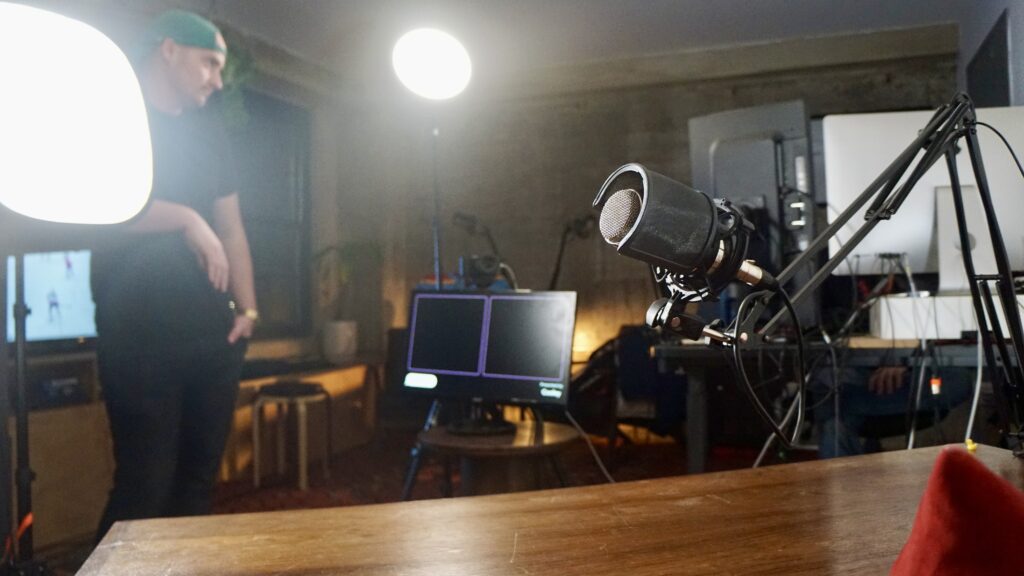
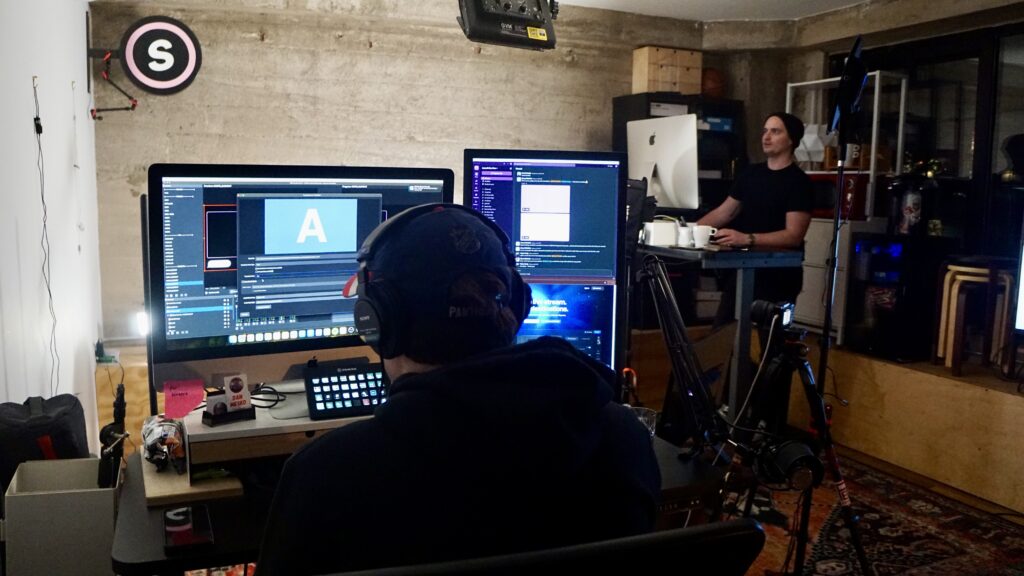
The view from the studio desk inside the Launch Live Now studios (Photo: Courtney Greene)
“If you look at any of those broadcasts, they do not have dynamic banner changes, they don’t have chats that they can feature,” Craig said of some home-built programs. “Sure, you might go live on Twitch and then you can talk to the users. But we have software that can collect all the comments from all the platforms. I don’t care if you’re on Rumble, if you’re on X, if you’re on YouTube, we’re simulcasting everywhere at once, and we can collect all of those comments and put them up on screen seamlessly.
“So just the production value in general, this is just what I’ve done for seven, eight years. I really love everybody that has a vision to get online and to execute on that and have an awesome show. We are tailoring our products to people that are in the TV world and really are used to that level of production value.”
Launch Live Now is bucking some of the more traditional trends in the media space. For decades, the strategy has been to build fans and viewers of a network brand, rather than the individual hosts. But Taylor Craig and partner Daniel Mesko are more interested in creating communities around individuals and see it as the future of the media ecosystem.
“I think live streaming is the next great wave of content creation,” said Craig. “I’m absolutely huge on that, and I just know that we’re not focused on networks. We’re focused on individuals. I’ve seen our competition. There is nobody who can do it better, faster, and cheaper than we can. We are just so agile. We’re not seeking funding or anything like that, but we are just absolutely amped for the growth of this industry, and we want to get anyone who is excited about a show idea launched as soon as possible.”
The team at the digital start-up goes through an entire show build process with creators, beginning with ironing out a name for a show and moving from there.
“For the build out (we have as ) many meetings as we need to figure out exactly what that concept is going to be,” Craig stated. “Are you going to have guests? Are you going to have banner changes? Some people don’t want banners. Do you want chat? Do you want this? We’ll take you through those scenes. We have to build out like a two-box, two-box with video, three-box, solo spotlight. You name it, every possible scene.
“These were things that – when I was at other networks – you’d put in a request to the graphics department. They go to the engineering staff. They implement it into the system. We can do this in a matter of minutes. So I would say our buildout process is very fast. We work with designers to make sure that the client is extremely happy with the way the screen looks and how they’re represented. Then once we have that buildout that includes transitions, music, title screen, be right back if you want to take breaks, the screen comes on camera.”
A photo from inside the Launch Live Now studios of Taylor Craig and Daniel Mesko. (Photo: Courtney Greene)
Once creators have selected their packages, the final step is picking a timeslot. The company offers four live timeslots per day on Mondays, Tuesdays, and Wednesdays, and three options on Thursdays and Fridays, with hosts having the option to work both in their Brooklyn studios or remotely.
For Taylor Craig and Mesko, the two former roommates are excited for what the future holds in the live video space and believe it can be primed to be a pioneer in the content creation production realm.
“I’m so excited about scale,” Craig admitted. “We’re not just building this to fill out. My partner, Dan, he’s a former blockchain engineer, left the software world, and was looking for a new, exciting opportunity. We both came up with this together. I always was looking for an excuse to work with him, because he’s such a smart guy. And we finally came together on this idea.
“We are building this — and Dan is integral in this — the company to be pretty much all remote. Where we can have a technical director and an executive producer, like a team of them doing a full schedule while another team is doing their full schedule,” concluded Taylor Craig. “And so the addressable market, when we get to that point, almost becomes anyone with a podcast, anyone that wants to do a live stream, which, by the way, we turn around into a podcast immediately. So you really get a good bang for your buck. But it’s just a massive market.
“We want to see this company go beyond just Dan and I schedule. We want to hire technical directors and producers at a time when legacy media are just laying them off. These are people I work with every single day. We’ve never consumed content at the level that we have now. We have very technical skills and there’s got to be a path to where we can use those skills in a new market, on a new platform.
“So that’s why I’m just super excited about this company. I want to help grow this new facet of the industry. Because I think, as I was talking about with networks and brand loyalty, it is sort of fading away a bit. Whereas individual communities are growing rapidly. That’s where we place our trust, and that’s who we want to build around.”
Barrett Media produces daily content on the music, news, and sports media industries. To stay updated, sign up for our newsletters and get the latest information delivered straight to your inbox.
The Philadelphia Eagles signed running back Saquon Barkley on Tuesday to a reported two-year, $41.2 million contract extension. Barkley had previously signed a three-year, $37.75 million deal with the Eagles as a free agent last March. This news comes after a dominant season in which Barkley rushed for over 2,000 yards, leading the Eagles to their second Super Bowl championship.
The announcement of Barkley’s new contract broke during ESPN’s airing of The Pat McAfee Show in the one o’clock hour. During the segment, the former Colts punter turned multi-media star hinted at incoming news through text messages he was receiving.
“This is an interesting time for our program,” said McAfee. “I’m just sitting waiting on a text message. If I could put that eyeball emoji out, I’d put that eyeball emoji out right now. Hey, something’s coming. Anytime you see me put the eyeball emoji out, it’s me saying I know what’s about to come out.”
McAfee has built a reputation for breaking major sports news stories on his program. Most recently, he was the first to report that Travis Kelce would be returning to the Kansas City Chiefs for the upcoming NFL season. Referring to his sources as “Source-Says,” McAfee’s access to insider information has drawn criticism from some in sports media. Many believe his connections with players and agents give him an unfair advantage in breaking news.
One of McAfee’s most outspoken critics is Fred Toucher of 98.5 The Sports Hub, who recently shared his disdain for McAfee and his broadcasting style.
“Pat McAfee sucks, and if you listen to him, you’re an idiot,” Toucher said. “You really might be an idiot, and the best is, ‘You don’t get it.’ Oh no, I get it. He works for Disney. This isn’t some guy on pirate radio here changing the way the game’s played.”
On Tuesday, McAfee jokingly addressed the idea of fully embracing the role of a sports insider.
“You know what, everyone f*****g hates me already,” McAfee said. “I don’t want to get into the ‘insider world’ just to piss people off. I already have enough people saying terrible things about me. So, forget it. Maybe I do get into the ‘insider world?’ Good luck, Starbucks stare-down guys. There might be a new pecking order in this entire game.”
Despite the criticism, McAfee acknowledged that being recognized in the ‘insider world’ is an honor, as it reflects the trust that people have placed in him and his show.
Barrett Media produces daily content on the music, news, and sports media industries. To stay updated, sign up for our newsletters and get the latest information delivered straight to your inbox.