After a two-year run with Audacy Houston, Jay Michaels has exited his role as Assistant Brand Manager for Hot AC “Mix 96.5” and Variety Hits “95.7 The Spot.”
Michaels joined the cluster in May 2023, taking on both programming responsibilities and an on-air role, hosting middays on Mix 96.5. In November, he expanded his footprint within the company, adding afternoon duties on sister station “99.1 The Mix” WMYX in Milwaukee and contributing to Audacy’s LGBTQ+ platform, Channel Q.
Michaels wrote on Facebook, “Well, this isn’t the way I wanted to start a Monday, but… who wants to hire me because we already know I spend way too much money on TikTok shop and Vivian and Hattie do not want to eat generic cat food.”
Prior to his time in Houston, Michaels served as Operations Manager for Cumulus Shreveport and PD/morning host for “Q97.3” KQHN. His resume also includes programming stints at 93X and 104.5 WJJK in Indianapolis, as well as on-air roles in Terre Haute, Louisville, and Evansville.
Barrett Media produces daily content on the music, news, and sports media industries. To stay updated, sign up for our newsletters and get the latest information delivered straight to your inbox.
Bill Reiter is stepping down from his national columnist role with CBS Sports. The seven-time APSE writing award winner shared on his social media platforms that he will be leaving CBS Sports, albeit remaining with the company for his daily CBS Sports Radio programReiter Than You, which airs weekdays from 10 a.m. to 12 p.m. EST.
Sharing the news via X, Reiter expressed gratitude for his time working for the network, covering some of the biggest moments and events in sports.
“After nine fascinating years, my time at CBS Sports is up,” wrote Reiter. “What a ride it’s been.”
Reiter began his journalism career writing for mainstream newspapers like the Chicago Tribune, Arkansas Democrat‑Gazette, Des Moines Register, and the Kansas City Star, earning multiple APSE awards and national recognition. Eventually, he joined CBS Sports in 2017 as a national columnist, contributing to CBSSports.com and appearing regularly on CBS Sports HQ.
“I was the National Columnist, helped launch a 24-hour sports network, hosted and executive produced my own TV show, co-hosted an NBA podcast (twice), wrote features, appeared on the CBS Evening News, moved to New York City and then back to Los Angeles, and ended up once again as an NBA insider,” wrote Reiter of his accomplishments with CBS Sports. “At CBS, I’ll be saying goodbye to many wonderful people I’ve worked with, talented colleagues who taught me a ton, many now lifelong friends.”
Moreover, Reiter—known for his candid, no-holds-barred style on-air, grounded in his newspaper reporting roots—says he plans to continue hosting his daily radio program, which now airs on the Infinity Sports Network every morning.
Throughout his time writing for CBS Sports, Reiter covered a wide range of sports, including the NBA, MLB, college football, and major events such as the Super Bowl, Olympics, and NCAA Tournament.
In conclusion, Reiter closed his post with an optimistic sign-off: “And now, on to the next thing!”
Barrett Media produces daily content on the music, news, and sports media industries. To stay updated, sign up for our newsletters and get the latest information delivered straight to your inbox.
Multimedia journalist Pablo Torre recently unearthed a 61-page ruling from system arbitrator Christopher Droney that contained evidence that NFL owners colluded to diminish guaranteed money in player contracts. Torre reported on the contents of the document alongside Pro Football Focus founder Mike Florio on a recent episode of his podcast, Pablo Torre Finds Out, and talked about the potential implications associated therein. In the ensuing days though, the story has not received the national attention some people believe it merits in that it contains information obtained through expedited discovery and details some of the inner workings between the league and NFLPA.
“I think it’s a big deal, but the NFL doesn’t want people to talk about it,” Florio said during an appearance on The Dan Le Batard Show with Stugotz on Monday. “The union buried the thing for reasons that still aren’t obvious because the union should be using it as a hammer, so that’s it in a nutshell. The NFL rarely gets caught doing anything it shouldn’t be doing. It got caught colluding, and no one wants to talk about it. Even now six days later, I can’t get people to talk about it, mainly because people fear reprisals.”
Florio spoke about how this document should have functioned as a cudgel of sorts for the union to gain more leverage against the league. On the contrary though, neither side has wanted to talk about it and it was not distributed for public consumption. While he acknowledged that people have bias that their reporting is important when it is the result of the work they put in, he finds it fascinating that the paper trail and circumstantial evidence has not generated more interest.
“I must have done 15 radio and podcast appearances last week that I ordinarily wouldn’t have done, so some folks get it, but the people who are in position to advance the ball, and think about it,” Florio said. “There is an army of reporters who devote their professional time to covering the NFL, and when a story like this comes along, there are ways to advance it. You get comments from players, you get comments from agents, you get different angles, you talk to an expert if need be to tell you what this all means.”
As their discussion regarding this topic concluded, Le Batard directed Florio to name the people who ultimately need to chase down this story. While he did not give specific reporters or outlets that should embark on this venture, he did give a general synopsis on media professional jobs who should be trying to advance the reporting, some of whom include insiders and those who cover the various teams involved.
“No one wants to bother,” Florio said. “Well, it’s because they don’t understand the story, they don’t want to understand the story, they don’t want to step into a bear trap and affect their own careers. I think it’s a cocktail of reasons that are causing most of the people in this business to just keep their heads low and their mouths shut.”
Barrett Media produces daily content on the music, news, and sports media industries. To stay updated, sign up for our newsletters and get the latest information delivered straight to your inbox.
Country radio personality Bryan “B-Dub” Washington continues to use his platform for more than just entertainment.
The host of “B-Dub Radio,” syndicated nationally by Skyview Networks, announced the conclusion of the third annual “B-Dub’s Longest Ride” fundraiser, raising $38,600 and eclipsing his original goal of $25,000.
The funds raised will benefit the Fisher House Foundation. This nonprofit organization provides free lodging and support to military and veteran families near VA hospitals and major military medical centers.
This year’s ride took B-Dub on a 5,833-mile journey through 16 states between June 15 and June 27. He met with local listeners, affiliates, and fellow riders, all of whom were united in support of the cause.
“This ride isn’t just about the miles or the road. It’s about showing up for the people who have already shown up for us,” B-Dub said. “When a service member is fighting to recover, their family should never have to fight to stay close. Fisher House makes that possible, and this ride helps make them possible.”
Fisher House Foundation President Dave Coker said, “Thanks to B-Dub for his incredible commitment to military and veteran families. Through his awareness and fundraising efforts, he and his fans are making an impact on those who have given so much for our country.”
What began in 2023 as a personal passion project has now become a cornerstone of B-Dub’s brand, with over $61,000 raised to date.
With support from more than 60 affiliate stations, the initiative has expanded its reach and resonance, driven by B-Dub’s blend of on-air presence, social media, and real-world connections.
For more information about the Fisher House Foundation, visit www.fisherhouse.org.
Barrett Media produces daily content on the music, news, and sports media industries. To stay updated, sign up for our newsletters and get the latest information delivered straight to your inbox.
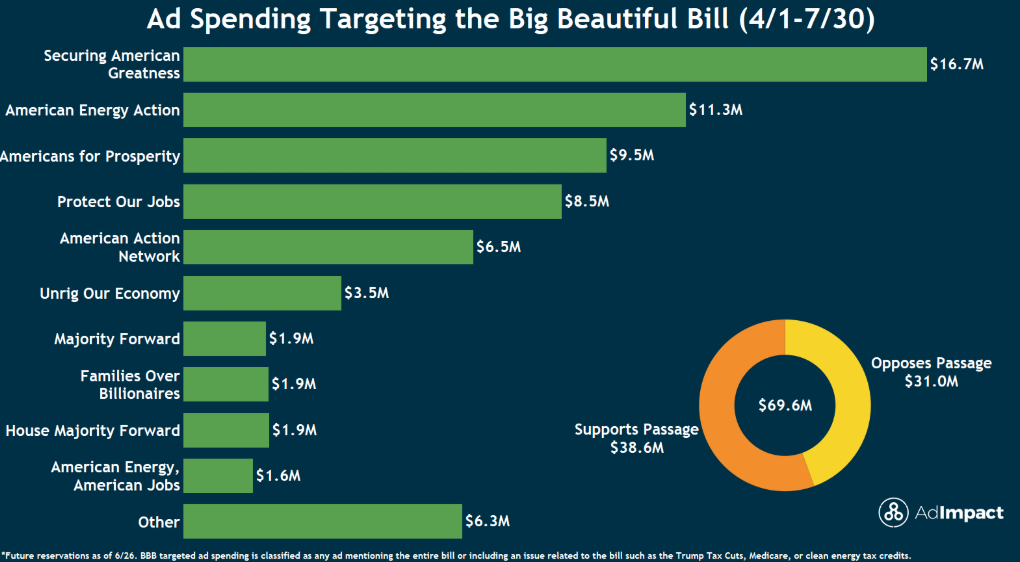
President Donald Trump is attempting to push through his “Big Beautiful Bill” in Congress. And those supporting it and opposing it are spending plenty to accomplish their goals.
According to data from AdImpact, between April 1st and July 30th, nearly $70 million will be spent on political advertising surrounding the Big Beautiful Bill.
$38.6 million has been spent in support of its passage, while $31 million of opposition dollars have been reserved and spent in recent weeks.
Nearly 25% of all spending surrounding the Big Beautiful Bill has come from the Securing American Greatness political action committee. That group spent $36 million supporting Trump’s presidential bid last year.
Almost half of all spending surrounding the bill has been targeted at Congressional Republicans who are up for re-election this cycle, like Sens. Susan Collins (R-ME), Joni Ernst (R-IA), Lisa Murkowski (R-AK), Chuck Grassley (R-IA), and Kevin Moran (R-KS), among others.
Of all political advertising spent between April 1st and June 26th, just over 20% of it was related to the Big Beautiful Bill. Meanwhile, just under 10% was spent in the hotly contested New Jersey governor’s primary, as well as an additional 5.9% in the New York mayor’s primary and the attorney general race in Virginia.
In total, $721 million has been spent in political advertising during the first six months of 2025, according to AdImpact. While that pales in comparison to the unprecedented spending levels of the 2024 presidential election, it is significantly outpacing previous political off-years. In 2021 and 2023, roughly $825 million was spent in each.
Barrett Media produces daily content on the music, news, and sports media industries. To stay updated, sign up for our newsletters and get the latest information delivered straight to your inbox.
Tricia Whitaker, sideline reporter for Friday Night Baseball on Apple TV+, has announced that she will be starting a podcast about life and sports with Indiana Hoosiers guard Sydney Parrish. The new weekly show does not yet have a name, but Whitaker has released a poll on the X platform with three potential options meriting consideration. Users have 24 hours to vote on the new name of the show, which will commence with discussions about life and trending topics followed by an in-depth interview with guests from the sports domain.
Whitaker had always wanted to start a podcast, but she did not want to do so alone. Upon meeting Parrish and learning of her aspirations to become involved in the space as well, they decided to embark on the project together. An official launch date for the show has not yet been divulged, but Parrish indicated that it will be “sooner than you think.”
Whitaker formerly worked on Bally Sports Sun as the sideline reporter and host for Tampa Bay Rays games, but she announced her departure from the broadcasts last November. Within her announcement, she talked about aiming to “prioritize things in life that matter most” to her at the moment and that she would have more time in the Midwest with her family, students and nephew. In addition to her reporting responsibilities, Whitaker is also an adjunct professor at The Media School within Indiana University Bloomington.
Parrish, a guard for the Hoosiers, recently completed her fifth season playing college basketball where she averaged 11.6 points per game on 5.5 rebounds and 1.9 assists. Throughout her five seasons within the NCAA – three with Indiana and two at Oregon – she scored a total of 1,389 points and was a two-time All-Big Ten selection. Outside of competing on the basketball court, Parrish graduated with a Bachelor of Science in sports media and also creates content on social media platforms.
Barrett Media produces daily content on the music, news, and sports media industries. To stay updated, sign up for our newsletters and get the latest information delivered straight to your inbox.
Beasley Media Group is selling one of its Tampa Bay properties. The company announced an agreement to sell 98.7The Shark to Educational Media Foundation (EMF) for a reported $8 million. The deal marks EMF’s long-anticipated debut in the competitive Tampa radio landscape.
The station has been part of Beasley’s portfolio since 2014. They acquired 98.7 FM through a swap with CBS Radio that included five other stations in the Tampa Bay cluster.
“We’re excited to enter into an agreement with EMF on the sale of 98.7 The Shark,” said Beasley Media Group CEO Caroline Beasley. “EMF’s longstanding commitment to delivering uplifting, family-friendly content aligns with the values of the community. And we’re confident they will make a meaningful impact as they enter this vibrant market.”
EMF operates national Christian radio networks K-LOVE and Air1. And aims to bring its “positive and encouraging” format to the region.
“After 43 years, it is truly a privilege and a blessing to finally be in Tampa,” said Tom Stultz, CEO of EMF. “Our mission is to be a trusted source of compelling media linking people everywhere to the hope of Christ. We anticipate K-LOVE’s positive and encouraging Christian format will become a welcomed, safe place to land for listeners in this fantastic city.”
The transaction is expected to close by the end of 2025, pending FCC approval and other standard closing conditions.
Barrett Media produces daily content on the music, news, and sports media industries. To stay updated, sign up for our newsletters and get the latest information delivered straight to your inbox.
Kevin Millar has been a member of the MLB Network talent roster for the last 15 years, primarily serving as the co-host of the popular afternoon television programIntentional Talk. Over the last two seasons, he has worked on the program alongside Siera Santos and Ryan Dempster, which brings consumers the latest baseball news and analysis in an entertaining and lighthearted manner. Miller recently made a guest appearance on Nothing Personal with David Samson where he was asked about the league-owned broadcast entity by Samson, the former president of the Miami Marlins.
Samson articulated that when he was in the executive ranks for the Major League Baseball franchise, he would watch the broadcast channel. Whenever someone said anything bad about the team, he mentioned that he would be on the phone to the league commissioner or Tony Pettiti, the former president and chief executive officer of MLB Network. Samson would ask them to “shut that guy up” and also voice that the Marlins should be the second highlight of the hour rather than 10th if they had a game. In his new role as a media member covering the game, he wondered how much of that still happened.
“Yeah, I get texts all the time,” Millar said. “I get good texts, I get funny texts, I get this text, but most of it’s, you know, are you going to get your feelings hurt? Of course you are. My job is not to hurt your feelings. I will hurt your feelings if it’s a lack of effort. I never am a result guy. I’m not going to get on a guy because he’s hitting .180 because a lot of different shows [go], ‘Well, oh he’s making $22 million, he’s hitting a buck 80.’ Well, that’s your fault, Dave, you signed him. Whose fault is it?”
Millar mentioned how feelings can get hurt when people do not look in the mirror every so often and talked about how the money in the game is astronomical. Within his discourse, he mentioned how New York Mets outfielder Juan Soto is being viewed as someone who should be “this perfect human being” who cannot have a brain lapse since he signed a 15-year contract reportedly worth $765 million. The only time that Millar will hurt people’s feelings, he explained, comes when the player does not respect the 90 feet, especially since he was a former player as well.
Millar expounded that he has a great relationship with MLB commissioner Robert D. Manfred Jr. and that a lot of what they cannot discuss comes from producers speaking in his earpiece. The show has established a reputation of having a signature mojo in which players who appear for an interview tend to hit home runs in their games mere hours later. In fact, Millar explained that this started with Giancarlo Stanton when he was playing for the Miami Marlins, and it continued to build from there.
“We don’t get in the nuts and bolts on analytics,” Millar said of the show. “We are getting into more of a locker room TV show, ‘I want to know who’s got a shower body that doesn’t look great,’ and, ‘I want to know who’s the cheapest dude that’s not picking up a steak dinner making $19 million. How many cheap multi-millionaires are out there that don’t play clubhouse guys to this day?’”
Barrett Media produces daily content on the music, news, and sports media industries. To stay updated, sign up for our newsletters and get the latest information delivered straight to your inbox.
On3 has added one of college football’s most respected journalists to its growing media roster. The company announced that veteran reporter Brett McMurphy will join the team as Senior National College Football Insider, effective July 1.
With more than three decades of experience, McMurphy is widely regarded as one of the most accomplished investigative journalists in the sport. He has built a reputation for breaking major national stories, particularly in areas such as NCAA conference realignment, College Football Playoff developments, coaching changes, and bowl selection news.
“Brett McMurphy is one of the greats in college sports media,” said Shannon Terry, founder and CEO of On3. “His integrity, relentlessness, and proven ability to break national news make him a perfect fit for On3’s mission to deliver best-in-class college football coverage. We’re thrilled to welcome him to our team.”
Among his most notable reports was the leak of SMU’s selection to the 2024 College Football Playoff—marking the first time bracket information had surfaced prior to official release in the playoff’s 11-year history. He also played a central role in the reporting of domestic violence allegations against a former Ohio State assistant, which ultimately led to the three-game suspension of then-head coach Urban Meyer.
McMurphy’s track record also includes breaking key realignment stories involving Gonzaga, Oregon, Washington, Arizona, Arizona State, and Utah as conferences across the country restructured. He has consistently been on the leading edge of college football’s biggest news cycles.
“I’m thrilled to join the premier college football digital sports media company,” McMurphy said. “I’m impressed how On3 is absolutely ‘all in’ on everything college football related. I appreciate the opportunity provided by Shannon Terry and Will Crall and look forward to continuing to build on the momentum they’ve created.”
A longtime voter for both the AP Top 25 and the Heisman Trophy, McMurphy most recently served as a senior reporter at the Action Network. His career also includes key roles at ESPN, CBS Sports, Stadium, AOL FanHouse, and The Tampa Tribune. In 2019, he was named Beat Writer of the Year by the Football Writers Association of America and earned a Pulitzer Prize investigative nomination for the second time in his career—though he was not selected as a finalist.
At On3, McMurphy will provide national college football coverage year-round, while also contributing across the company’s multimedia platforms including video and podcast content.
Barrett Media produces daily content on the music, news, and sports media industries. To stay updated, sign up for our newsletters and get the latest information delivered straight to your inbox.
Businesses are racing to make online experiences faster and smoother, and quick sign-in features have now become the norm. With everything from one-click shopping to biometric logins and pay-by-face systems in retail available, today’s consumers are moving faster than ever. As speed improves, though, questions about safety are surfacing just as fast. While convenience might win customers, it also opens doors to risk and possible fraud.
The Trade-Off: Fast Access vs. Security
Many industries are experimenting with ultra-fast login systems, especially where money moves quickly. From ride-sharing apps to buy-now-pay-later platforms, rapid authentication methods are being used to remove any pause between desire and transaction. These methods often skip traditional ID checks or only ask for minimal user input. Great for speed, but occasionally risky.
A telling example comes from the online gambling world. Some platforms, particularly casinos with no identity checks, now allow users to deposit and play without the usual registration friction. These no-KYC services often appeal to crypto users and players who often gamble on their phones and want privacy and fast access.
The Rise of One-Tap Commerce
eCommerce giants like Amazon and Apple have been pioneers of simplified login and checkout flows for a long time now, aiming to make purchases almost invisible. In these cases, user data is stored securely, but that’s based on an assumption that the customer’s device is safe and that their credentials haven’t been stolen or sold.
This assumption is also true for platforms that offer “sign in with Google” or “sign in with Apple.” While users don’t have to remember a lot of passwords, they are tying many services to a single point of failure. If someone gains access to their Google account, that person could walk through several digital doors without much resistance.
In sectors like fast fashion or digital subscription services, the easier it is to sign in, the quicker the sale. These shortcuts make users more vulnerable when data leaks happen, which they do, frequently.
Biometrics: Trusting Your Face or Finger
Biometric logins are more common, especially on mobile. Face ID and fingerprint recognition are said to be safer than passwords, and in many cases, that holds up. Unlike passwords, biometrics can’t be guessed or phished. Still, they can be manipulated.
There have already been incidents where early facial recognition systems were fooled by photos, masks, or even twins. Once biometric data is compromised, it can’t be changed. You can update your password, but not your face. This is why some security experts argue that biometrics should be a part of multi-factor systems, not a stand-alone key.
Despite the risks, industries like banking and fintech are using biometric ID systems for both authentication and fraud detection. It’s not a magic fix, but it is a step forward in usability.
The Psychology of Fast Sign-In
Speed can be a psychological tool. Marketers know that every second of delay increases the chance a user will abandon the process. That’s why pop-up windows ask users to sign in with saved credentials, and why shopping carts remember your preferences long after you’ve closed the tab.
Quick access lowers the friction between want and buy, but that same speed can bypass the normal thought process that might prevent impulse purchases or unsafe transactions. Users don’t always take the time to read privacy policies or understand where their data is going. If the login is too easy, people may not even realize they’ve opened themselves up to risk.
Riskier Niches, Bigger Rewards?
Certain digital niches, like the crypto sector, digital collectibles, and adult content platforms, are more aggressive in trying to achieve frictionless entry. On these platforms, users often want anonymity and fast access over regulatory compliance, and these industries push boundaries by offering near-instant access. Sometimes with decentralized logins or no traditional credentials at all.
People who value privacy appreciate this, but it also presents a goldmine for identity theft and money laundering. Without careful design, a fast system can become a dangerous one.
Photo Credit: Canva
That’s why many are calling for a middle ground: fast logins that still involve some behind-the-scenes vetting, or real-time checks that don’t bother the user but still guard the gates. Several new startups claim to use AI to scan for unusual patterns or detect when a login attempt feels “off.” These invisible checks might be the compromise the industry needs.
Where Media and Retail Converge
As media platforms add subscription layers or sell merchandise directly, the pressure to adopt faster login flows is growing. Whether it’s logging in to read an exclusive article, buy branded gear, or tip a podcast host, the fewer steps, the better. That means media companies are now playing in the same sandbox as retailers and app developers.
The challenge becomes balancing audience experience with safety. No brand wants a breach tied to its login portal. That’s why some companies are taking a page from the retail sector by offering limited guest access, partial paywalls, or timed sessions instead of always-on, account-based access. It’s not as sleek, but it helps build a line of defense.
The Legal Grey Area
In the U.S., there’s no unified federal standard that governs how fast or secure a sign-in process must be. It’s mostly up to the business to decide how much risk they want to carry. Some industries have state-level rules or guidelines, especially those tied to finance or healthcare. Others operate in a legal fog, doing whatever gets users in the door fastest.
While that flexibility is part of innovating, it’s also part of the problem. Without clear rules, the balance between speed and caution becomes a guessing game. Consumers are expected to manage their own safety, often without knowing the risks involved.
Conclusion
There’s no going back to slow sign-ups and clunky password screens. Fast access is here to stay. Still, companies and users should think twice before choosing convenience over caution. From no-KYC casinos to one-click purchases and face-ID logins, the pressure to reduce friction has made digital life faster, but not always safer. In a world where trust is currency, it’s not just about how fast users get in. It’s about who gets in and why.