WGN Radio in Chicago is mourning the loss of former Vice President and General Manager Dan Fabian, who died last week.
Dan Fabian served in the role for the venerable news/talk station from 1986 until his retirement in 1996. His career with the station spanned more than three decades, starting with the outlet in 1965.
Credited with helping to shape the modern sound of the station, Fabian was instrumental in bringing big personalities to WGN Radio, including Spike O’Dell. He also shepherded the station through its shift from Wally Phillips to Bob Collins in the morning drive timeslot.
Fabian once told the Chicago Tribune that his philosophy for the station was “back-fence radio.”
“The whole idea was to look out the window and see if the sky is falling,” he shared. “If it is falling, then you’re all over it and you try to figure out what to do about it together. If it’s not falling, then you kick back and say, ‘Well, what is going on? Seen any good movies lately? So how’s the family?’”
Dan Fabian was 81 years old.
Barrett Media produces daily content on the music, news, and sports media industries. To stay updated, sign up for our newsletters and get the latest information delivered straight to your inbox.
Former 930 WBEN and WHAM 1180 host Allan Harris has died after a battle with an unspecified illness.
Harris worked at WHAM 1180 as well as in local television news in Rochester before moving to Buffalo and serving as a traffic reporter and news anchor at 930 WBEN. He served in a similar capacity for other Audacy Buffalo stations, as well. He was fondly remembered in Rochester for his continuing coverage of the 1991 ice storm that slammed the area.
“We greatly appreciate all of the phenomenal work that the doctors, nurses and staff and Buffalo General and Gates Vascular Institute did for him,” Harris’ family wrote in a message on social media announcing his passing. “There are no words to describe the loss we all feel.”
Audacy Buffalo Market Manager Tim Wenger shared similar sentiments, stating “Heavy hearts at WBEN and Audacy as we mourn the loss of Allan Harris. An amazing broadcaster, co-worker, and friend. His voice and presence will be greatly missed.”
Harris was 76 years old.
Barrett Media produces daily content on the music, news, and sports media industries. To stay updated, sign up for our newsletters and get the latest information delivered straight to your inbox.
As FOX Sports continues to gear towards its broadcast of Super Bowl LX from Caesars Superdome in New Orleans, La., viewers are becoming more acclimated with its revamped lead NFL broadcast team. Play-by-play announcer Kevin Burkhardt and sideline reporters Erin Andrews and Tom Rinaldi welcomed new analyst and seven-time Super Bowl champion Tom Brady to the booth this season, commencing a 10-year contract reportedly worth $375 million. Ahead of calling a pivotal NFC matchup between the Buffalo Bills and Los Angeles Rams from SoFi Stadium, Brady joined the network’s NFL pregame shows live from their nearby studios.
While Brady was appearing on FOX NFL Sunday, he reminisced on his time with the New England Patriots and threw a pass to former teammate and studio analyst Rob Gronkowski. As his FOX Sports colleague and former New York Giants defensive end Michael Strahan played defense, Gronkowski successfully caught the spiral from Brady, leading to laughter from the cast. Earlier in the show, host Curt Menefee asked Brady how he has been doing in his new role.
“It’s been so fun,” Brady said. “The best part is I have the best teammates in the world. Kevin Burkhardt, Erin [Andrews], Tom Rinaldi, my boy [Richie Zyontz], [Rich Russo], so just coming into this has been so much fun. [I have] really enjoyed every part of it.”
Gronkowski replied to Brady’s discourse by saying that he has great teammates, akin to when he was playing professional football. In addition, he stated that no one told them there was homework associated with the job and was curious about the preparation he had been embarking on for a game.
“A lot of listening, a lot of reading, a lot of studying,” Brady explained. “I think for all of us, we just want to deliver for people, so get as much information as you can, and there’s a lot of places to get it from, so just enjoying that part of really staying intact and attuned with something that I love.”
FOX NFL studio analyst and four-time Super Bowl champion Terry Bradshaw replied to Brady by divulging that he does not believe in studying. Moreover, he mentioned how Brady has an avidity for fishing, resulting in him disclosing that he was recently in the Bahamas when the crew did not have a game to call last weekend. Brady was on the call for the Thanksgiving Day game between the Dallas Cowboys and New York Giants that averaged 38.8 million viewers, according to Nielsen Media Research and Adobe Analytics, representing the most-watched NFL game of the season.
Since Brady has a minority ownership stake in the Las Vegas Raiders, he is operating under restrictions that limit his access to team facilities and ability to criticize the officials among other stipulations. These impediments were put in place as Brady’s ownership approval was pending and have remained as such since formally permitted to become a limited partner within the Raiders organization. Later in the interview, Howie Long followed up by asking Brady to discuss the most unexpected thing he has encountered in the booth. Within his answer, he credited Burkhardt for guiding him in the right direction during the broadcast while also discussing the location from which he is viewing the action.
“I think the biggest challenge is I had so many years of playing quarterback where you’re under center and then you’re on the sideline watching your defense and hearing play calls,” Brady said. “I didn’t watch any games from the 50-yard line halfway up the stadium, so just getting your eyes in the right place and things are happening so fast down there, and there’s a lot of things between offense [and] defense.”
Bradshaw subsequently queried if there was any difficulty in viewing all of the different aspects of a given play, such as motions, the line and blitzes. Brady concurred with this assertion and proceeded to emphasize the importance of preparation and repetition. Before he had stepped foot in the broadcast booth, he had called several mock games both in the studio and on site with Burkhardt, building invaluable rapport and an understanding of how to most effectively work with his new colleagues.
“[Y]ou don’t realize that you have TV screens at home that are huge and people can see high-def, and it’s not always like that, even for the monitors we have,” Brady said, “so again, it takes a little time and reps.”
Barrett Media produces daily content on the music, news, and sports media industries. To stay updated, sign up for our newsletters and get the latest information delivered straight to your inbox.
WHAM 1180 in Rochester is mourning the loss of former host and owner Jack Palvino, after he passed away over the weekend.
Palvino hosted a show on the station and also co-owned the cluster in his Lincoln Group alongside Bud Wertheimer and Ed Musicus. The group purchased the station in 1978.
He also owned and worked at WVOR, WHTK, WPXY, and WHRR in Rochester. He also co-owned WBUF in Buffalo, as well as a pair of stations in Ohio.
WHAM 1180 is now owned by iHeartMedia.
A 30-year trustee of the New York State Broadcasters Association, Palvino was elected to the NYSBA Hall of Fame in 2015.
“Of all the stations, this one is the special one,” Palvino said of 1180 WHAM during his Hall of Fame induction speech. “This place has a legacy that is absolutely unique and it’s a wonderful, wonderful memory.”
Jack Palvino was 90 years old.
Barrett Media produces daily content on the music, news, and sports media industries. To stay updated, sign up for our newsletters and get the latest information delivered straight to your inbox.
As the College Football Playoff embarks on an expanded 12-team bracket for the first time, The Walt Disney Company (ESPN/ABC) and Warner Bros. Discovery (TNT Sports) are slated to broadcast games within its first round. While Disney is currently operating under a 12-year deal with the College Football Playoff for media rights set to expire in two more years, it reached a six-year extension with the invitational tournament reportedly worth $1.3 billion per annum. Earlier in the year, ESPN agreed to sublicense select games within the College Football Playoff to TNT Sports under a five-year deal, beginning with two first-round games per year through 2025. ESPN announced its commentary teams for the opening slate of games, which commence on Friday, Dec. 20 and run through the following day.
The opening game of the College Football Playoff between No. 10 Indiana and No. 7 Notre Dame will take place on Friday, Dec. 20 at 8 p.m. EST airing live on ESPN and ABC. Play-by-play announcer Sean McDonough, analyst Greg McElroy and sideline reporter Molly McGrath will be on the call in their second season together as a commentary team. The winner of this game will advance to the Allstate Sugar Bowl against No. 2 Georgia on Wednesday, Jan. 1 at 8:45 p.m. EST, a matchup the trio will also be calling on ESPN.
The lead college football commentary team of play-by-play announcer Chris Fowler, analyst Kirk Herbstreit and sideline reporter Holly Rowe will be calling a game on television during every round of the College Football Playoff. This schedule officially begins on Saturday, Dec. 21 at 8 p.m. EST when No. 9 Tennessee faces No. 8 Ohio State live on ABC and ESPN. The winner of this game goes on to the Rose Bowl for the quarterfinal game against No. 1 Ohio, featuring the same commentary team on Wednesday, Jan. 1 at 5 p.m. EST on ESPN. McGrath will join the broadcast team for the CFP National Championship from Atlanta, Ga. on Monday, Jan. 20 live on ESPN.
TNT Sports will air two first-round games on Saturday, Dec. 21 on the TNT linear television network and Max streaming service. No. 11 SMU faces No. 6 Penn State at 12 p.m. EST with the commentary team of Mark Jones, Roddy Jones and Quint Kessenich. A few hours later at 4 p.m. EST, Dave Pasch, Dusty Dvoracek and Taylor McGregor call No. 12 Clemson facing No. 5 Texas. ESPN will televise the first quarterfinal matchup at the Vrbo Fiesta Bowl on Tuesday, Dec. 31 at 7:30 p.m. EST with Bob Wischusen, Louis Riddick and Kris Budden receiving the assignment.
Commentators for the Capital One Orange Bowl and Goodyear Cotton Bowl within the semifinals are still to be determined; however, the company announced that reporters Laura Rutledge and Katie George will each receive a broadcast assignment at this time. In the preceding round, George will work with Joe Tessitore and Jesse Palmer at the Chick-fil-A Peach Bowl on Wednesday, Jan. 1 at 1 p.m. EST on ESPN. The company will reveal its MegaCast plans, commentators for ESPN Radio and studio programming surrounding the games at a later date.
ESPN is expanding Inside the College Football Playoff to five episodes and announced that it will premiere on Tuesday, Dec. 17 through the ESPN+ streaming service. The show will feature behind the scenes access, plus contributions and perspectives from ESPN commentators such as Paul Finebaum, Rece Davis, Tim Tebow and Laura Rutledge. This is the sixth season of the ESPN original series, which will conclude on Friday, Jan. 24 with a look at the CFP National Championship Game.
Barrett Media produces daily content on the music, news, and sports media industries. To stay updated, sign up for our newsletters and get the latest information delivered straight to your inbox.
CNN anchor Alisyn Camerota has announced she is leaving her post at the cable news network after more than a decade with the company.
On Sunday, Camerota revealed she was making her final appearance on CNN as her contract is set to expire.
“I’ve had such incredible opportunities here these days 10-plus years,” she said on the air as she announced her exit. “I’ve interviewed presidents, and heroes, and extraordinary people – the kind of peak career experiences that I had dreamed of since I was a teenager. I’m always touched when a viewer comes up and tells me that I helped get them through these challenging times.”
Alisyn Camerota joined the network in 2014 after a lengthy tenure at Fox News. She then served as the host of the CNN morning show New Day, before the network reimagined its morning lineup in 2022.
“Alisyn is a rare talent with the ability to interview world leaders and everyday heroes with both strength and empathy,” CNN CEO Mark Thompson said in a statement released on Sunday. “She’s been a wonderful colleague at CNN for more than a decade, and we will be cheering her on in her new pursuits where she will surely find much success.”
Barrett Media produces daily content on the music, news, and sports media industries. To stay updated, sign up for our newsletters and get the latest information delivered straight to your inbox.
Many in sports radio circles took notice of the recent moves made by KNBR. The Bay Area sports station parted ways with Tom Tolbert and John Lund, two popular voices on the station. Tolbert is one the most important hosts to ever occupy the airwaves in San Francisco. Lund enjoyed over a decade of success alongside Greg Papa. Neither lost their fastball or ability to connect, but they did have a larger effect on the station’s bottom line. With revenues down for many radio operators, Cumulus Media chose to make bold changes.
Following the news of Tobert and Lund leaving, Greg Silver and Derek Papa were named their replacements. Both are younger and have proven fathers in the industry. They’ve been working hard to reach this level, and though excited to take the reins, they’ve entered less than ideal situations. Fair or unfair, the public will see their arrivals as being driven by cost rather than talent. Over time they can change that narrative. I hope for each of their sake that they do. However, few are going to suggest that this is the ideal way to give young talent a break and enjoy success.
But today’s column isn’t about the Tolbert/Lund and Silver/Papa situation. There’s a bigger issue to address. Radio groups across the country have been parting with a lot of top talent. It’s paving the way for digital companies and creators themselves to develop new ways forward. That begs the question ‘do radio companies care that they’re helping launch businesses that could harm their own’?
Some industry folks blame radio management, salespeople, and advertisers for declining revenues. It’s silly to lump everyone together since different groups and cities face different challenges. Just as fair to question though is how valuable top stars are in today’s radio climate. Is it smart business for a radio outlet to spend a few hundred thousand dollars or even seven figures on accomplished talent when revenues are shrinking? The golden days of radio hosts earning high six figures and low seven figures are decreasing. Many on-air talent would be satisfied earning 100-250 thousand dollars per year. When you reach that level though, it’s easy to expect more once you learn your value to advertisers, investors, and executives.
But at some point, radio has a limit of what it can invest. Given the state of the business, it’s more likely top earners will earn less in the future than more. Talent thinking they’re untouchable because they generate ratings are out of touch with the current landscape. It’s more now about the amount you make, and what you bring in.
Which brings us to digital groups, and talent taking control of their futures.
Locked On, All City, Jomboy, Omaha Productions, The Volume, Outkick, The Ringer, Meadowlark Media, Barstool Sports, Bleav, A to Z Sports, and other digital groups have emerged over the past decade. They see a bright future in digital audio and video while radio still prioritizes its over the air product.
Digital groups are investing dollars in new and proven voices and betting on the come, while radio lives quarter to quarter and year to year, often reducing head count to pursue profitability. Reach, return on investment, and staff sizes aren’t as large for most digital outlets, but it’s only a matter of time before they become larger. In the meantime, they’re hunting for opportunities, and radio just continues making them available.
Take for instance the Bay Area. Since 2020, a massive amount of talent have become available. Among them, Damon Bruce, Larry Krueger, Paul McCaffrey, Ray Ratto, Ray Woodson, Rod Brooks, Bob Fitzgerald, FP Santangelo, Eric Byrnes, John Lund, and Tom Tolbert. Drew Hoffar, Kevin Frandsen, Gianna Franco, Kate Scott, Lorenzo Neal, Chris Townsend, Matt Kolsky, and Ryan Covay were involved in shows too but some landed work in other mediums, while some left the business.
Even executives in the Bay Area have left such as Stacey Kauffman, Lee Hammer, and Jeremiah Crowe. A popular local sports TV host Brodie Brazil was also laid off this year. He’s generated over 10 million views of his content on YouTube. Digital groups see this, and they start developing business plans.
To attract advertisers and listeners/viewers, you need people who are familiar, capable of attracting attention, and possess the ability to move product. One outlet could launch tomorrow with 5-6 of those hosts and deliver a product that could challenge KNBR and 95.7 The Game for local advertising dollars. They wouldn’t be saddled with corporate debt or internal challenges from other cluster brands. They’d also be focused solely on digital not on radio.
Another advantage for creators and digital groups is that YouTube provides a path to monetization. Talent capable of delivering thousands of subscribers and large amounts of watch hours can find a realistic path to 50K-100K annually. That may not be what talent made before, but that also doesn’t include advertising deals, events, or the value of being your own boss, working remotely, and growing a business even larger in years 2, 3 or 4. Keep in mind, if you can get millions to watch, the earnings are even higher.
Look at what transpired last year in Dallas. Mike Rhyner, Jeff Cavanaugh, and Ben and Skin became available. iHeart saw an opening, and and built a brand (97.1 The Freak) with them. It didn’t last or work but it paved the way for All City to enter the market, and scoop up Dan McDowell and Jake Kemp. AllCity took a similar plunge in Philadelphia hiring Anthony Gargano and Jon Marks. Locked On and TEGNA have done something similar in Cleveland reuniting The Bull and Fox. BetRivers has enjoyed success too in New York with Mike Francesa.
A city that could face the same issue in the future is Tampa. WDAE is the local sports radio leader but it hasn’t faced local sports competition since 98.7 The Fan folded in 2014. Meanwhile, people connected to the brand such as Jay Recher, Ian Beckles, JP Peterson, Zac Blobner, John Mamola, Ron Diaz, and Ronnie Lane have either left or been let go. That creates an opportunity for a digital group to build a brand and compete for local sports dollars. Heck, those guys could do it themselves, though it’d take longer, and require adding someone to lead sales and social media, and investing dollars marketing a new product.
If you look to the past, you’ll see what awaits in the future. Clay Travis went all-in on Outkick and dominating the national stage after leaving 104.5 The Zone in Nashville. Bill Simmons created The Ringer after ESPN chose not to renew his contract. Dan Le Batard and John Skipper built Meadowlark Media after ESPN cut ties with Le Batard and his Miami crew.
Even smaller groups like A to Z Sports in Nashville, and hosts like Jake Asman, Damon Bruce, and Tim Montemayor have built businesses after being pushed aside by radio. For some, being your own boss is a stopgap job until something else opens. But one or two will put it together, do big things on their own, and never look back.
I understand radio’s need to control costs, but each time a top talent is sent packing, they’re being dared to launch a business and create future revenue pain for their former outlet. Personalities with established track records possess audience trust, social followings, and team/player and advertising relationships. Not every host who takes the plunge will succeed, but some will. If it’s hard generating revenue now, think about what awaits when you’re selling against increased competition that’s built its identity on your airwaves.
The question radio executives should be asking is ‘why are these people considered expendable to us yet highly valued and sought after by digital groups and local advertisers?’ If we keep cutting ties with difference makers, we shouldn’t be surprised when the difference they make starts to impact our own success.
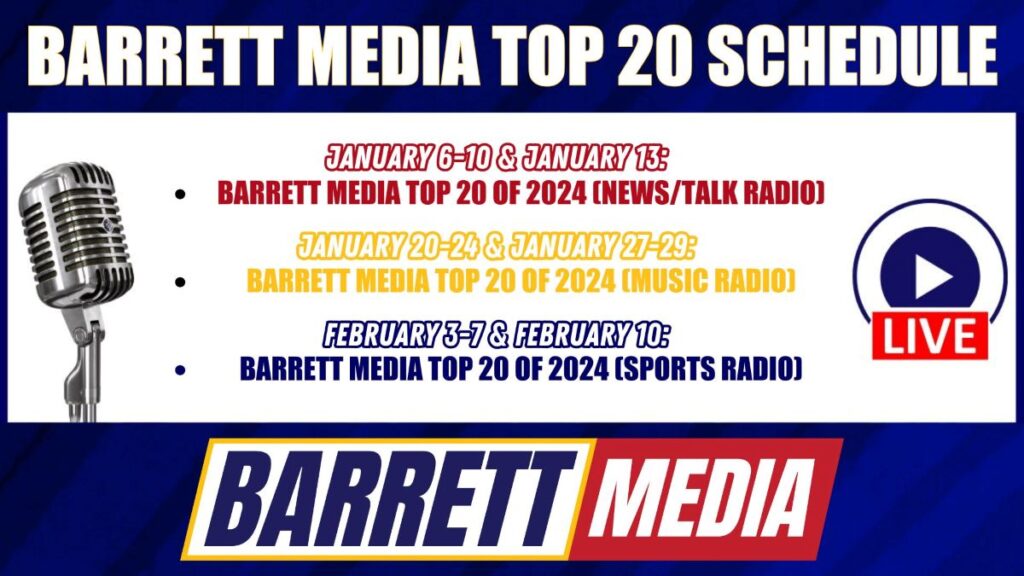
BNM and BMM Top 20 Series
I mentioned a few weeks ago that our annual Top 20 series for news/talk was moving back to January. The BNM Top 20 of 2024 gets released January 6-10, and January 13. Lists are being sent to all programmers and executive voters today. Music radio will follow, with the first ever BMM Top 20 of 2024 dropping January 20-24 and 27-29. The BSM Top 20 of 2024 doesn’t come out until the first week of February. Given the changes across the radio industry, this year’s results should be interesting.
2025 BSM Summit Sale
The 2025 BSM Summit presented by Point to Point Marketing comes to Chicago on May 8-9, 2025. Tickets this month are ON-SALE for $249.99. They’ll increase to $299.99 on January 1st. 8 speakers were announced last week, and I’ll have more to reveal in the weeks and months ahead. Hotel rooms can also be reserved by visiting the Summit website. The Westin Michigan Avenue is our hotel partner for this year’s show.
Quick Hits
A reminder that I’m looking to hire a Music Radio Editor. I’m also going to be adding a part-time social media assistant in early 2025. If interested in being considered, send a resume and work samples to Jason@BarrettMedia.com.
Though they’re not in the end zone yet, it appears that ESPN and Stephen A. Smith are close. That’s great news. Stephen A. works his ass off, and has done an incredible job delivering audience and revenue for the company. Jimmy Pitaro and Bob Iger recognize that. Sometimes top stars in business aren’t valued internally the way they are externally. I’m glad that’s not the case here. Stephen A. and ESPN belong together.
I don’t love ESPN New York‘s decision to break up The Michael Kay Show but I’m glad that all three members of the show have been retained. Change is inevitable in the radio business. To Michael, Peter and Don, congrats on a heck of a run in afternoons.
Chris Mannix‘s piece on Adrian Wojnarowski was excellent. If you haven’t read it, it’s worth your time. The details of Woj’s cancer diagnosis earned most of the attention this week, but there was one part in the story that stood out. Woj said that he reached a point where he didn’t want to spend one more day chasing news that mattered little in the grand scheme of life. He explained how he attended a memorial for Chris Mortensen, and was struck by how many ESPN colleagues weren’t there. It provided a great reminder that the job isn’t everything, and eventually all that’s left are your family and close friends. The older you get, the more that hits home.
Thank You ‘Triple H‘ Paul Levesque for getting things done. The WWE product with Pat McAfee at the commentary desk is simply next level. Having Pat back in 2025 as the company launches on Netflix and gears up for WrestleMania season is going to be awesome.
It was 20 years ago today that Pantera guitarist “Dimebag” Darrell Abbott was shot and killed on stage by an audience member in Columbus, Ohio. A terrible tragedy that deprived heavy metal fans of one of the genres most important guitar players and bands. I’ll be cranking Walk, Cowboys From Hell, Cemetary Gates, and This Love at max volume today as a way of paying my respects.
Media brands that have prioritized TikTok over other social platforms got a big scare last week. A federal court ruled that TikTok can be banned in the US amid safety concerns. TikTok’s parent company ByteDance has until January 19th to sell the platform or law would require app companies like Apple and Google, and internet hosting providers to stop supporting the app thus forcing a ban. ByteDance is expected to file an injunction to ensure that the app does not face extinction in the United States. Regardless of what happens, it’s hard to have faith in a platform that the government frequently discusses shutting down.
Stephanie Eads and I are traveling to Nashville in February to finally experience Country Radio Seminar. I’ve heard great things about the show for years, and am excited to cover the event, and build new relationships. For details about the event, go here.
Newsmax’s Rob Schmitt is on a roll. The talented host beat CNN’s Erin Burnett head to head during the 7pm ET hour. Schmitt won two of the three days before Thanksgiving, and followed it up with wins last Monday, Tuesday and Wednesday. The conservative news outlet is enjoying strong ratings momentum since the election.
Congrats to former WCBS 880 anchor Steve Scott. After years of delivering the news in the big apple, Scott has headed west to do the same for the Bay Area’s dominant news outlet KCBS Radio.
Barrett Media produces daily content on the music, news, and sports media industries. To stay updated, sign up for our newsletters and get the latest information delivered straight to your inbox.
Can anybody make radio work anymore? I mean, really work, remaining profitable with a long-term future in store?
Stephen King couldn’t. He had what some people would consider the ideal situation for a radio operation – nice little cluster with competitive ratings in a small market where radio sales business is transacted in person – and he’s given up. We get reports from other towns across America of mom-and-pop stations closing and selling off the land under their towers. If you’re one of the dreamers we see on Facebook with the desire to take over a small town station and do it right/have fun/prove that radio isn’t dead, you can get in cheap right now. Why aren’t you?
Correct. You know better. The audience is not growing. Sales are not growing. Entire clusters are now fully automated/voice tracked/unmanned. Big companies are praying that AI will save them. It’s becoming increasingly hard to remain optimistic about the medium.
The other day, while running errands, I listened to a lot of South Florida’s broadcast radio stations. Throughout the week, I kept asking myself, who is this for? Who needs this? The talk radio was abysmal, the music radio pointless in a Spotify age. Is anybody excited by a radio station’s year-end countdown, if they have one, or are they more concerned with their Spotify Wrapped, flawed though it may be this year? (I can think of one exception, WXPN Philadelphia’s wildly eclectic 885 Greatest Songs of the 21st Century, but that’s all.) When Assad flees or Pete Hegseth has another drink, are politically-minded people tuning to radio for opinions or listening to podcasts about it? And is there anyone left doing truly local talk radio or morning radio? (I know, yes, some are, but it’s increasingly rare and if AI could produce even a poor imitation of a local show, radio operators will do it.)
All of this is to say that when you’re looking for reasons why some stations are turning out the lights, a lot of it comes down to whether radio’s providing anything you can’t get elsewhere, anything better than what you can get from streaming. It’s the same dilemma print publications encountered years ago – do you need a newspaper with yesterday’s news when you can get today’s news online – and you know what happened to print.
Take a walk around your neighborhood some morning and count the number of papers on people’s driveways. Then imagine the number of car radios set to streaming instead of AM/FM, and the lack of actual radios in homes, and the percentage of people walking around with smartphones capable of replacing radios, newspapers, television… it’s nothing new, but more people are noticing, and no amount of industry number-slinging – reach! We have reach! – is going to change that.
Once, I thought that the future for radio would be similar to that of newspapers, where insanely rich benefactors would step in and buy properties to preserve them as local institutions, or non-profits would operate commercial stations for the same altruistic reason, but I don’t think that’s gonna happen. It’s not working too well for newspapers, either, if the Jeff Bezos and Patrick Soon-Shiong experiences are any indication. Besides, the old school prestige of being the owner of the local paper doesn’t translate to radio. You own the local radio station? That’s nice. What else do you do?
I don’t know if there’s a return from this, but I do know that reducing local content has killed off one of radio’s two traditional strategic advantages (the other is ubiquity, and that’s just about gone, too). It was about the content and the people who create it, and the lack of effective competition, and now that the content is not compelling and the creators off making podcasts or working in different fields, it’s not unimaginable that other station owners will follow Stephen King in pulling the plug, and taking a write-off rather than try to find another EMF to take the thing off their hands.
If you ARE crazy enough to buy into radio, though, do everyone a favor. Put something on there that’s truly different, something Spotify or podcasts can’t do. Find creative talent and let them do every “you can’t do that” idea they have. If radio’s going down, it might as well go down fighting.
Barrett Media produces daily content on the music, news, and sports media industries. To stay updated, sign up for our newsletters and get the latest information delivered straight to your inbox.
Radio and digital brands have an opportunity to cut through the clutter and make a momentary connection with the one thing every human on this planet shares: a birthday.
My mother and I shared a December birthday. Add Christmas and four kids to my father’s clergyman salary, and December had to be one of the most stressful months at our house. Time heals and changes reality, but we felt celebrated because our parents did what gifts and trips can never do. They loved us unconditionally.
Okay, now that we’ve checked the Holiday Happy Feelings box, let’s discuss ways to improve our connection with the audience.
Before Al Gore invented the Internet, our database’s birthday acknowledgments were unique. Wait, did we have a database prior to the Internet? Yes. Stations with focused marketing departments nurtured those databases, with names accessed through marketing companies, research respondents, and disciplined street teams. But the Internet has made data-grabbing so much easier over the last thirty years.
Too Much Celebrating
Today, we can wish someone a happy birthday on Facebook, X, LinkedIn, Instagram, Snapchat, and the platform where we live our lives…SMS (texting). Have the multiple ways to deliver the message made the birthday greeting less special?
I celebrated a birthday recently, and the greetings that caught my eye were two email messages. One was from Copper Mountain, one of my favorite ski resorts when I lived in Colorado. I haven’t skied Copper Mountain in 20 years, but I guess I gave them my information, and I’ve never unsubscribed.
It was special because it reminded me of a great time in my journey. However, there was an immediate internal reaction: “Hey, somebody is paying attention.” Now, think about someone at a place in their life where they need some virtual recognition. Your radio station isn’t simply promoting itself with these emails. It’s connecting, recognizing, encouraging, and possibly changing someone’s day.
If that’s true, and I think it is, then maybe we should put more thought into our database birthday greetings. It’s not enough to email your database a Happy Birthday message. If that’s all you do, please don’t stop. I’m challenging us to refresh the approach.
The second email to get my attention was from Uber. Along with the birthday cupcake graphic, the message went beyond the typical “It’s your special day” accolade. Their message was unique. “There are 49,211 other drivers and couriers with the same birthday. That’s a lot of cake.”
Of course, as someone who has sat in more than a thousand weekly promo meetings through the decades, my brain immediately went to the moment someone came up with that idea in the conference room. My second reaction was the reason for writing this column. For a moment, I felt part of a group. Sure, it is a group of 49,211 people I will never know, but it is a group nonetheless.
Five Things To Consider When Freshening The Approach:
Here are a few ideas to freshen the noisy connection world of database birthday greetings, whether you have a database of 400 or 40,000.
1. It’s In The Mail!: Electronic communication has perfected our procrastination. But if you want something to be delivered to a residential mailbox and arrive in time for a person’s birthday, you have to plan and play the USPS game. Take a group photo of your airstaff celebrating a birthday. Have every staff member sign the card. Keep a stack in the Control Room or the office and have it become part of their daily routine. Oh, wait. Your midday talent is voice tracked from another market? No problem. Send a box of birthday cards with the host’s picture and make it a personal greeting from your midday jock
2. What Do I Get Out Of This: My Planet Fitness birthday message included a $30 gift from several vendors. I didn’t accept it because it meant I had to sign up for another database. However, I’m certain a lot of people take advantage of those “free” gifts. The best gift is one you can use with little or no effort. Include a Starbucks gift link in the email. If you’re sending a snail mail card, include a $10 Dairy Queen or Chick-fil-A card to get a free ice cream.
3. Will I Remember It Next Week?: The birthday greetings from Copper Mountain and Uber made an impression on me. Beyond the nice memory I got from the Copper email, they included a quote from the iconic Warren Miller: “If you don’t do it this year, you’ll be one year older when you do.” Drop the ski pole. Uber gave me a unique number to remember. I’ll likely save both of those emails and easily pull them up when I want to remember the quote or the number. It seems simple, but so far, I haven’t deleted those emails.
4. Can We Get Personal? Technology gives us a new opportunity every week. When your street team is at an event taking selfies with fans, can you take the extra step and get those fans to sign up on an iPad to have the photo enhanced and delivered to their inbox or phone? When you capture the information, maybe they’ll give you a birthday. Then, you resend the photo on their birthday as a memory.
5. What’s Your One Thing?: About 23 years ago, I gave Mark Niederhauser my birthday and anniversary. Every year, I get an email or a text celebrating those events. Mark is a promo guru with Warner Brothers Nashville. There’s a good chance you’re in his birthday database because he made it his One Thing with his clients and friends. Mark hasn’t worked me on a record in more than 20 years, but every August and December, I know I’m getting a note from him. Think about your database as individuals.
Birthdays are an opportunity to connect with our audience. Create a meeting with your thinkers and refresh the idea of celebrating someone else’s most important day.
Jim Rome, one of radio’s original bad boys, is still grinding at 60 and said he’s looking forward to interviewing the grandchild of one of the athletes he covered over his career.
Rome was interviewed by Dan Le Batard, another sports radio legend, on Le Batard’s show South Beach Sessions and admitted that he’s matured over the years.
“I’m not that guy everybody hates,” Rome said. “We get older and we evolve.” At this point, something like provoking a fight with former Rams quarterback Jim Everett isn’t likely to happen. “Obviously I would not have canned Everett ‘Chris’ a fifth time, ” he said.
That a more grown-up version of Rome continues to be successful is a bit of a surprise to him. “I used to think when I was 30, the last thing this world needs is a 50-year-old smack talker. Nobody’s listening to that. And yet here I am 60 and talking a little bit of junk,” he said.
Rome and Le Batard reminisced over how Rome got into the young sports radio field. When he was a kid, Rome wanted to be a pro athlete. “I figured out in Little League that’s never going to happen,” he said. “ So how do you stay in sports?”
In high school, Rome recalled being a bit of a nerd, obsessed with sports. “I was not the cool kid for sure. Very small group of friends. Didn’t get the girl,” he said. But he always had a bit of a mouth and had a chip on his shoulder.
“I had something to prove and I was gonna get mine and I wanted to be proud of me, and like, yo, man, I mean things worked out pretty well. How you like me now,’ he said.
Rome said.got his start on a small radio station in Santa Barbara and he was looking for his big break. He dreamed of being on WFAN in New York. Then a San Diego station changed formats and went all sports. He got a job at the station and things happened quickly: a TV show on ESPN2 and a syndicated radio show on stations all over the country.
Though he was on air, Rome always treated his show like a business, because he grew up in a family that owned a small business. “At the dinner table every night I hear ‘take care of the business and the business will take care of you,” he said. “And I told the staff: take care of the show and the show will take care of you.”
At this point in his career, Rome says watched many athletes’ entire careers go by. Some of those athletes did care for his harsh takes. He recalled that Raider Hall of Fame defensive end Howie Long was “one of those guys that heard me on the radio. He threatened to kick my ass.” At one point they met, and Long cracked that Rome was bigger than he’d thought. They bonded a bit while talking about their children.
Long told Rome that he “had a nine-year-old who could beat your ass right now.” Rome never figured out whether Long was talking about Chris or Kyle, both of whom played in the NFL. Either way, they would have,” Rome noted.
Rome said he wants to keep doing the show long enough to interview the grandkids of one of the athletes he’s known and interviewed. And then “when I’m done, I’ll be done.”
While admitting that he spent way more time with his nose to the grindstone than smelling the flowers, Rome didn’t have much regret about his career.
“I’ve lived a whole life, talking sports and interviewing athletes. They pay me to do this. It’s a joke, man. I hope they never find out, but I was going to make sure they never found out by paying that price and doing the work,” he said.
Barrett Media produces daily content on the music, news, and sports media industries. To stay updated, sign up for our newsletters and get the latest information delivered straight to your inbox.