There’s a lot of doom and gloom in the radio business these days and for the most part, there is good reason for it. Whether you use the term “layoff” or “RIF” or “on the beach”, good people have lost livelihoods. Listening levels have declined and even with the change in PPM from five minutes to three minutes to credit the quarter hour beginning early next year, the prognosis isn’t great.
Under the heading of “misery loves company”, it could be worse. Just look at cable. Or perhaps we aren’t supposed to use the word “cable” anymore per a quote in Cynopsis. Kathleen Finch, the outgoing Chairman and CEO of US Networks at Warner Bros. Discovery (she’s retiring) said during an interview in London that “we should stop limiting ourselves to calling ourselves cable execs that make cable content. That’s going away at some point so what we all are is creatives”. Who would have believed that “cable” could be verboten for cable people? Will Larry the Cable Guy become Larry the Creative Guy? Perhaps we should all become “creatives” although as a researcher, “creative research” generally refers to making it up.
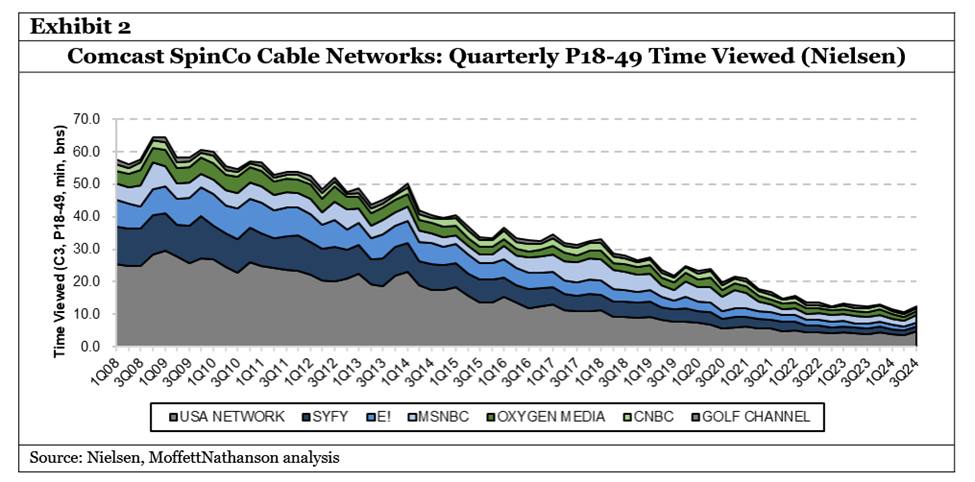
Another trade publication, TV Newscheck, linked to a story in Policyband highlighting some Nielsen data compiled by the research firm MoffettNathanson. If you missed it, Comcast has bundled most of their cable networks into a separate company (temporarily called SpinCo) keeping only Bravo in the Comcast fold. Here’s the relevant chart:
If you’re not used to TV data, this is based on persons 18-49 (more prevalent in video than the P25-54 we typically use in radio) and covers the billions of minutes of viewing to the cable networks that are being spun off. Craig Moffett’s comment on the chart involved the use of the word “catastrophic”. Yes, the chart goes back to 2008, but as someone with a bit of experience with Nielsen data, I don’t think I could find ratings data that would show this kind of decline for any one company in our business.
Brad Adgate in Forbes noted that the high-water mark for cable penetration was in May 2011, when Nielsen said 90.7% of all US households subscribed. The most recent number was 55.3%, but “traditional cable” (not including “virtual cable” companies or vMPVDs) was below 40%. Combining 2022 and 2023, almost ten million US households cancelled their cable subscriptions. Per Nielsen’s latest Gauge report (October 2024), just 26.3% of all viewing time for persons 2+ was spent with cable. By contrast, streaming was up to 40.5%, broadcast was 24.0%, and “other” was 9.2%.
If cable networks have lousy national reach with the possible exception of live sports, what about streaming? Ad Age’s Jack Neff wrote an interesting article last week entitled “Why People See the Same Ads So Often-Behind the Ad Industry’s Murky Secret”. The article is behind a paywall, but if you can get to it, the story makes for some enlightening reading.
Like many of you, I watch a reasonable amount of streaming. As a hockey fan, watching an entire game on ESPN+ ensures GEICO, Progressive, and a few other advertisers that they’ll get about a ten frequency with me. That’s for one game. Another streamer had us targeted for ads for HIV treatments.
Let’s put this all together. If we take out live sports, cable network viewing is down drastically to the point that one cable executive, I mean creative executive, suggested that the word “cable” is toxic. Meanwhile, advertisers are paying for crazy frequencies when their ads run on ad-supported streaming platforms. Yet the advertising dollars keep flowing to these platforms when radio, despite our audience decline, offers a far better ad environment at lower cost.
To someone who has been around for a while, it seems like nothing ever changes. In my younger days, we complained about local ad dollars going heavily into newspapers when circulation was declining. Then it was the glitz of broadcast television while local cable was offering “TV at radio prices”. Now, streamers run ridiculous frequencies for advertisers which may turn consumers against them. I wish I had some brilliant idea to offer that would change things. Maybe you do…
Barrett Media produces daily content on the music, news, and sports media industries. To stay updated, sign up for our newsletters and get the latest information delivered straight to your inbox.
Mike Stern is a music radio consultant specializing in Alternative and Active Rock for the Detroit-based Jacobs Media.
Stern is a former VP of programming for Emmis Chicago. He has overseen stations in Chicago, Detroit, Denver, Las Vegas, Milwaukee, and Dayton.
He is a former editor for the late Radio & Records and Billboard.
He consulted for Arbitron, where he helped launch the twice-weekly column “Not Your Quarter Hour.”
He is this week’s featured consultant.
Jeff Lynn: What is the current state of Alternative radio?
Mike Stern: The format is in a much better state than it was just twenty-four months ago.
For the most part, Alternative stations have stopped chasing after one-off TikTok artists and gone back to what the format is best at: finding and exposing talented new musicians who will (ideally) have long careers.
At the same time stations have done a better job embracing their heritage and understanding the value of core artists from the 90s and 2000s that the majority of their audience still love and want to hear.
JL: How is the current cycle of Alternative music?
MS: Assuming you are asking about new music, at the moment, it’s dreadful. The irony is, if you’d have asked me 120 days ago, I would have said it was amazing. The third quarter yielded a nice group of songs that cut through and researched well with the audience.
But then, just when things were going well, we hit the fourth quarter, and everything dried up. There have been a few bright spots, but stations are mostly still riding songs that should be in recurrent by now while hoping the new year will bring a fresh crop of great new music.
JL: What percentage of current vs. gold makes a good mix?
MS: There simply is not a one-size-fits-all answer for this.
I work with stations that are all over the spectrum when it comes to how much new music they expose. Some of the variables that impact this decision include how much heritage the format has in the market, the competition, what role the station plays in its cluster, the age and ethnic composition of the market, diary or PPM, and much more.
Having said all that, one thing stations could be better at is adjusting based on the product flow. With contemporary music being weaker right now, it would be smarter to cut back on how much they are playing. If stations are playing weaker songs just to fill slots on a playlist, it’s time to adjust and play more gold titles.
JL: And as far as gold is concerned, how far back is it too far?
MS: This answer is very much like the last one. There isn’t a simple formula. Some stations have gone back to the first wave of 80s Alternative music and are having remarkable success. Other stations are more contemporary, and going back that far feels out of place. Generally speaking, though, the format starts with Nirvana.
JL: Does the Alternative audience rely on radio for music discovery, and if so, can you be too unfamiliar vs. playing the hits?
MS: Unfortunately, the audience doesn’t rely on the radio for new music discovery as much as they used to. But that doesn’t mean the station can’t play a role in helping new artists grow their careers. There is still a sweet spot when an artist has begun to grow their following but hasn’t quite broken through to the mainstream where radio can still be a difference maker.
And yes, with that comes the risk of being too unfamiliar by not playing enough hits. That has always been part of the challenge for Alternative programmers. Getting that balance right remains a crucial component of a successful station.
JL: How important is talent to the overall product?
MS: You won’t find a bigger champion for talent than me. The difference a good talent can make in how a station is embraced by the audience cannot be understated.
JL: What is the perceived barrier of entry to advertisers and Alternative radio, and how do you overcome it?
MS: Not being a seller, I may not be the right person to answer this, but I believe the barriers to entry for advertisers at Alternative are easier to overcome today for two reasons.
First, the core gold artists are so much more mainstream. While the Red Hot Chili Peppers and Green Day were once underground acts, today, they fill stadiums.
Second, the listeners have grown up. Alternative stations now attract an older crowd than they used to. The core listeners have careers and children. There are minivans involved!
JL: Are there regional differences in what works in Alternative music?
MS: There are. The format has always been stronger out west than on the east coast. The Midwest tends to be more rock-focused. But I would still say the biggest differences revolve around whether the format was represented in an individual market and during what years. Certain “sure-fire” hits might not have been exposed as much in a city that went without an Alternative station for a period. That difference can really impact a station today.
JL: What advice can you give to talent outside the morning show to perform at a high level?
MS: I don’t believe there is a lot of difference between advice for morning hosts and advice for talent outside of mornings. How they present the material is different, but the concepts are the same:
Be a real person on air. Have feelings, opinions, hopes, dreams, and fears just like your listeners.
Don’t pay lip service to being local. Be a part of your community. Find a way to contribute to your city.
Entertain every time you open the mic. Don’t phone in breaks. We know from PPM that the average time a listener spends with your station is short. Take every opportunity to make an impact.
JL: What is the best career advice you were ever given?
MS: These are more about programming than managing a career, but there are three things I always try to remember and have tried to share over the years:
Be brilliant at the basics. Get your fundamentals right. – Steve Goldstein
When in doubt, ask the audience. Do as much research as you can. – Fred Jacobs.
Be the loudest, most attention-getting station in the market. – Andy Bloom.
30300 Telegraph Road Suite 240 Bingham Farms, MI 48025
248.353.9030 Phone
Barrett Media produces daily content on the music, news, and sports media industries. To stay updated, sign up for our newsletters and get the latest information delivered straight to your inbox.
When Mina Kimes received the call about participating in a new animated NFL telecast themed around The Simpsons, it represented several different passions in one, distinctive venture. Kimes, who has been an avid fan of the sitcom for many years, has thrived as an NFL analyst with ESPN and signed a new multi-year agreement to remain with the company last year. A framed photo of Lisa Simpson is on display within the backdrop of her studio setup, recognizing the individual she regards as a hero who she feels embodies her own characteristics the most.
Even before she was offered a role as an analyst for the presentation, Kimes frequently made references to The Simpsons within her content, conveying an inextricable kinship with an award-winning television staple. The animated comedy is in the midst of its 36th season and has produced 776 episodes throughout that time, entertaining audiences through modern satire and epochal hyperbole.
“When you watch the game, if you’re a fan of the show, you’re going to be rewarded in so many ways, not just with how unusual and fun it is, but with all of the references,” Kimes said, “and I think being able to draw on so many seasons, so many characters, so many quotable lines, is what’s going to make this thing really sing.”
Consumers will be able to view this animated presentation of the Monday Night Football matchup between the Cincinnati Bengals and Dallas Cowboys utilizing the ESPN+ or Disney+ streaming services. The alignment of dissemination verticals aligns with ESPN’s strategy of audience expansion as traditional media companies evolve and look to thrive amid altered equivalencies and new stakeholders, such as technology firms and social media outlets.
In addition to The Simpsons Funday Football production, the traditional broadcast of the game will air on ESPN and ABC. Disney is simulcasting Monday Night Football on the over-the-air broadcast network for the remainder of the regular season, and this feed will also be available on ESPN+. The streaming service and ESPN2 will present Monday Night Football with Peyton and Eli as the alternate broadcast continues its fourth season. Kimes is focused on executing her role within this multiplatform accumulation of telecasts, which has involved varied means of preliminary tasks.
“I have spent more time with these teams – I would watch them anyways despite sort of where their seasons are trending – but I’ve spent extra time studying the rosters [and] some of their tendencies just knowing that this game was around the corner,” Kimes said. “And then as far as The Simpsons-related prep, again, it’s kind of going back and reading up on some of the characters and their catchphrases and watching some of the clips and here and there just so that I kind of feel immersed enough in Simpsons world to actually call the game like I live there.”
Kimes will call The Simpsons broadcast alongside analyst Dan Orlovsky and play-by-play announcer Drew Carter. Whereas Kimes and Orlovsky star on NFL Live and were friends before starting at ESPN, she and Carter have not had a chance to collaborate at the company. Carter looks forward to exhibiting the rapport he has established with his colleagues as they bring commentary to a game rife with external elements.
“A lot of it, especially when you’re in a three-man booth, is saying what you need to say and then getting out of the way,” Carter explained. “We’ve had a lot of conversations about how we’re going to handle a three-man booth when it’s not traditional and you can’t glance at the other person or tap them on the shoulder because we’re not going to be right next to each other.”
Disney+ integrated an ESPN+ tile into its app last week, rendering a streamlined viewing experience that blends different subsections of the company. Curating the selection amid the user interface allows for the company to aim in diminishing purported divergences as it gears towards building out its direct-to-consumer products. This includes the expected launch of the ESPN Flagship direct-to-consumer product next fall.
“I think just everybody’s watching it for different reasons,” Kimes said. “There are diehard fans of the team, there are people who nerd out on football stuff and then there’s folks who want to be entertained, and hopefully our game will bring all of those things, but I think that unique flavor is something that could make this extra entertaining, especially for fans of the show.”
When Disney approached the NFL with the idea for alternate broadcasts, the league was supportive and viewed it as an opportunity to leverage a global franchise and expand awareness and viewers of football. The undertaking has been approximately one year in the making, and the league is excited to take part in the journey of this experience featuring two exhilarating football teams. Although the league considers itself fortunate to have best-in-class partners producing games that average 18.1 million viewers per matchup, it views digital media as an area of growth.
“Disney+ is a robust area with the millions and millions of subscribers they have,” said Hans Schroeder, executive vice president and chief operating officer of NFL Media. “To bring an NFL experience into that environment that’s new and different is incredibly exciting. To go into borders and across borders in a different way, to go into time zones and to time periods that we don’t typically offer our content in. All of those are, for us, tremendous opportunities to engage, to learn, and hopefully for our fans to give them new experiences that will inform what we do going forward.”
.@danorlovsky7 and @minakimes will be on the broadcast for the Simpsons alternative broadcast for Bengals-Cowboys on Monday Night Football 🤩
Having access to a wide array of intellectual property enables properties within Disney business units to work in tandem and catalyze unparalleled projects. Carter has been synonymous with several of these efforts, including the two iterations of the Big City Greens Classic. In Week 4 of the NFL season last year, Carter called the first animated NFL telecast in the history of the company centered around the Toy Story franchise. The presentation faced difficulties early on related to a faulty chip within a football, but things smoothed over once the football was taken out of rotation.
“This is like putting together a live broadcast on steroids,” Carter articulated. “You’re taking all of the technical challenges and potential pitfalls and multiplying it by a thousand, so hopefully it goes off without a hitch.”
The animated broadcast will follow a storyline that aligns with the format of typical episodes of The Simpsons. In fact, those associated with the show have created custom scenes and elements to be used throughout the presentation. Carter, Kimes and Orlovsky will be interviewing many of The Simpsons characters during the game that will add to the viewing experience. Kimes is cognizant of the fact that due to the profusion of ancillary content, there may not be as much time for the incisive, penetrating commentary she delivers on other platforms.
“Folks aren’t watching for detailed Xs and Os breakdowns of every single play, but you’re watching this [thinking] you want to be entertained, but you also want to follow the game,” Kimes delineated, “and I think in moments where there are big plays or big decisions, choosing the moments wisely as ones where Dan and I can just be analysts and do analysis, while also, in other sports, laying out for all of the incredible Simpsons-related content.”
The broadcast will operate on a slight delay, allowing for the production team to replace NFL players with characters from the show so they can make signature plays, fully leaning into the milieu associated with The Simpsons universe. Even though select members of the crew will know the sequence of plays slightly ahead of time, Carter professed that he will vaguely be informed by a producer that something big is forthcoming.
“You want to walk that line where our reaction has to be organic like we are calling a regular game,” Carter said. “Like Joe Buck has no idea what’s going to happen on any given snap, so you have to be ready, but also being ready in the sense that if we want to put one of these characters in the game or we want to roll in an element, knowing that we’ll be able to do that in a way that maximizes all the hard work that people have put into it.”
WOO-HOO! The Simpsons are ready for Funday Football 🍩
Ahead of Monday night’s broadcast, Carter divulged that Kimes may introduce herself to viewers akin to The Simpsons character Troy McClure, specifying locations from where they may know her. There has been a proliferation in ESPN personalities taking on projects through partnerships or licensing deals with the company in recent years, working in tandem to generate new offerings and elevate their personal brands. In the end, Kimes believes that her involvement with various media properties can foster augmented levels of awareness towards this animated enterprise.
“My hope is that people who tune into this game, some of them recognize us from NFL Live, or maybe people who listen to my podcast or watch it on ESPN2 are inclined to follow me to ESPN+ to watch this game,” Kimes said. “I think that’s the thing about having all of these shows on different platforms is we are sort of the common thread between them, and the hope is that familiarity will maybe drive interest or reward people who have been longtime listeners and viewers.”
Prior to being asked to participate in this presentation, Carter had never seen an episode of The Simpsons. As a result, part of his preparation for the show has been watching episodes within the series, learning the characters, salient eccentricities and taglines. Carter envisions the show leaning on Kimes’ passion and knowledge for The Simpsons, but he has enjoyed different aspects of the comedy amid constructing the groundwork of his foundational proficiency in this sector.
“I’m crushing tape, but instead of football, I’m watching a TV show,” Carter emphasized. “It’s the most fun I’ve ever had prepping for a game.”
Whereas the Toy Story broadcast last season utilized motion capture suits for the commentators, the team will be wearing Meta Quest Pro headsets this year and experiencing the game from Springfield. The technology permits customization of the surroundings for the broadcasters to enable the ease of following the game, but there are challenges associated with the added immersion into this environment. For example, even though the broadcasters will all be calling the game from the Bristol studios, they will not be able to nonverbally communicate and pick up cues.
“The good thing about calling football games is I play fantasy football, so pretty much everyone who catches a pass or runs the ball, I’ll know who they are and not have to look down,” Carter said. “It’s just the only time it becomes difficult is when I want to reference a stat or something that I have in my notes in front of me, and I have to take the headset off to do that, so it takes some time getting used to for sure.”
In addition to this broadcast airing during prime time, the show is also expected to appeal to a broader demographic. Even though Carter has not been in meetings with research and analytics professionals, he views the average viewer as either a fan of the animated comedy or those who are curious about the presentation. Kimes reminisced on watching Toy Story Funday Football and remembered several explainer segments that broke down aspects of football in simple terms for younger audiences to understand.
“I think my intention is to do this with all ages in mind, but it’s definitely not going to be geared towards kids in the same way,” Kimes said. “Probably, however, if there’s a difference between this and a normal game, other than all the many very obvious differences, it’s just kind of leaning into the casualness and the fun of it.”
This Christmas, we’re fulfilling Mickey’s one wish 💫
The Disney Dunk the Halls broadcast of Spurs-Knicks streams live on Christmas Day on ESPN2, ESPN+ and Disney+ 🏀 pic.twitter.com/zPLHxMrSps
Later in the month, Carter is going to be calling the first real-time animated NBA game on ESPN platforms, a Christmas Day matchup between the San Antonio Spurs and New York Knicks taking place at Madison Square Garden. Carter, along with ESPN NBA analyst Monica McNutt, will utilize the virtual reality headsets to call the game from Main Street, USA featuring iconic Disney characters including Mickey and Minnie Mouse. The presentation will air at 12 p.m. EST on ESPN2, Disney+ and ESPN+, accompanying the traditional broadcast and commencing the five-game NBA slate.
“I think those characters are more geared towards a younger audience, so that part of it is different,” Carter said. “But I think The Simpsons is actually easier to prepare for, I think, because it’s just one show, whereas the Disney telecast, it’s pulling from a variety of different properties. So, it will be different, but to be honest with you, I’m kind of taking it one game at a time.”
Throughout his career in sports media, Carter has pondered over the value of his profession on numerous occasions. While doctors, teachers and lawyers all have direct impacts on their clientele, he avers that it is tougher to evince the residual effects as a broadcaster. After the first animated broadcast of NHL Big City Greens, Carter received messages on social media about how the project inspired viewers to become more invested in hockey, effectuating awareness, consumption and retention. Discerning the inherent value of the Disney portfolio, ESPN and its partners have shifted the paradigmatic means of presentation and remain committed to enriching the viewing experience with a creative verve premised on innovation towards a new frontier.
“That’s the mission statement – it’s ‘Serving sports fans’ – so for us, we want to give people a different way to consume their favorite product, whether that’s The Simpsons or football, or preferably if people like both, this is a beautiful marriage of those two things and a chance for them to watch that in a way that they’ve never seen it before. In a way, it’s like a three-hour Simpsons movie, so if you love the show, then you’re going to love the game, and if you love football, you want to see it presented in a different way.”
Barrett Media produces daily content on the music, news, and sports media industries. To stay updated, sign up for our newsletters and get the latest information delivered straight to your inbox.
There are veteran sports talk radio hosts and then there’s Sports Radio 93.3 KJR in Seattle’s Dave ‘Softy’ Mahler and Dick Fain. The duo hosts the afternoon drive show on the station, Softy and Dick, and have done so since 2018. The two KJR institutions have been with the station, however, since the late 90’s, and had worked together prior to partnering up in afternoons.
While I was very aware of their show, having seen it listed for many years in the BSM Top 20 Major Market Local Sports Radio Afternoon Shows lists, I had never heard more than a small portion of it, so, I was excited to tune in and eavesdrop in on the Friday Dec. 6th edition of the show.
At first, it was hard for me as an ‘outsider’ to tell who was who, as both hosts sound somewhat similar when they’re talking in a passionate manner. And let me tell you, they talk that way a lot. A whole lot.
In fact, of all the shows I have listened to for this weekly feature, this show stands out as the one that sounds the most like real fans of the local teams are hosting. I don’t mean they are always a fan of what is happening, rather they talk about sports in a way that is less like your standard sports talk host and more like you would hear in a group setting with a bunch of guys kicking around the sports topics of the day.
Where the two hosts separate is Fain has some lower gears. Softy, not so much. If he is speaking, he is generally doing so at a high volume and the point he is making will be a passionate one. It’s what makes him who he is and one of the reasons he has succeeded for so long in the market.
A Seattle Time article from 2016 described him this way: “Softy is beloved for his passion. He rants, raves, cries and shouts depending on how his teams — your teams — are doing. Fans relate to him because he cares as much as they do. Sometimes that’s the problem. Among his critics, he can cross the line with personal attacks or rash reactions. Washington State and Oregon fans loathe him, and he gleefully antagonizes them.”
Let’s be honest, every market needs someone in sports talk media who fits that description. Seattle has Dave ‘Softy’ Mahler.
On this ‘Football Friday’ the guys were forced to get their takes in quickly. The station is home to the Seattle Kraken broadcasts and with the team on an east coast road trip, pregame was starting only 90 minutes into what is normally a four-hour show.
The hosts wasted no time getting right into football talk as they pointed out that there are differing opinions at the radio station around why the Seattle Seahawks offense is as bad as it is. The hosts pointed it is most likely a “system failure, with a lot of people to blame, so it isn’t hard to see why people can’t agree on which is the biggest area to blame.”
As Fain gave his opinion, he mentioned something called D.V.O.A. – which stands for Defense-adjusted Value Over Average. He mentioned the team is last in the league in Offensive D.V.O.A. When he did, Mahler cut him off before he got too far. “We have a habit sometimes in this business of throwing stuff out there like that and assuming everyone knows what the hell we are talking about,” Softy said. “So, what the hell does D.V.O.A. even mean for the average schmuck out there, meaning me?”
Fain explained that it measures a team’s efficiency by comparing success on every single play to a league average based on situation and opponent. After talking through it, Softy deduced it is similar to a handicap in golf.
Next up, the veteran hosts did a very veteran move by recalling audio clips from The Ian Furness Show, which airs prior to them. Furness had gotten a couple of educated opinions on the Seahawks offense, both of which mentioned the team’s Offensive Coordinator Ryan Grubb who is in his first season with the Seahawks and first season in the NFL after a successful run as a college coach.
The hosts went back and forth on different reasonings for the offensive struggles and covered the entire topic about as in-depth as possible. They even got into the nitty-gritty of whether or not the offensive line struggles more with run blocking or pass blocking and the hosts showed in that part of the conversation they can disagree a bit and talk through it, so it provides both entertainment and value for the listener, with differing opinions.
The hosts brought in producer Jackson Felts as a third voice and had him give his take on the Seahawks and how they can continue to lose games despite having one of the league’s best defenses.
While virtually no part of the Seattle offense went unscathed in the conversation, it was clear the one place everyone agreed on was the offensive line. Softy added in summation, “We are [usually] tasked here every day with filling four hours of radio and going on the air and saying for four hours ‘the offensive line sucks, the offensive line sucks, the offensive line sucks,’ over and over again is not going to do anybody any good.
“But if we weren’t doing this for a living, and all three of us were just sitting in a bar talking about the Seahawks, having a drink, we would say ‘the offensive line sucks, let’s talk basketball.’ It’d take two seconds for this conversation to be over and we would move on.”
Later, I learned it doesn’t always have to be a topic about local sports that can fire these guys up. As they talked about Bill Belichick interviewing for the head coaching positing at the University of North Carolina and the story being reported that he had asked for his son Stephen to be named head-coach-in-waiting as a condition if he accepted the job, they had the same amount of oomph behind their thoughts.
As the guys pointed out, college football has never been run more like the pros than it is now, so perhaps it is a better fit than anyone would think at first. They talked about whether or not Belichick’s interest in the job is more about the future position for his son or if it could be he doesn’t think he would be able to secure one of the open NFL jobs this offseason.
A partnership with a local casino had the hosts playing ‘Fact or Fiction’ with the audience where they chose the Carolina Panthers, getting 12.5 points against the Philadelphia Eagles as their play of the week. The challenge was to guess if that play would hit and be a fact or miss and be fiction. (Turned out to very much be a fact!). The promotion netted someone a weekly $1,000 prize and a chance at an overall $10,000 grand prize.
That segment of the show was followed up by handicapper Lee Sterling joining the show and giving some of his picks for the week from both college and pro football. They ended the segment with the Seahawks, who were 2.5-point underdogs at the Arizona Cardinals, despite the team having a 9-1-1 record in their last 11 games at State Farm Stadium.
Sterling provided some excellent foresight as he said the Cardinals would be treating the game as a ‘must-win’ for playoff positioning, and historically the team has failed in those types of games. He took the Seahawks and nailed the pick as they won the game outright, 30-18.
Before the show wrapped, the hosts welcomed former NFL quarterback and current football analyst Hugh Millen on. The only negative part of the interview was they eventually ran out of time needing to hit the Kraken pre-game show on time. Millen was hot from the get-go when he was asked about some of the opinions which had been given on the station that day as it related to the Seahawks and, more specifically, the job being done by Grubb. He explained he watches a lot of tape and does in-depth reviews of the Seahawks offense to form his opinion of how the rookie Offensive Coordinator is doing.
“I have to take every ounce of knowledge I have acquired over 50 years to determine what the problem is,” Millen said. “I’m not listening to ‘Wally Website’ who throws out an opinion.” Millen said he only likes to hear the opinion of someone who could draw up football plays on a board and explain them in detail.
“If they can’t give me something that impresses me, I’m not listening,” he added. “Some guy who has an agenda because he loves the quarterback, now he is going to rip on the offensive coordinator, because it fills his narrative about how he loves the quarterback. I’ll pass on that analysis.”
Millen emphatically said about the job of being an offensive coordinator, “I think it’s damn hard.” He added, referring to analyzing the role a coordinator plays in the success or failure of a team, “It’s the hardest thing I do as an analyst.”
Softy Mahler and Dick Fain were cut short on this Friday and when the show finished, they had a lot more to give. They’ll have to hold the rest until after the weekend, although you get the feeling they’ll still be talking sports and giving their opinions of what is happening in local and national sports. That’s who they are and that is exactly what Seattle sports fans have come to expect in afternoon drive each weekday on KJR.
NBC Sports called on female Chiefs fan–no not that Chiefs fan–to help open Sunday Night Football this week.
Heidi Gardner of Saturday Night Live appears (after Carrie Underwood’s Waiting All Day for Saturday Night) to explain why rooting for Kansas City is so much fun.
Being a Chiefs fan can be “entirely unpredictable . . . or completely foreseeable. Unbelievably spectacular . . . or just the same thing over and over again,” Garnder says.
“I’m talking about winning,” she says. ““Maybe everyone else gets tired of us. But then, do something about it.”
Life as a Chiefs fan is pretty great… just ask Saturday Night Live's Heidi Gardner. pic.twitter.com/Yv8DhgalCK
Gardner also throws a little shade on the Chiefs’ opponent, the San Diego Chargers, talking about weird things coach Jim Harbaugh and quarterback Justin Herbert have done.
SNF is usually the highest rated primetime program on TV and NBC has been dressing it up by using big names to tease the upcoming matchup. Among those appearing so far this season are Celine Dion, Samuel L. Jackson and Michael Keaton.
Barrett Media produces daily content on the music, news, and sports media industries. To stay updated, sign up for our newsletters and get the latest information delivered straight to your inbox.
As the sweepstakes to sign free agent outfielder Juan Soto continue, rumors are percolating around the baseball world concerning the 26-year-old free agent. With fans looking for the latest information from insiders, various sports radio stations have had writers on to discussion the situation. Jon Heyman, insider for MLB Network and columnist at the New York Post, came onto the program to discuss the latest information surrounding Soto and the rest of Major League Baseball free agency.
Keith McPherson, who started hosting at WFAN approximately three years ago, asked Heyman about the situation, but he also ostensibly questioned his credibility as a journalist. McPherson cited Heyman’s reporting surrounding the free agency of Yankees outfielder Aaron Judge in 2022, specifically citing when he tweeted that he appeared headed to the San Francisco Giants. In the post, Heyman misspelled Judge’s first name, writing ‘Arson’ instead of ‘Aaron,’ which continues to be referenced by social media users. Moreover, McPherson insinuated that Heyman is being paid by Scott Boras, the agent for Soto, to report certain information. In fact, he asked how much money from the Soto deal Heyman would get for breaking the story.
“Unfortunately, I get no money for anything,” Heyman said. “I have no financial stake.”
McPherson explained that Heyman probably would not break the Soto news since Boras is based on the West Coast, causing a three-hour time difference. In reply, Heyman explained that there is a lot of competition for the stories and that it is unknown where you can get them. Furthermore, Heyman explained that he is not represented by an agent and that those who are may have certain advantages.
McPherson elucidated that it would be good for Heyman to break the news regarding Soto in order to put the aforementioned Judge tweet in the proverbial rear-view mirror. This led him to question the difference between what Soto could potentially receive compared to the reported nine-year, $360 million deal that Judge received as a free agent.
“By the way, I don’t need to break this story,” Heyman said later in the interview. “I’ve broken a lot of stories. I think the reason that got such play is because people believe everything I tweet. I have 100,000 tweets, and you get one that was wrong – and it did say ‘appears’ – and I know I rushed it and it was a big mistake and I regret it, but two years later, at some point I think someone could probably drop it if they’re a nice person.”
Upon making this point, McPherson mentioned the way he introduced Heyman, stating that everyone in baseball knows who he is and respects his work. Heyman cut him off, seemingly taking umbrage towards what McPherson had stated amid the interview, and said that he would not be going on the radio with him again. In addition, he conveyed that the entire segment had been a disaster, prompting McPherson to laugh and say that it was okay. Heyman seemed nonplussed that McPherson would question his integrity, specifying when he asked if he was getting a portion of the contract just because he has a relationship with an agent.
“I know you’re not a journalist – you don’t know anything about this. I know you get it – you don’t – but that’s an outrageous comment. You should know that much – you should know that much, and I’m done with you, and I’m done with WFAN. Goodbye. I can’t even believe it. I can’t even believe it!”
As the segment ended, McPherson articulated that Heyman needed to get to bed and that he did not expect the interview to go that way. From there, he expounded on his perspective about the exchange and how some of his comments were in jest.
“I think if you heard my tone and the way that I am completely joking and kidding and having a lighter conversation, something that I spoke recently about too, with all of this Juan Soto genre is like we need some comic relief, man,” McPherson said. “I introduced you and gave credit to how everybody follows your words and your tweets and what you do, and if you felt some type of way about it, and even like you said you regret it, I said, ‘No regrets.’”
McPherson apologized to Heyman if the remark came off as being flippant, understanding that it may have been a sore spot after two years. Additionally, he assumed that Heyman may have something better to do regarding Soto’s free agency and was surprised that the interview went 10 minutes.
“If you were listening to my show earlier, I said some of those things,” McPherson explained. “I’m very lighthearted, I’m not a journalist, I’m not trying to be a reporter. I’m a radio host and a fan, and this is all fun and entertainment, and I’m sorry if you’re offended and you weren’t having fun on my show.”
Barrett Media produces daily content on the music, news, and sports media industries. To stay updated, sign up for our newsletters and get the latest information delivered straight to your inbox.
Longtime Houston morning co-host Shara Fryer has been missing from the show on 740 KTRH. Her co-host, Jimmy Barrett, has confirmed she was part of cuts from iHeartMedia.
Earlier this week, Barrett confirmed that Fryer had exited as iHeartMedia made nationwide cuts last month that affected hundreds of staffers from the radio giant.
“Everybody’s been asking, ‘Where’s Shara Fryer? Where’s Shara? What’s going on?’ And you deserve to know Shara is no longer with our KTRH morning show, with Houston’s Morning News,” Barrett said.
“We are in a business … a media business that is constantly changing, and with that comes staffing changes,” he continued. “Consolidation leads to changes. And when the changes happen, then positions come and positions go… So with this reorganization, Shara is no longer with our morning show.”
Fryer had been with 740 KTRH for 12 years before exiting during the cuts. She was previously teamed with Matt Patrick in the daypart. She joined the station after a distinguished 25-year career in local television, with stops in Houston, Austin and San Antonio, among others.
Shara Fryer was one of several members of the iHeartMedia Houston cluster to be laid off as the company cut 5% of its workforce. She had yet to comment publicly on her departure before Jimmy Barrett made mention of it this week.
Barrett Media produces daily content on the music, news, and sports media industries. To stay updated, sign up for our newsletters and get the latest information delivered straight to your inbox.
Earlier in the week, there were several reports pertaining to the future of Stephen A. Smith working at ESPN ahead of the expiration of his contract in July 2025. The two sides are in negotiations on a six-year deal worth $20 million annually, marking the largest yearly amount ever paid to an ESPN on-air personality outside of a licensing deal. Reports have also indicated that Smith’s contract would be paid from a variety of entities aside from ESPN, including Disney Entertainment and ESPN BET. Smith currently serves as the executive producer and featured commentator on First Take and as an analyst for the NBA Countdown studio program.
Warner Bros. Discovery recently agreed to a deal through which it will sublicenseInside the NBA to The Walt Disney Company, which plans to utilize the show surrounding marquee basketball events. The award-winning combination of Ernie Johnson, Charles Barkley, Shaquille O’Neal and Kenny “The Jet” Smith has proven to resonate with viewers over the years, and the show will continue despite TNT Sports no longer presenting live NBA game broadcasts in the United States. Disney is set to begin a new 11-year media rights deal with the league for a reported $2.62 billion per year commencing next season.
While NBA Countdown is expected to continue for events in which Inside the NBA is not on the air, former ESPN president John Skipper does not foresee Smith being restricted to the one show. Skipper, who is the co-founder and chief executive officer of Meadowlark Media, recently appeared on The Sporting Class alongside David Samson and Pablo Torre where they discussed the settlement between Warner Bros. Discovery and the National Basketball Association, along with its subsequent effects. Samson, the former president of the Miami Marlins, stated that NBA Countdown was becoming “a B-level team studio show” for pregame and postgame coverage.
“They certainly will not want to call it that, and they probably have to account for my friend Stephen A. Smith, who really cares about the NBA and is not going to want to just be in the shadow of these other guys,” Skipper said. “I think you’ll see him on Inside the NBA at some point.”
Samson elucidated that the only way for ESPN to pay Smith $20 million per year is by spreading it across different areas of The Walt Disney Company. Within his discourse, he explained that different departments under chief executive officer Bob Iger could be negotiating what they are going to extract from their budgets. These conversations would presumably allocate how the contract would be paid and, he feels, part of the reason why Smith could become involved in other areas of the media conglomerate.
“It’s true, of course, and ordinarily they feel like they’re ridiculous because there’s no way anybody could do all that,” Samson said of these discussions. “With Stephen A., he is maybe the hardest-working on-air talent – among the hardest-working on-air talents – I ever saw. He would do a radio show in the morning, a talk show in the afternoon…. Stephen works, works and works.”
Reflecting on the hypothetical scenario, Samson conveyed that he finds it funny when companies fight internally. He illustrated Iger having different fiefdoms within his empire that are either competing to take his place or stand out. Yet he emphasized that in the end, the $20 million salary would still be paid by a combination of subsidiaries that are under The Walt Disney Company rather than wholly separate entities themselves. Skipper, however, does not believe that this structure will end up coming to fruition.
“I will actually hazard to guess that all of the salary’s being paid by ESPN and that Stephen A. has the ambition to be doing other things that he wants to do, and that they are reaching out to the other parts of the company to say, ‘Gee, could you take a meeting with Stephen A.? He’s interested in producing a scripted film,’ so my guess would be that they’re not,” Skipper explained. “I don’t ever remember being involved in many instances where we were going looking for money from other divisions.”
Barrett Media produces daily content on the music, news, and sports media industries. To stay updated, sign up for our newsletters and get the latest information delivered straight to your inbox.
Midwest Communications “Froggy 99.9” KVOX-FM Fargo, ND Brand Manager and afternoon host Benjamin ‘Ben Merritt’ Chartier has been arrested and faces a charge of possessing child pornography.
According to KVRR TV Chartier, 40, was apprehended following an investigation that revealed he had been posting videos depicting children involved in sexual acts with other minors, as well as instances of sexual abuse perpetrated by adults.
The North Dakota Bureau of Criminal Investigation initiated an inquiry following the receipt of information from the National Center for Missing and Exploited Children.
The uploaded files included children between 3- and 16-years-old sexually abusing each other.
At least one video showed an adult sexually abusing a 3-year-old girl.
Investigators also found messaging from Chartier to others about a sexual attraction to children.
He is being held in the Cass County jail.
All mentions of Merritt have been removed from the KVOX-FM website, and a report released by the company’s KFGO did not acknowledge his affiliation with the organization.
Barrett Media produces daily content on the music, news, and sports media industries. To stay updated, sign up for our newsletters and get the latest information delivered straight to your inbox.
On Black Friday, Amazon showed it can not only attract an audience with NFL football, but that it has better ways to sell viewers its advertisers products.
Earlier this week, Amazon released Nielsen data that showed that viewing was up 41% for the second edition of Black Friday Football. In addition, the online retailer said that the number of sponsors using interactive and shoppable commercials during the game was up 30% from last year.
With its expertise in on-line retailing, Amazon has data on what viewers buy and the technology to connect them with products they want, giving it an advantage over traditional media companies.
“They own the two critical components, the back end and they own the subscriber on Prime. Combining the two of them is a piece of cake,” said Michael Bologna, chief accelerator at Brightline, a top interactive TV company, as well as a pioneer in addressable advertising.
Amazon said that the customer engagement rate with interactive ads during the Chiefs-Raiders game on Black Friday increased 10% from last year, based on remote control click and scan rates.
In addition, the company said that 40% of the advertisers were new to Black Friday Football and 20% of the brands aired new, unique Black Friday commercials created for the occasion.
EDO, a research and data firm that tracks the effectiveness of ad campaigns, said that the ads that ran during Black Friday Football were 6% more effective than the average ad in an NFL primetime game. At the same time ad on the Amazon football stream were 74% more effective compared to the average ad running in primetime on broadcast and cable.
“This year we had an average audience viewership increase of 41% over last season’s inaugural event, and 30 percent more advertisers adopted interactive ad formats that were seamlessly shoppable for fans. The Black Friday game is changing consumer behaviors for both fans and advertisers as a new sports holiday on one of the biggest shopping days,” said Danielle Carney, Head of Live Sports and Video Sales for Amazon Ads. “Prime Video’s leaned-in audience came ready to engage with our Black Friday advertisers through clicks, scans, and search which resulted in our highest customer engagement on record.”
Advertisers during the Black Friday game this year included Google Pixel, Solo Stove, Mazda, Ralph Lauren Fragrances, Microsoft, and Uber Eats.
Mazda was the presenting sponsor of Black Friday Pre-Kick, while Uber Eats was the presenting sponsor of Black Friday Kickoff
Barrett Media produces daily content on the music, news, and sports media industries. To stay updated, sign up for our newsletters and get the latest information delivered straight to your inbox.