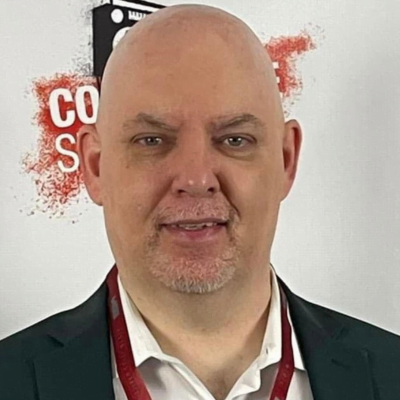
Many times in life we’re presented with opportunities that force us to adjust our thinking and reconsider our original game plan. Nobody knows that better than Brandon Tierney. While he’s built a fantastic career and become one of the lead voices on national sports talk radio today, he didn’t get there without a few trials and tribulations along the way.
 What makes this piece fun for me is that I have personal knowledge of some of those twists and turns due to having had the privilege of managing BT in San Francisco. What’s ironic is how similar our backgrounds are and it’s those similarities which make it easy to see why we were likely to cross paths at some point.
First, we’re both born in Brooklyn with father’s who worked for and are now retired from the NYPD. Secondly, he graduated from Marist College in Poughkeepsie, NY while I was working in radio less than a mile from the University. Third, he left NY to explore a radio career in PA, MI, NV and CA. I did the same moving to CT, PA, MO and CA. Fourth, he’s a diehard Yankees and Knicks fan. Those were my teams as well. The only area where things get muddy is when it comes to football. I was wiser and placed my faith in the NY Giants while BT fell victim to becoming a NY Jets fan. Poor guy.
 Because we shared so much in common, that allowed for a very strong Program Director/On-Air Talent relationship. BT knew when he worked for me that I had his back and was going to do everything I could to support him and get the best out of him and I knew that when push came to shove and I needed strong leadership and execution from one of my prime time guys, he’d be ready to deliver. In my opinion, having that type of connection between PD and Host is vital for a station’s success.
It didn’t matter if the volume in the room got raised or if we disagreed on a subject because the goal for both of us was always the same – to win! Because we shared trust in one another and could be open and honest with our discussions, we were both able to play a huge role in the launch of 95.7 The Game and make it a special place to work at.
 I can still remember two signature moments at the station when BT was with us that are worth sharing. The first was during one of our very first staff meetings when I laid out expectations for the team and gave them a realistic view of where we were and what we were going to need to do to become a legitimate contender in the market. After I explained the importance of everyone pulling in the same direction and winning their own individual battles, BT was the first to step up in front of the group and tell everyone how he wasn’t afraid of the challenge and was ready to take out his cannon and blow a hole in the competition’s building.
Instantly the room erupted with laughter and some of the guys were fired up and BT’s energy, confidence and passion was impossible not to recognize. It told everyone in the room that we were going to have fun, not be intimidated and compete as aggressively as possible.
 BT was also the one to stick me with a nickname that I haven’t been able to shake to this day. When we launched the radio station we did so in an aggressive manner which fit most of our team and was easy for the younger demographic of our audience to relate to. One of the promos took some jabs at our competitor and had a monkey sound effect playing in the background which indicated that the station was being run by a monkey (If you’re a PD and haven’t been called that you haven’t arrived yet). Well BT comes on the air with Eric Davis after the promo fires and proclaims “they’ve got the chimp and we’ve got the pimp“.
I’d show up at a few broadcasts after that and have listeners approach me and ask “Are you the Pimp” and all I could do was laugh. It’s sort of like “The Godfather” nickname given to Luke Wilson in the movie “Old School”. By no means does it fit but it’s funny and people remember it. 3 years later it still hasn’t gone away.
 While I could spend all day recapping our 2-year run in SF, that never would have happened had I not heard Brandon on the air in NY. The first time I heard him, he was on ESPN New York (it was 1050 ESPN at the time). Brandon was doing sports updates during the “Wally & The Keeg” afternoon drive time show and I immediately thought “who the heck is the guy doing a 2-minute talk show in the sports updates“?
He didn’t sound like the typical NY sports update anchor but he came across with a very cool sound and style and he had great passion and energy and I remember thinking “this is a guy to watch for in the future“. I had no idea at this time of his depth as a talk show host or whether or not the station had plans for him, I just remember that he stuck out. Obviously the station did have plans for him because they would end up utilizing him in a number of different roles over his 8+ year stay there.
 While the on-air side of BT is easy to identify, one of the other great qualities about Brandon is how he conducts himself outside the workplace. First, he’s very loyal to his friends and family and anyone who’s been around him knows how much he loves and appreciates his wife Jen.
Second, for all the bravado you hear thru the speakers, he’s also the type of individual who will give a behind the scenes member an “atta boy” when they do a good job or some words of encouragement if they stumble. One of my current on-air personalities at 95.7 The Game (Zakariah) didn’t make the cut during an on-air competition and while he was dejected from being eliminated, BT made time to talk to him and encourage him to not give up. He then sought me out and proceeded to tell me why the guy was worth keeping around. Not every key personality on a radio station is willing to do that, especially for someone who’s unproven.
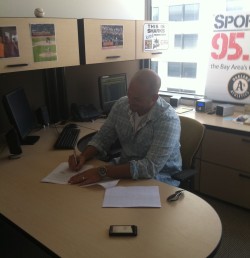
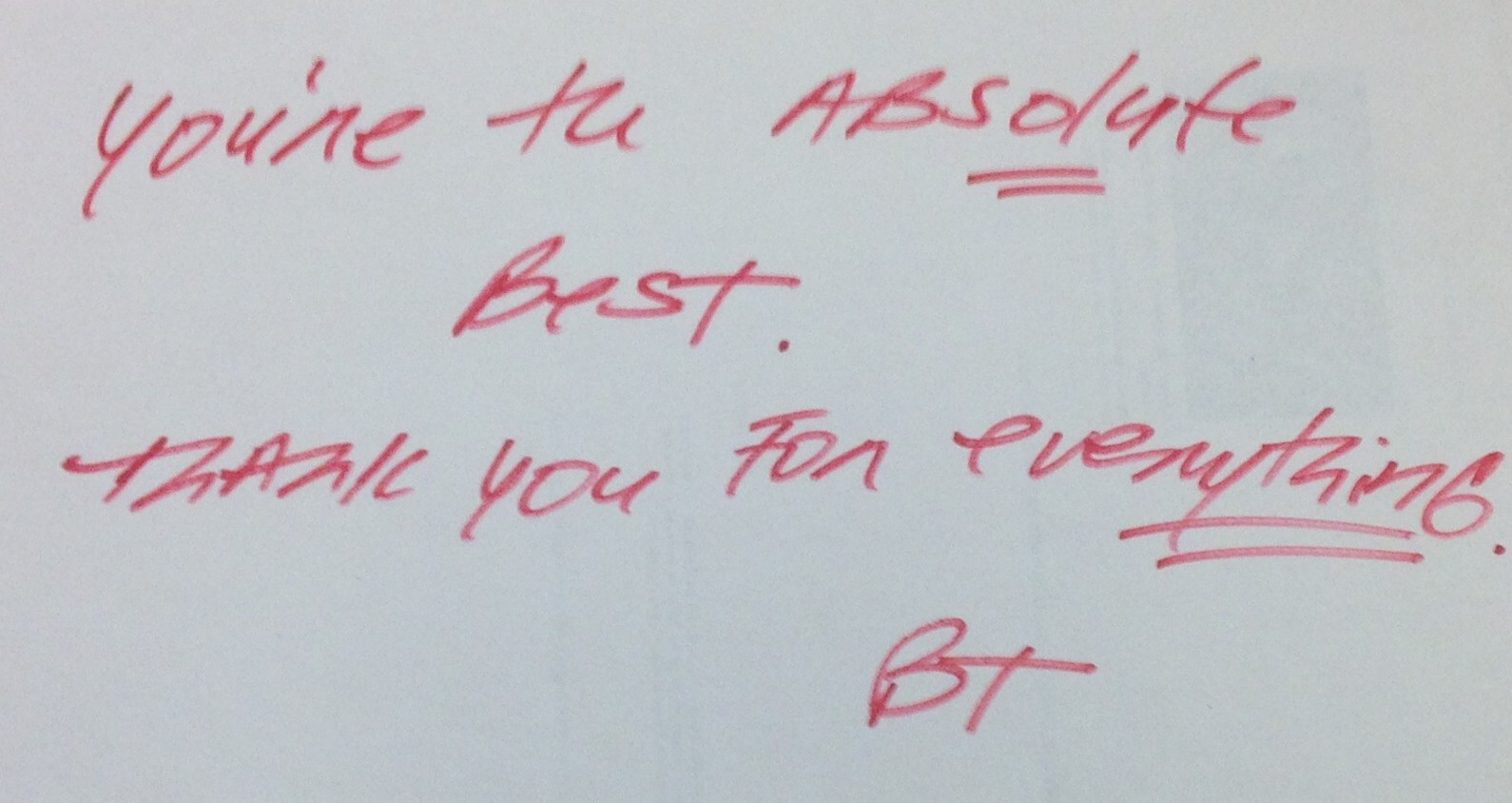 I remember opening my office door on Monday after BT had left for NYC and this note was under it (pic on the left). It reinforced that he appreciated the way I tried to make him better and as a Program Director, that’s my number one goal when working with talent. To have it recognized by the people you invest time is part of what makes the job rewarding.
I caught up with BT recently to have him put into perspective many of the experiences he’s gone thru in the industry because I thought they’d be interesting to those who are looking to reach the same level he’s advanced to. I also wanted to pick his brain on some of the key components to doing a daily talk radio show and as usual, he had plenty to say.
Q: When did you first realize you wanted to pursue a career in sports radio? What triggered it?
 A: I always had a passion for writing and as the medium exploded during my college years, I knew it was a path I would pursue. Truthfully, the foundation was born much, much earlier but I never viewed it as a viable profession until I was 19 or 20. My laboratory was my basement, watching games with my Dad and reading the sports section as early as 7 years old.
After every basketball practice, my Dad and I would hit the diner and debate all of the local teams, what they needed to do in the draft, free agency, etc. I had an early appreciation for the history of sport and he sensed that and always engaged me, quizzed me and explained the different eras to me. Every car ride was in essence, a mock radio show, even though I didn’t know it at the time. Still, growing up, and even early on in college, my focus was directed at playing baseball, not broadcasting.
Q: Prior to entering the industry, which talk show hosts and broadcasters did you listen to and would list as influences on your career?
 A: Options were pretty limited back then. ESPN New York didn’t exist, neither did YES or SNY. It was WFAN all day, every day. If you didn’t like Mike, you better enjoy Dog. If Dog wasn’t your cup of tea, you better like Mike’s style. There was no streaming or apps available either. Whatever your local market served up, you listened to.
I’ve always said that I’ve taken pieces from both: Mike’s attention to detail and ability to recall stats and Dog’s ability to entertain and incite. Of course, I loved Marv Albert’s work with the Knicks but Mark Jackson’s no-look passes and Mattingly’s HR trot were things I emulated, or at least tried to, not Albert’s inflection or overall delivery.
Q: Your first stint in sports radio as a daily talk show host came in Allentown, PA. How did you land the opportunity and what did you learn from that first experience in sports broadcasting?
 A: I was relentless but not having much success breaking into the business. Because I played baseball at Marist, my summers still revolved around baseball, meaning my resume was pretty empty in terms of internships or practical experience. I had a Journalism degree but that was about it. I worked construction for spending money and I always kept my writing skills sharp but quite frankly, outside of having a burning passion for the medium, I wasn’t very appealing to potential employers. I even had a stint at Fidelity working in the IRA Department before finally breaking thru with a post grad internship at Fox 5’s “Good Day New York.”
I was still living at home in Brooklyn and had to be at the studio by 3:30 every morning and I’d listen to Joe Benigno on the way in and really appreciated how raw and real his delivery was. By then, radio was like a drug for me. I remember locating a website with every sports radio and television station in the country and sent my resume, basement demo tape, head shot and cover letter everywhere. Alabama, Alaska, Arkansas, Wyoming, etc.
Most ignored me, while a few sent rejection letters, until finally, a tiny station in Allentown responded and said they were looking for a co-host for their morning show. The station had one sales person, a few desks and a sparse studio but it had a microphone and in my heart I knew it had my name on it. Before entering the office for the interview, I went to the rest room, took one knee, and prayed over the sink, kind of like Rocky did in his corner before hearing the bell. I knew absolutely nothing about the business, the equipment, the FCC…nothing. But I knew I had a lot to say. Everything else I learned on the fly and it was awesome.
Q: From Allentown you moved to Las Vegas for a little bit to work for the Sports Fan Radio Network. That then helped land you in Detroit where you were hired by WDFN. How did the Detroit situation come about and how would you characterize your experience in the motor city?
 A: I’ve always pointed to Detroit as the most pivotal point in my career. Allentown got me in the door, Sports Fan increased my exposure but Detroit was my first true exposure with a rabid and territorial fan base. WDFN was one of our affiliates for Sports Fan and I remember bombarding Gregg Henson with e-mails and phone calls regarding a full-time on-air opening he posted on Rick Scott’s industry site, which I did not get. He liked me but didn’t think I was ready and he was right. I remember sitting in my kitchen in Las Vegas a few months later and Gregg offered me a Sat/Sun shift along with a few other clerical things to make ends meet financially. It was a big risk because it was limited hours with zero benefits but we connected. He told me to trust him and that in a few months he expected a big corporate shakeup but couldn’t divulge any details. Within five days my car was packed and I drove from Nevada to Detroit.
Several months later he called me into his office, closed the door and congratulated me on becoming the new midday host. I was flying solo and that really helped me ease into being myself on-air. A few weeks after I took over middays, he called me into his office and let me have it. He implored me to stay true to my roots and let it rip. That’s definitely when something clicked. His exact words were: “You’re a New Yorker, so you already have one strike against you here, these people bleeping hate you. Bleep them. I hired you because you have balls. Bleep them, and do your thing. The city will eventually embrace you.”
Eventually, I developed a strong rapport with Pistons HC Rick Carlisle and the ice thawed. I worked hard to establish credibility with the fans, players and Pistons front office. I was always at Comerica Park, even though the Tigers were terrible. I treated the Lions with the same passion after a loss the way I treated the Jets. I locked in, worked my ass off, hustled, and began to blossom. I was young, a little crazy, and it just worked.
I also learned about the business side in Detroit and took my first stand with management and eventually walked away from a contract extension because I thought it was way below market value, which it was. I hadn’t yet hired an agent and Clear Channel attempted to leverage my youth against me. I actually cleaned out my desk after a show, went back to my apartment, got drunk and tried to convince myself that I didn’t just destroy my career. A very, very pivotal point for me and something I am very proud of.
Q: Next you got the call to head home to NY to join 1050 ESPN and while at the station you’d climb the ladder and land a spot opposite Stephen A. Smith which immediately put you under the biggest microscope of your career at that time. How was it working with Stephen A. and what were the best/worst parts of the experience?
 A: I’ll never forget our first show together. We were in two different locations: he was in our Manhattan studio and I was on remote on the LIRR platform outside of Shea Stadium for the Mets home opener. We never met before and while he might conveniently forget this, he was a bit dismissive at first and obviously that wasn’t flying on my end. I wouldn’t say that the first segment was contentious but it was certainly uncomfortable, choppy and lacked flow. During the first break, I’m staring into space wondering what the hell I just got myself into and literally the first phone call we take the next segment, the caller welcomes SAS to the station and jokingly but sternly cautioned him to “watch it with BT. He’s sharp, has a lot of fans and will become a big asset to the show.”
That thawed the ice, we both laughed and the next day in studio, we clicked immediately.He was new to radio and I as carving out my turf but I let him know that I had his back and wasn’t looking to mow him down. At the end of the day, he’s from Queens and I’m from Brooklyn, and things flowed naturally.
Stephen A. is incredibly generous, smart and fair, and he is one of the great, unique talents to ever work in our medium. I’ve said it before and I still believe if ESPN had let us vibe and in essence stayed out of our way, we would have owned the city. It was a unique, combustible, energetic and funny show. Years later, a few key management figures acknowledged to me that they made a big mistake breaking us up and micro-managing the show. No regrets, as I am a big believer in everything happening for a reason but when it comes to Stephen A, I will always have his back and he’ll always have mine.
Q: Once that show ended, you were paired with Jody Mac who was a familiar name and voice to NY sports radio listeners. How would you describe that experience and how was it different from working with Stephen?
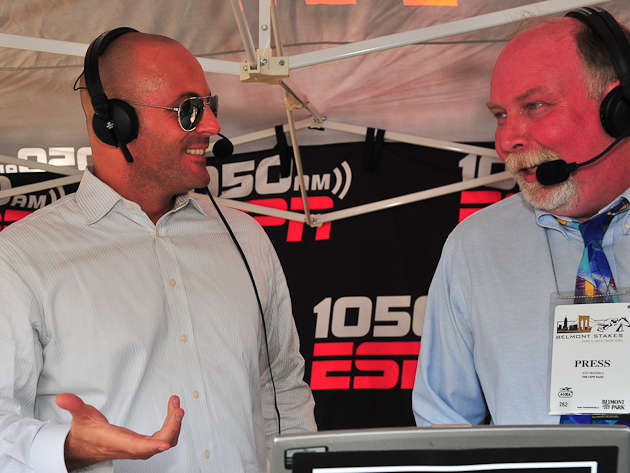 A: Totally a different speed but very, very enjoyable. Jody Mac has a heart of gold and brings his hard hat to work every day. He’s always ready to scrap and knows something about everything. I knew that if I mentioned a key play in the Cardinals game or the Nuggets game from the night before, even though we were local in New York, he was always up to speed. It was a fun blend of Mac’s old school methods and my approach, which can fluctuate between old and new school.
I remember the day I set up Jody’s Twitter account after months of prodding. We let the audience know and it was my goal to get him 1000 followers in one hour and just as we hit the post for a :10 legal ID to end the show, one more cranked in and it hit four digits, and I signed off. Great guy, heart of gold, easy partner.
Q: After nearly 9 years you parted ways with ESPN NY. When you look back on the overall experience with the station, how would you sum it up?
 A: Overall it was very positive and I’m extremely proud of my time with ESPN. The power of the company expanded my platforms and reach and was a key period in my career, opening pivotal doors with TV and Knicks radio broadcasts.
It also introduced me to the corporate structure of the 4 letters, which at times, for talent, is frustrating. Bristol’s idea of radio is very different from what works in New York. New York is loud and at times, uncomfortably loud, which at times, they resisted, particularly with me. It always felt more as a vehicle for TV, rather than a true, conventional radio station.
Q: Following ESPN NY, you moved to San Francisco to help launch 95.7 The Game. How did that situation come about and what made moving to SF appealing to you?
 A: I remember sitting on my couch in Hoboken, weighing a PM drive opportunity when I received a text message from you, urging me to consider the Bay Area before jumping into anything else. I was married less than five months at the time, and my wife and I felt an immediate surge of excitement. The Bay Area was appealing from minute #1: the lifestyle along with the vibrant sports scene pushed it right to the top of the list.
I could tell that you and I shared quite a bit in common too other than being loud and opinionated so once you shared your vision for the station and I visited a few times, I knew I could trust you and it felt right. We were all in and thrilled we did so. Two wonderful years in an amazing city that Jen and I will never forget.
Q: While at 95.7 The Game, you hosted PM drive opposite former NFL Cornerback Eric Davis. What was the best and toughest part of working with a former athlete?
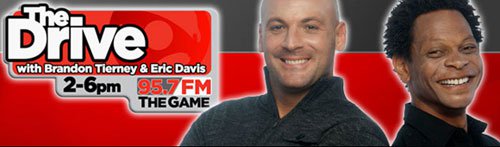 A: Specifically with ED, we were trying to develop show chemistry without knowing each other, so understandably, our first obstacle was learning how to trust one another. It seems easy but it’s not, not under the umbrella of pressure to achieve ratings growth while helping launch a new sports station versus KNBR, one of the industry titans.
The toughest part of that was again, being an outsider and being an outsider from New York, which equates to immediate resistance from fans. My in-your-face style was a different vibe than most of the sports talk in the Bay Area and it was a constant battle to win people over. Every segment felt like a cage match, battling to prove that I was the best man for the job.
ED is very laid back so we needed to find common ground, which eventually happened. I learned so much about the actual game of football from him that it’s impossible to do it justice in this piece. The mind of a pro athlete, the business side…all things I gained by working with him. An obvious plus were his contacts and Super Bowl crew. Montana, Rice, Deion and Roger Craig…you name the star, we had him on our show.
Q: You then left 95.7 The Game to help launch the CBS Sports Radio Network where you’re hosting morning drive with Tiki Barber and Dana Jacobsen. How would you describe the experience of doing national network programming so far?
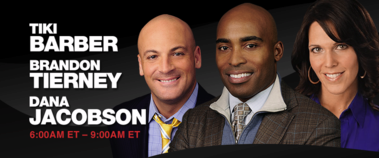 A: I absolutely love the blank canvas my national show provides me with. I enjoy discussing topics more than games at this point being that it’s more stimulating. Gay athletes, domestic violence…pertinent issues that society deals with, we are able to dive into those issues deeper on the national scene than I would locally. The local teams fuel are the local heart beat, but when executed properly, national shows can provide more poignant moments, in my opinion.
With over 150 affiliates nationwide, the feedback from listeners is more diverse and less stale. Don’t get me wrong, there are elements of local radio that I absolutely miss, but a national forum is an incredible gift. Specifically, the show has grown tremendously, We have more fun. Our quirks and defects are coming thru, and we embrace them, which humanizes the show.
Q: What are the biggest differences in how you approach hosting a show nationally vs. locally? Do you have a preference in either of them?
 A: On the national level, you essentially check your affinity for baseball at the door, which for me at times is tough. Football drives the engine, and aside from the NBA Playoffs with Lebron or free agency or Tiger Woods or social issues that develop, it’s pigskin 24/7. Baseball is dying a slow death nationally, which saddens me, but I’m smart enough to recognize that. Quite frankly, it was an adjustment I was reticent to make at first but I have. It’s a regional sport and in some markets, it remains fertile: New York, Boston, Philly, St. Louis and the Bay Area come to mind. For the most part however it’s all about football. As for preference, I truly enjoy both for different reasons because they are two different types of shows.
Q: When doing a show, what order of importance do you place on the following: Interviews, Callers, Using Audio, Debate Between Hosts and Entertainment Stories (not sports)? Why?
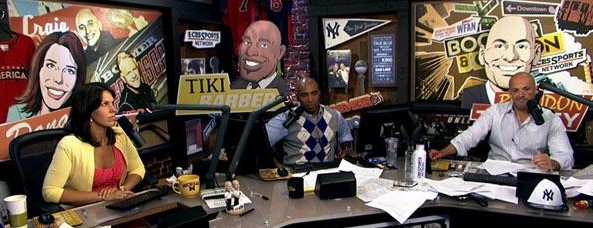 A: For me, the template for a radio show, particularly when there are three people involved, revolves around compelling stories that spark debate. Not contrived debate but genuine and sincere disagreement. When plotting out my show, I envision a blank canvas with no calls and no guests and I go from there. As a morning show, it’s nice to ease into the program with personal stuff. I might even relay a disagreement my wife and I had the previous night because it’s something everyone can relate to. People are starting their day and for the most part, no one cares about how the Yankees or Tigers lost last night. If it’s big enough, like instant replay or a brawl or a serious injury, we’ll hit it early, otherwise I leave it for Dana’s update.
While negotiating with CBS, it was made clear that we will take calls, which was very important to me. I feel it adds a certain pulse that is necessary and if screened and handled properly, is a real asset for our network. We interview actors, authors and of course A-list sports figures too. If we think you can enhance our program, we will bring you on. If you’re boring and lack opinions or substance, you won’t be around long. Doing interviews just to kill time will never fly on my show. Lazy radio kills me.
Q: You’ve learned from some talented programming minds such as Eric Spitz, Gregg Henson, Kevin Graham, Michael Thompson, Justin Craig, Scott Masteller and myself. What have been some of the biggest takeaways you’ve gained from these people and how do you apply them in what you do on-air today?
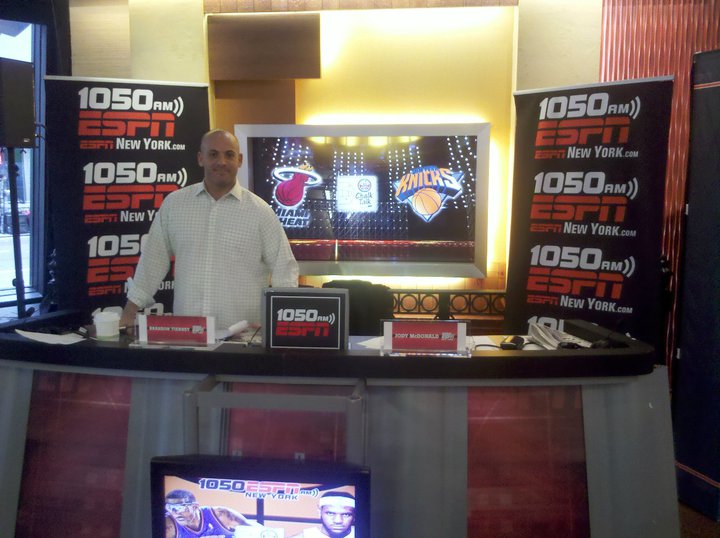 A: Very different people with very different management styles and thoughts on what makes a compelling show. I learned quite a bit from Scott Masteller in terms of properly using sound to enhance segments and to effectively tease forward, which is something you also believe in. Succinctly teasing without giving it away was always a challenge for me because for a long time, in my mind, more words equated to a more powerful delivery. Not necessarily true. Also, playing sound just for the sake of playing sound is a big crutch in our business. Use sound to punctuate a point or to bridge something together.
Gregg Henson was the first PD I worked for who encouraged guy talk, which is key and he also helped me find my natural personality on-air. As for Eric Spitz, he’s seen it all and has a very calm and cerebral management style, which I like. He also has our back. Every PD will say that but sometimes it feels hollow and talent can sniff that out immediately. It’s a true partnership and Spitzie is terrific.
As for you, if I was starting a station tomorrow, you’d be sitting in one of the key offices making key decisions. People want to follow you, work for you, succeed for you. One of the brilliant minds in our industry and I can honestly say that you tightened up my game and made me better.
Q: If there’s one aspect of your game that you consider to be your strong suit what would you say it is? Where do you feel you need to improve still as an on-air talent?
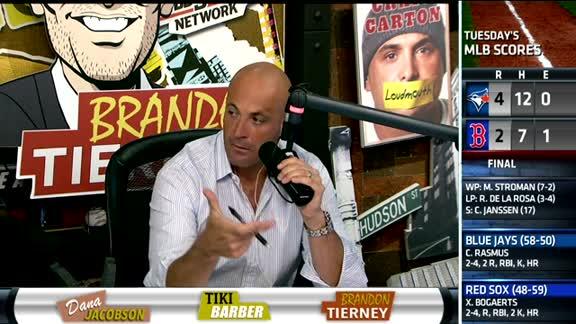 A: Natural energy and charisma are big strengths for myself. I have a general enthusiasm for flipping open a microphone, being engaged in the content and immersed in whatever is topical. At the end of the day, I am extremely motivated to meet the challenge of taking an otherwise benign topic and presenting it in way that provokes thought and stimulates conversation. Think of any topic as a tree, once you move past the root and the first few obvious branches, what’s next? That’s what separates the good from the great and that is what I strive for. Every branch represents unique opportunity.
In terms of improving, everyone can improve, even absolute strengths. If a golfer shoots a 66, next time, hit the putt on 18 and finish with a 65. I am striving to get better at every aspect of radio and TV and that will never change. I truly enjoy interviews and take pride in getting answers others might not get. It’s like a boxer: going for a one shot KO is foolish; work the body, loosen ’em up, then drop the uppercut. It’s an art, something I strive to perfect. If I happen to piss you off along the way, tough.
Q: In order to continue improving as a talent and as a show, what are some ways you and your colleagues focus on measuring your growth?
 A: Our barometer is pretty simple: did we laugh and did the show move? Did we deliver what the audience expects? Did we ask the pertinent questions? Did it feel big? There’s an internal mechanism every good radio show host must have but you have to be honest with yourself. I have no problem saying out loud “that segment sucked, let’s pick it up” once we hit break. We’ve worked hard to create fun, fast segments that are aimed at grabbing the audience.
Q: Outside of your show you are very active with your followers on social media. Not all personalities believe though that they should do that. Why do you believe it’s important?
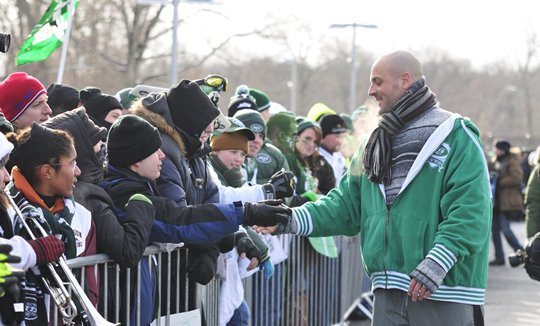 A: It’s an extension of my show and allows me to express myself without filter or time restraints. I honestly enjoy being able to chat with true fans as much as I enjoy the challenge of trying to convert critics. Plus, not everyone that follows me on Twitter listens to my radio show. Some watch me on TOPS on CBS Sports Network, others have listened to me thru the years calling St. John’s basketball games. It’s a way to put everything in one big blender, hit mix, and see what whips up. I’m accessible, I’m not hiding.
Q: For someone considering a career in our industry today, what advice would you like to pass along to them?
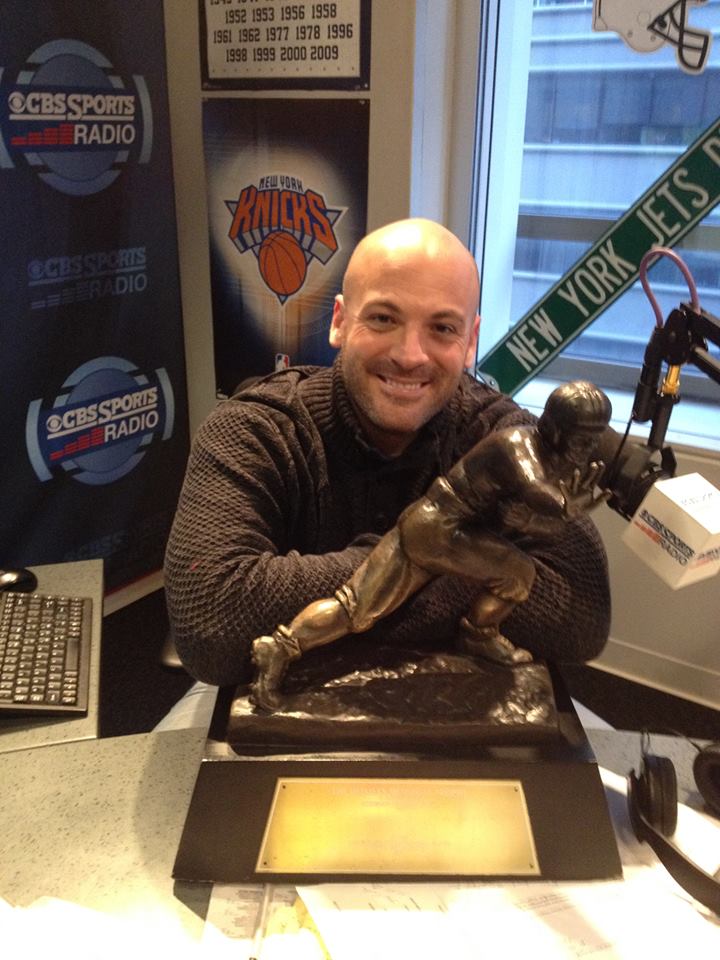 A: Before you waste a penny on resumes, CD’s, postage or head shots, walk to the nearest mirror and stare at the reflection. Lock in on your eyes, and self-assess in the most honest manner possible. Are you willing to relocate and bounce from station to station with no assurances of future success or riches? Are you a grinder? Is it a passion? Does radio pump blood to your heart and oxygen to your brain? Does it stimulate your senses to the point that you cannot imagine being fulfilled without it? If the answer isn’t emphatically yes, make a u-turn, save yourself the trouble and find a conventional job because you will fail.
Brandon Tierney can be heard throughout the country weekday mornings from 6a-9a EST on the CBS Sports Radio Network. For more information on his show with Tiki Barber and Dana Jacobsen click here. You can also follow Brandon on Twitter by clicking here.