If you’re a music radio fanatic and the music is a great part of why you jumped into radio, what are you waiting for? We are being outplayed by platforms that were not even a piece of code twenty years ago. Today, few of us are doing anything about it other than reacting.
There was a time when radio didn’t wait for a spreadsheet to grant permission to chase a hit. Stations — large and small — broke records because someone behind the mic believed in those hits. Music quarter hours were built in tandem by both the programmer and air talent. Many reading this wax poetic about placing certain records inside the music hour simply by the way the song felt in a clock position.
Music radio always grows when an individual is willing to risk a little discomfort for new music discovery. If radio wants to matter tomorrow — or today — it can’t just reflect pop culture. Radio has to create it.
So, when asked early last week to be a part of Barrett Media’s weekly 4-Cast discussion on music differentiation among formats, I was reminded that playlists all over the country are homogenized. Smaller-market brands without research resources are following larger-market formats. While other large markets are watching their major-market peers.
This is hardly a new phenomenon.
By format, successful brands were often echoed throughout a region of the country or, at times, the entire country. Stations in New Hampshire would watch the music activity of those in New York. Brands in Champaign would mirror large-market stations in Chicago.
In the summer of 2024, we encouraged those without solid outside guidance to use various data tools to track immediate listener acceptance. We still encourage you to maintain discipline in music list building. The “hits are the hits.”
However, aggressively looking for emerging musicians or trends free from outside label influence will create a music playlist unique to your market.
As an example, here are a few country products and their five-song snapshot — a little over a quarter hour — from their midday shows:
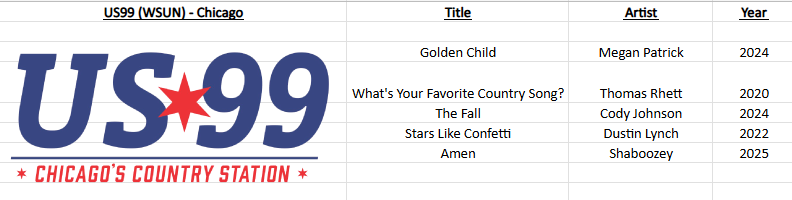
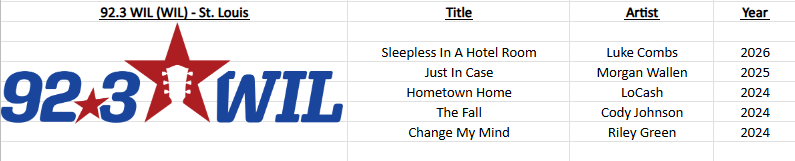
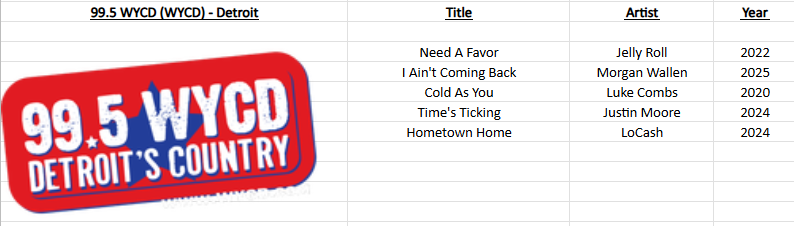
We could repeat this exercise for Adult Contemporary, Hot AC, Classic Rock, and nearly every rated format in America. We would find the same mentality. Find a successful example — and clone it.
Past examples of chart-toppers in the country orbit that delivered buzz for courageous programmers sensing a hit include:
Fancy Like — Walker Hayes
This wasn’t built by Nashville. TikTok takes the credit for this smash. Walker Hayes and his daughter posted a quirky dance in their kitchen that went viral. Smart marketers at Applebee’s — mentioned in the lyrics — turned it into a national ad campaign.
Country radio followed that cultural moment in time rather than creating it.
Old Town Road — Lil Nas X
Another TikTok victory. Before radio would touch it, the song exploded on TikTok with the “Yeehaw Challenge.” Far from traditional country, the re-release added Billy Ray Cyrus, forcing country to confront genre lines.
Billboard removed it from the country chart while the song continued getting monster country spins. It became the longest-running No. 1 in Hot 100 history while some blinder-focused country programmers debated whether to play it.
Cruise — Florida Georgia Line
This gigantic hit started on college campuses regionally. However, the addition of Nelly sent it into the stratosphere. Fueled by college crowds and streaming buzz, Cruise rewrote the country-pop playbook with a new, groundbreaking sound, becoming one of the biggest-selling country singles ever. Proof that another grassroots sensation forced country radio’s hand.
Music trends are being exposed and formed at lightning speed. Digital dominates, and music discovery is happening within a day. Smart country programmers will watch these platforms and even develop a Listener Advisory Board to assist in combing through the mounds of content exposed daily.
This isn’t a punitive jab at country music providers.
The above examples are just that — examples. Every format is allowing culture to pace its stations. From the late 1950s through the 1980s, music radio was a pop-cultural phenomenon. Aside from the corner vinyl store, radio was where kids unearthed new trends in music and pop culture.
Another short list of songs that built virally without record company muscle, becoming too strong to ignore, include:
The Middle — Zedd/Maren Morris
Originally written for Camila Cabello (and she sang a demo of The Middle), a deal couldn’t be put together. Demi Lovato also passed on the project. The song floated around the industry, with co-writer Sarah Aarons pitching her version.
Maren Morris eventually recorded the version that topped the charts and would not die in radio station research camps. The record also received substantial country radio exposure. Another possible early Secret Weapon missed.
Truth Hurts — Lizzo
Released in 2017, the track had early programming adopters, but that didn’t last. The bouncy, stripped-down song only blew up after being featured in the Netflix film Someone Great. A meme (“I just took a DNA test…”) went viral, streaming surged, and radio picked it up, making it a number one hit in 2019.
An industry nugget ignored by programmers and fumbled by the record label. (Also see Red Pony Club by Chappell Roan.)
Running Up That Hill — Kate Bush
This one became a pop-culture no-brainer. Top 40 programmers initially scoffed at allowing a 1985 fringe-pop ditty onto their playlists. When Max was running from Vecna in 2022’s Stranger Things, it sealed the deal. The song was everywhere. TikTok, digital platforms, and streaming skyrocketed while radio programmers scrambled to find an air-quality version, eventually adding the 37-year-old song into heavy rotation. Pop culture pushed radio — again.
Treat your playlist as a living, breathing part of your programming. Start with a weekly — or daily — peek at digital sales data. Post-Super Bowl streams were dominated by Bad Bunny, Lynyrd Skynyrd, and Kid Rock. A peek at today’s streaming hits shows that Classic Rock should be playing Free Bird several times a day due to exposure following Team USA’s men’s hockey remarkable win over Canada on Sunday morning.
What is bubbling under, and where should you look to ensure your music list is reflecting — or creating — pop-culture moments?
We Are Charlie Kirk — Spalexma
Be careful with this one because of the politics it carries. In addition, this is an A.I.-generated tune that, in some regions, is getting ear play without traditional radio airplay. Spotify and TikTok are seeing robust trends on this track.
Say My Name in Your Sleep — Maisie Peters
Released digitally in November 2025, this ghostly tune sticks in your head and ranks high on YouTube’s list of Most Replayed Songs. There’s strong streaming interest and playlisting on Spotify, but radio is largely ignoring it. Secret weapon possibly — here.
Party 4 U — Charli XCX (resurgence)
Originally recorded nine years ago, a TikTok- and Spotify-driven streaming surge is giving this single new life. The official release came in 2020, with Atlantic Records reissuing it last May. TikTok and Instagram Reels trends are focusing on the second verse, driving the growth. Radio impact remains minimal compared to online buzz.
You make a great effort to ensure your packaging is unique, your talent can’t be duplicated, and events you own connect with your community.
Regardless of the format, your playlist should be custom to your vision and the expectations of the listener. If you are fortunate to have live Listener Panels, ask your participants to read their Top 20 Most Played songs on Spotify — or any platform.
You and the panel group will certainly be surprised. Your playlist needs surprises too.
Two weeks back, Barrett Media colleague Jim Ryan wrote that music radio shouldn’t seek better research. What music radio needs to grow Average Quarter Hour with TALENT is courage.
The same goes for your playlist. Where are the courageous?
Barrett Media produces daily content on the music, news, and sports media industries. Sign up for our newsletters to stay updated and get the latest information right in your inbox.