At nearly every industry conference, it’s the same question. It’s asked in some form on every panel, from programmers to executives to talent coaches: Where are we going to find the next crop of news/talk radio hosts?
The question hangs in the air, asked with the right amount of concern and a tone that suggests everyone knows the answer isn’t simple.
But there’s a bigger, more important question that doesn’t get asked nearly enough. Instead of wondering where the next hosts are coming from, the industry should be asking: Where is news/talk radio going to find the next crop of listeners?
Because if you look at the recent data, it’s hard not to feel uneasy about the future.
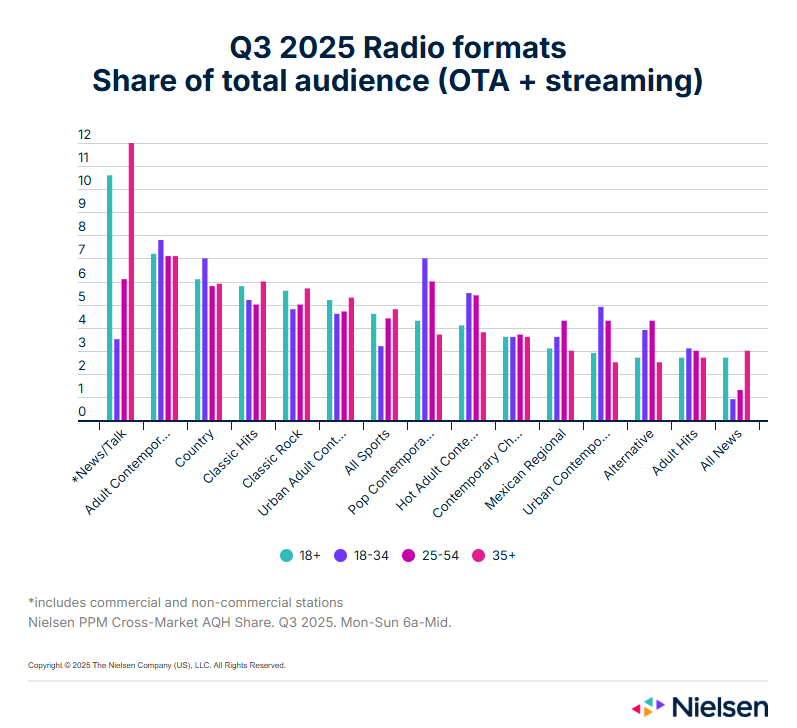
According to figures from Nielsen and Edison Research, news/talk radio remains a powerhouse with older audiences. Among those aged 35 and older, the format dominates with a 12 share. The next closest format sits at a 7. That’s a massive gap — one that shows just how loyal and engaged the older news/talk audience is.
But that’s where the good news stops. For listeners 18 to 34, the only format with a lower share than news/talk is all-news. Not great. And in the all-important 25-54 demographic, news/talk pulls only a 6 share. That means the overwhelming majority of news/talk radio’s audience is significantly older than the advertisers — and stations — would like them to be.
That’s a problem no matter how you look at it.
The reality is that listeners aren’t just going to stumble into the format one day because they got older. There’s a common myth in the business that as people age, they’ll naturally “graduate” into listening to news/talk. The thinking goes: they’ll start paying taxes, caring about politics, and suddenly find comfort in a smart, opinion-driven AM show.
That’s wishful thinking.
If you think a 27-year-old who listens to podcasts, gets their news on TikTok, and streams YouTube commentary for hours a day is magically going to become a news/talk radio listener when they turn 35, you’re sadly mistaken. It doesn’t work that way.
There has to be programming that appeals to them. They have to know it exists. And there has to be an investment from companies and stations to reach those listeners where they are.
That means creating shows that sound different. It means experimenting in ways that reflect the way younger audiences consume audio. It means focusing on content that speaks their language — without dumbing it down. And it means doing the hard work to promote those shows where the next generation of listeners actually spend time.
The path forward isn’t complicated, but it’s uncomfortable. News/talk radio has long been built around a stable of voices who have done it well for decades. But that familiarity, while comforting to long-time listeners, can also be a barrier to growth. You can’t just keep the same sound, the same pacing, the same clock, and the same topics and expect younger audiences to flock in.
Younger listeners want authenticity. They want personality and storytelling. They want to feel like the person behind the mic understands what life looks like right now — not 20 years ago. And they’re used to hearing that kind of connection in podcasts, YouTube shows, and streaming platforms.
The good news is that there’s still an opportunity for news/talk to evolve. The storytelling, the immediacy, the emotion — all of that still matters. But it has to be presented in a way that meets modern expectations. Stations that recognize this now can build a foundation for the future. Stations that don’t may find themselves with a loyal audience that simply doesn’t exist ten years from now.
So yes, finding the next generation of hosts is important. Insanely important, and is still a gigantic problem that needs a solution going forward. The format needs new voices, new perspectives, and new ways to tell stories.
But if the next generation of listeners doesn’t exist, it won’t matter who’s behind the microphone.
It’s clear that news/talk radio has some work to do to make up ground with younger audiences. The best time to do it was yesterday. The second-best time to do it is today.
Barrett Media produces daily content on the music, news, and sports media industries. To stay updated, sign up for our newsletters and get the latest information delivered straight to your inbox.