

The Jacobs Media Techsurvey 2026 dropped some revealing data about the radio business recently, and I can’t stop thinking about one particular finding.
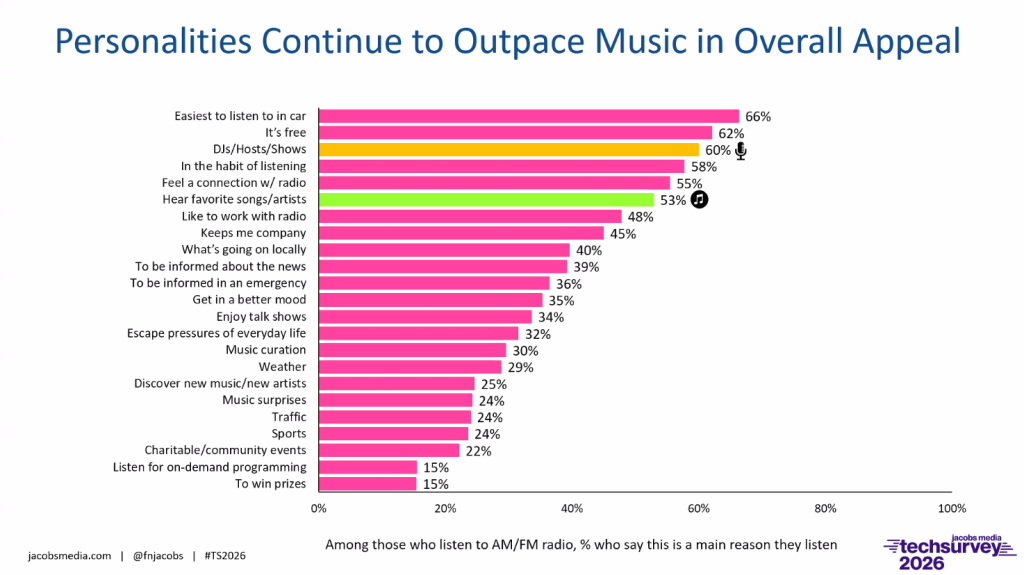
When asked why they listen to radio, 66% of respondents cited ease of listening in the car, 62% pointed to the fact that it’s free, and 60% said they tune in for the DJs, hosts, and shows.
That last number should be a wake-up call for radio executives — but I’m not convinced they want to hear it.
Think about what that data is actually saying. Personalities rank just behind “it’s free” as a reason people actively choose radio.
They beat out “plays my favorite music and artists” at 53%. They outrank local information at 40%. It even tops “it’s a habit” at 58%.
Listeners aren’t just tolerating the people on their radio. They’re showing up specifically because of them. That’s not some trivial detail. It’s the whole ballgame.
And yet, the industry keeps treating talent like a line item to eliminate. Wherever major companies like iHeartMedia, Cumulus, and Audacy have found an opportunity to cut DJs, shows, and hosts, they’ve taken it without hesitation. The most expendable item in virtually every major company’s budget isn’t technology, music rights, or real estate. It’s people. That’s a stunning disconnect from what the data tells us listeners actually value. Worse, every cut nudges another listener toward a competing medium that’s happy to fill the void.
At some point, “How do we create more profit?” can’t keep getting answered with another round of layoffs. Whether radio leaders want this to be true or not, the data is unambiguous: in radio, people are the commodity. Listeners want entertainment. They want connection. They want it for free. Someone is going to fill that need — and if radio keeps gutting its talent base, another platform will gladly step in and do it.
Can AI fill that void? Probably not in any meaningful way. Can a piped-in, nationally syndicated show do the job? Maybe, to a degree. But neither truly replaces the local voice that makes a station feel like it belongs to a community. The sad irony is that radio still has the infrastructure, the reach, and the audience to win this fight. It just keeps making decisions that undermine its own greatest strengths.
Now look at the top three reasons people listen to radio, and consider that two of them face constant external pressure. Audio competition in the car grows every single year. That in-car advantage isn’t vanishing overnight, but it’s eroding steadily. Being free is a durable advantage. That’s exteremly unlikely to change. However, talent is the factor radio controls entirely, and it’s the very thing the industry keeps dismantling with each new budget cycle.
Suppose a study found that one of the top three reasons people choose a grocery store is the variety of products available. No one in that industry would respond by drastically cutting their inventory. That would be, plainly, business suicide. You wouldn’t want to invest in the grocery industry. You’d think it was run by morons. Obviously, the people leading major grocery brands would be viewed as buffoons.
So why does radio keep eliminating the commodity that draws listeners in? The answer is short-sighted thinking, driven by the pressure to produce short-term gains. Meanwhile, the long-term cost keeps quietly compounding in the background.
The talent pool shrinks day after day, week after week, year after year. Each individual cut feels manageable in isolation. But cumulatively, they’re carving out the soul of the medium. Radio is a relationship business. On the air, in the office, and on the streets. With listeners and advertisers alike. Listeners know when that relationship has been hollowed out and replaced with automation and recycled content. And don’t think for one second advertisers don’t notice, either.
It’s past time to wake up and reckon with what the research is plainly telling us. Radio is never going to cut its way to prosperity. The industry has enough advantages to remain relevant and profitable for years to come — but only if it stops treating its most valuable asset as a budget problem to solve. The quicker major company leaders genuinely internalize that reality, the better the odds that local radio stations will still have someone worth tuning in for.
The data is pointing the way forward. The only question is whether anyone in power is willing to follow it.
Barrett Media produces daily content on the music, news, and sports media industries. Sign up for our newsletters to stay updated and get the latest information right in your inbox.


The answer is clear for all who want to see it
Radio is a manager heavy industry
As long as ratings and revenue are sensible, the decline will be ignored
Then at crisis, expensive consultants will be retained to fix what the industry created
It is the way of the manager dominated system here and in many other industries
It is how the sausage is made