RUM Group has previously operated the Rumble digital video platform. Now it’s expanding those operations while focusing on its core.
What We Know: RUM Group will now operate two core business units. It will oversee the Rumble video platform and Quake AI. Previously, Quake AI was known as Northern Data. It encompasses both its cloud and AI businesses. That portion of the businesses is new to Rumble after it acquired Northern Data.
What They Said: “We are living through a once-in-a-generation shift. As artificial intelligence makes knowledge abundant, the scarcest and most valuable resource on Earth becomes the one thing machines can’t manufacture — human imagination. RUM exists to build the future where that ingenuity wins, and to make sure it belongs to the dreamers and the doers. Quake AI gives that imagination a foundation. Rumble gives it a voice.” -Rumble CEO Chris Pavlovski
What Remains Unclear: How the Rumble video platform and Northern Data will work together regarding development. RUM Group teased a release of those details in the near future.
What It Means: Rumble has been a strong player in the podcast space, especially with conservative news podcasts. Many in the format have been critical of YouTube’s content moderation in the past, making the move to Rumble. With the rise of AI-related businesses, it will be interesting to see how that new division is incorporated and used on the video platform.
Barrett Media produces daily content on the music, news, and sports media industries. Sign up for our newsletters to stay updated and get the latest information right in your inbox.
Approaching The Summit is a series of special interviews created in partnership with Point to Point Marketing featuring speakers at the upcoming 2026 Barrett Media Audio Summit in New York City. Follow along with this series as prominent names surrounding the event June 30-July 2 share their insights and expectations for what’s to come in the big apple. The Summit takes place at the SVA Theatre on West 23rd Street. For tickets and hotel room reservations, click here or visit the Summit section at the top of the website.
Garrett Searight: When you found out that you were receiving the Gold Standard in Broadcasting Award, what was your reaction? What went through your mind?
Mark Simone: I thought it was the greatest honor of all because Barrett is the gold standard of radio publications. Nobody covers the business better.
GS: When you look at the summit coming up, you’re going to be on stage again. You’ve been a regular for years. What is it about having the opportunity to share with the industry that entices you?
MS: It gets the biggest and best of the radio business and the broadcasting business together. Not just talk, but now sports and music. It’s the absolute best of the business and the smartest people we have. To hear all of them and mingle with them, it’s like a graduate course. It’s great every year.
GS: What are the things that you hope to share or discuss at the summit?
MS: There’s this crazy myth that radio is dying. That myth has been around since the 1940s. There are actually more people listening to radio today than 20 years ago. 159 million people every day. I hope we can get that across. Radio has a huge future, and you constantly need to tweak it. I hope we can all get together and figure that out, too.
GS: I’ve always appreciated listening to your show because it’s geared toward today’s radio audience. You’re not trying to stretch for 12 minutes just to get to the break. You’re hitting so many different topics. How important is it for the industry to hear that today, when nobody wants to hear someone drone on, trying to get to the next break?
MS: I think we’re supposed to break at 17 minutes after the hour. I’m lucky if I get there by :21 because I just don’t want to stop. It’s not about my opinions. It’s about giving listeners information, stories, and inside intel on things. We cover a lot of ground, and it’s not just politics. It’s everything. Sometimes I can’t get it all in. That’s why we started doing a bonus segment for the podcast listeners on the weekend, because we ended up with 50 things we never got to. We do them there.
GS: Why is it important for the radio industry to gather and share ideas in a setting like this?
MS: Like I said, you have the smartest broadcasting executives and the greatest air talent. We can all learn from each other. We all borrow from each other. Getting together is a lot like the developers’ conferences in the tech world. That’s what this is. It’s where we come up with ideas and move the business forward.
GS: When you approach being on stage, how much do you plan out what you want to share versus shooting from the hip?
MS: It may look like I’m shooting from the hip, but I do this all the time. I’m always in front of an audience speaking somewhere many days a week, so you hone the message. I know what I want to say when I get up there. Sometimes I just have some notes, keywords, and things to remember. When you see a speaker get up and pull out 16 pages of paper to read, you get a little nauseous. I never do that. No notes.
GS: Mark, congratulations again on the award. It’s much deserved.
MS: Oh, thanks a lot. I really appreciate it.
Barrett Media produces daily content on the music, news, and sports media industries. Sign up for our newsletters to stay updated and get the latest information right in your inbox.
The NBA’s new 11-year media rights era opened with a resounding statement. Deputy Commissioner Mark Tatum is crediting the league’s broadcast partners for driving a historic first season.
What We Know: The 2025-26 regular season averaged 1.78 million viewers across NBC, Peacock, Amazon Prime Video, and ESPN. That’s up 16% from last year and the most-watched season in seven years. Fans also watched more than 920 million hours of NBA content, up 25% and the most since 2011-12. The postseason sealed the story. The 2026 NBA Finals between the New York Knicks and San Antonio Spurs averaged 20.6 million viewers on ABC and ESPN. The most-watched NBA Finals in 28 years.
NBA Deputy Commissioner Mark Tatum on the success of the league’s media partners in year one: “NBC and Amazon, specifically our newest partners have been incredible at telling stories. Telling the stories of players, and really celebrating the game of basketball. Educating some of our more casual fans of why they should follow and why they should watch. I think ABC and ESPN, who has returned as our partner, continues to do a wonderful job of that as well. They do a great job of cross-promoting these finals. It’s a combination of all those different partners who are doing a wonderful job of telling the great stories that are in the NBA today.”
NBA Deputy Commissioner Mark Tatum on talks with streaming partners for NBA Europe rights: “We’re having conversations with a ton of people. Including some of the big global streaming partners. There has been an incredible amount of inbound interest on taking those games and distributing them not only throughout Europe but globally. That’s what’s going to be so compelling about this. Just like the NBA is a North America-based product and league. However, it’s relevant and broadcast globally. We think we’re going to create that in Europe. Where it will be a European-based league, but there will be global interest here in North America, Asia and Africa. Given some of the brands, investors, and partners that we’re talking to, we have no doubt that it will create some global interest there. Therefore media partners are very interested in carrying that content.”
What Remains Unclear: The NBA has reportedly held conversations with Amazon and YouTube about broadcasting NBA Europe games. However, no deal has been reached. It also remains unclear whether streaming and content rights will complement or replace traditional media agreements in European markets. Furthermore, how the league structures global distribution — balancing domestic European broadcasters against streaming platforms — remains an open question heading into franchise selection.
What It Means: Year one validated the NBA’s shift from TNT Sports to NBC Sports and Amazon. The Finals surge — driven by the Knicks’ first title since 1973 — handed Tatum and Commissioner Adam Silver enormous negotiating leverage. Especially regarding anything regarding NBA Europe. Tatum has made clear the value of NBA Europe lies in its global appeal, not just its continental footprint. With a year under the Nielsen Big Data + Panel measurement, it will be interesting to see year over year comparisons for the 2026-2027 season.
Barrett Media produces daily content on the music, news, and sports media industries. Sign up for our newsletters to stay updated and get the latest information right in your inbox.
YouTube and social media have become the dominant forces in podcast discovery. New research confirms that 61% of listeners found their favorite show through one of those two channels.
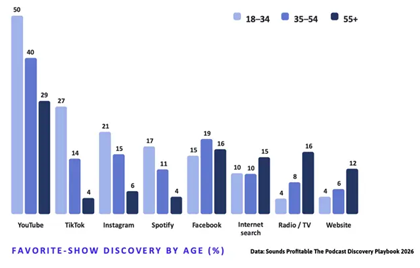
What We Know: Sounds Profitable and JAR Podcast Solutions released joint research examining how listeners discover, engage with, and recommend podcasts. YouTube leads all platforms — 40% of listeners discovered their favorite program there, more than double any other source. Additionally, 40% use YouTube as their primary listening platform, outpacing Spotify (18%) and Apple Podcasts (11%). Meanwhile, organic content drives discovery more than paid promotion. Among social media discoverers, 60% found shows through followed accounts, versus 33% through sponsored content. Discovery patterns also vary sharply by demographic. TikTok discovery is nearly seven times more common among listeners 18–34 than those 55 and older. Apple Podcasts browsing remains a key entry point for affluent, audio-first listeners in news and technology.
What The Data Shows:(via Sounds Profitable/JAR Podcast Solutions)
Sounds Profitable / JAT Podcast Solutions Research (https://soundsprofitable.com/research/the-podcast-discovery-playbook-2026/?utm_source=podnews.net&utm_medium=web&utm_campaign=podnews.net%3A2026-06-19)
What They Said: Tom Webster, Partner at Sounds Profitable: “What this research makes clear is that discovery is happening where people already spend their time. YouTube, social feeds, search, and personal recommendations have become the front door to podcasting. If you’re relying primarily on trailers, chart positions, or cross-promotion within podcast apps, you’re missing where most new listeners are actually entering the medium.”
Roger Nairn, Co-Founder and CEO of JAR Podcast Solutions: “What excites us about these findings is that they give brands and creators a much clearer roadmap. The audience discovering podcasts on TikTok behaves differently than the audience discovering them through Apple Podcasts, YouTube search, or host recommendations. Understanding those differences allows marketers to build smarter strategies and invest in the channels that actually align with their goals.”
What Remains Unclear: Personal recommendations remain a powerful but underexamined discovery channel. Nearly two-thirds of listeners receive podcast recommendations from friends, family, or colleagues, and 72% say they are likely to act on them. However, the research does not clarify how personal recommendations interact with or amplify social media discovery. It also leaves open whether these behavioral trends differ across international markets.
What It Means: Creators and advertisers can no longer treat app-based discovery as their primary growth strategy. Instead, social-first content and platform-specific targeting have become essential. The data also signals opportunity for brands — brand-produced podcasts generated a 27-point net lift in trial intent overall. The other element to look it with this data is how low search and radio are for podcast discoverability among younger audiences. Radio still does well with the 55 and over crowd. However, it’s very low on the younger ends of the demos.
Barrett Media produces daily content on the music, news, and sports media industries. Sign up for our newsletters to stay updated and get the latest information right in your inbox.
Spotify wants its superfans first in line. Reserved by Spotify officially launched today in the U.S., changing how dedicated listeners access concert tickets.
What We Know: Reserved went live June 18 for eligible Premium subscribers ages 18 and up. The feature runs in partnership with Live Nation and is powered by Ticketmaster. Eligible fans get a window to buy up to two tickets before general sale opens. Spotify determines eligibility using signals like streams, saves, shares, and listener location.
What’s at Stake: Two tickets stay held for each eligible fan throughout their entire purchase window. Offers surface on the Home screen, in push notifications, and inside Your Updates. Unclaimed tickets roll automatically to the next tier of dedicated fans. Checkout happens through Ticketmaster, and fans must connect accounts to unlock access.
What Remains Unclear: Spotify hasn’t disclosed the full algorithm behind fan eligibility. The company says withholding details prevents fans from gaming the system. It’s also unclear how many artists or tours expand beyond this week’s launch slate. Meanwhile, window lengths and ticket counts vary by campaign, according to Spotify.
What It Means: Reserved pushes Spotify further into live music commerce, not just streaming. It also hands Live Nation and Ticketmaster a high-intent sales channel built on real fan data. For labels and programmers, engagement metrics now carry tangible ticketing weight. Consequently, expect rivals to watch this fan-reward ticketing model closely in the months ahead.
Barrett Media produces daily content on the music, news, and sports media industries. Sign up for our newsletters to stay updated and get the latest information right in your inbox.
During his time as CEO of The Daily Wire, Jeremy Boreing led discussions with the company about a potential sale to Fox News. It never came to fruition, but that’s not something he regrets today.
What We Know: In late 2024, Boreing said that the company “was not closed off” from being acquired by Fox News. That statement came amid reports that the two sides had been in discussion about a sale. Ultimately, Boreing exited the company he founded alongside Ben Shapiro and no sale was completed. Since then, The Daily Wire has undergone multiple rounds of layoffs. In an interview with Patrick Bet-David, Boreing said that the discussions were “never at third base” but that they were extensive.
What They Said: “If I could have foreseen how things ended up for me at the company, then it would have been better for me if we had sold the company. But no, I never looked back and wished that we had sold. Of course, it would have ended better for me if we had sold in 2023 or 2020, financially. But I look at what we did in 2023. We made the Pendragon Cycle. I look at what we did in 2024 like so many companies — but like, the biggest of so many companies — we impacted a pivotal election for the country. We finished and released Am I Racist?, which became the biggest theatrical release of a documentary in a decade. We terminated Candace Owens. Which I felt like was a morally important thing to do. And important for the health of the conservative movement.” -Jeremy Boreing
What Remains Unclear: What the sticking points were that hindered a potential sale. Boreing has not gone into details about what ended talks between the two.
What It Means: Jeremy Boreing has spoken extensively about his time leading The Daily Wire. However, it is one of the first times that he has discussed this particular situation. In some aspects, he made it sound as if the talks were never close to completion. He did say that it felt as if “We had already rounded the bases twice” emotionally when discussing a deal for the company.
Barrett Media produces daily content on the music, news, and sports media industries. Sign up for our newsletters to stay updated and get the latest information right in your inbox.
YouTube was once a frontrunner for a new five-game NFL package this coming season. Now, according to Puck Media’s John Ourand, the streaming giant isn’t buying anything potentially over a single game being pulled from the package by the league.
What We Know: YouTube entered negotiations with the NFL on a new five-game slate for the upcoming season. Reporting says the package included four game windows ESPN relinquished as part of its NFL Network acquisition. It also included the Week 1 season opener in Melbourne, Australia. According to Ourand, the NFL then pulled the Australia game from YouTube’s portion of the package. The league expected YouTube to still split the remaining inventory with Netflix. Instead, YouTube walked away from the NFL completely. The move raised fresh questions about how aggressively the Google-owned platform — which already holds exclusive NFL Sunday Ticket rights through 2029 — truly wants to compete for live sports rights.
What They Said: An anonymous rights holder to Puck Media’ John Ourand regarding YouTube: “It’s such a laborious process whenever I pitch them. I really do believe that they’re genuinely just trying to figure out if they want to be in the live rights game or not.”
What Remains Unclear: It remains uncertain whether YouTube will re-engage the NFL on revised terms for next season. Furthermore, questions linger about YouTube’s long-term live rights strategy. The lone broadcast on YouTube last year of the Chargers-Chiefs NFL International Series game from Brazil saw an average U.S. audience of 18.5 million.
What It Means: Every streaming platform’s business model is different. However, YouTube is insistent on not having content behind paywalls. That’s the draw to the YouTube audience. Content for free and whenever I’d want it. YouTube doesn’t need sports rights to be successful. We’ve seen the growth of the platform with content discovery for podcasts. There is a brighter future there with less overhead costs associated to make profit. However, what these decisions could mean for the Sunday Ticket on the platform is a much larger question with more streaming platforms demanding NFL content.
Barrett Media produces daily content on the music, news, and sports media industries. Sign up for our newsletters to stay updated and get the latest information right in your inbox.
Skip Dillard didn’t choose radio. Radio chose him. From the time he was a kid he said he was “was addicted to radio,” comparing the pull to alcohol or drugs.
One Lesson, Every Market
Dillard has programmed in Detroit, Buffalo, New Orleans, San Francisco, Washington D.C., and for the better part of his career New York City. Today he is Program Director for 94.7 The Block in NYC and holds a national role overseeing the Rhythmic and Throwback formats at Audacy. When asked what traveled with him across every city and station he’s programmed, the answer comes fast.
“Radio is at its very, very best when it touches people,” Dillard says. He calls community “the most important aspect” of the job. “Figure out what listeners need and try to give that to them day in and day out,” he says. “That’s been the secret to my success.”
Two Brands, Two Battles
Dillard spent over a decade protecting WBLS, a legacy New York institution. Then he built WXBK, 94.7 The Block, from the ground up. I asked about the difference between protecting a heritage brand and building a totally new one. “Both have their unique challenges,” he says.
WBLS meant guiding a storied brand through the shift from diary ratings to electronic measurement. “There were a lot of problems going to the PPM methodology,” he says, and some of the station’s biggest talents struggled at first. The Block presented a different fight entirely: “getting your niche in a market full of heritage radio.”
His team built The Block’s throwback Hip Hop sound on research. “We looked at the [older] playlists from those [heritage] stations, and then did music tests based around when those records broke in New York,” he says. Stations and DJs often pushed “the B side of what was actually being worked” as a single and then those records ended up becoming the bigger hit in the city.
But the real differentiator wasn’t the music. “A partnership with the community you serve, whether it’s New York or Des Moines, Iowa, is crucial, and that was part of the plan here,” he says.
Get Up From Your Desk
“Look at your zip codes, where your listeners are coming in from,” Dillard says, advising young programmers where to start if they’re new to a market.
Reach out to local organizations, he says, because “they’re always looking for an opportunity to have a mouthpiece for things they’re doing.”
But most importantly, “get out from your desk. Read all the data and research you have access to, and then get up and go outside,” he says. “I learned more at a festival, or weekend gathering, or networking event about what’s going on in my community than I will ever find out from any kind of research data.”
Urban radio brands handle politics differently, and Dillard thinks that’s exactly right. Some stations, like Audacy’s in Atlanta, lean in. “People have come to respect that from V103 in Atlanta,” he says. “They just expect to be informed about what’s going on.”
Other markets call for restraint. “Politics has never been more polarizing,” Dillard says. “Listeners are beat down with it every single day on their phones, on television.” His guiding question: “Is it better that I inform rather than become another source of polarization?”
He’s also realistic about lanes when it comes to strategy for The Block. Nobody beats The Breakfast Club at its own game. “That would be crazy if you had a morning show and someone say, hey, I’m gonna be as political as they are,” he says. “It’s where they put their tent pole.” His advice for everyone else: give listeners the facts and trust them to decide. “I think people are a heck of a lot smarter than we often give them credit for, and we have to realize that,” he says.
Bridging the Generational Gap
The Block trades heavily in nostalgia which would lead one to believe that the audience would only be older. Instead, younger listeners have been showing up, and Dillard sees that audience growing. “What’s nostalgic to us is very fresh and new to them,” he says.
He credits sampling for the bridge. Modern pop and rap lean hard on those same originals, sending younger ears back to the source. “People are looking back to the 90s, the early 2000s, and finding and reacquainting themselves,” he says.
A recent college consulting project reshaped how Dillard sees that generation. The students he spoke with about what’s important to them never once mentioned money. “They wanted to be relevant, and they wanted to make a difference,” he says. “They don’t want to be a cog in a wheel.” That conversation left him hopeful. “These young people, if you really listen to them, they can give us hope, they can give us strength, because they’re moving beyond the divisions, they’re moving beyond race.”
Juneteenth, Black Music Month, and America 250, All at Once
This year’s calendar stacks Juneteenth, Black Music Month, and the lead-up to America’s 250th anniversary into the same narrow window. Dillard doesn’t see a scheduling headache. He sees an opening. “Black people played a crucial part in the development and success of this country, and continue to do so,” he says.
He’s blunt about the alternative. “We have an unfortunate situation where, in some aspects of our present day politics and society, we want to marginalize the contributions of Black people, and other ethnic and religious groups,” he says.
Dillard’s own family history sits underneath that belief. He’s stood inside a house in Danville, Virginia, on land his grandmother’s people once worked, a property descendants of the enslaving family still own today. “It left me with an emotional understanding of where we’ve been, a very bloody and hard and painful past,” he says. “There were a few tears I shed, but when it was all said and done, it filled me with a sense of purpose. It filled me with a sense of belief.” His conclusion: “If we could get through slavery, the civil rights movement, world wars, 9/11, we can get through anything. We just have to work together, not fear each other.”
A Different Kind of Patriotism
Dillard isn’t asking stations to paper over the complicated relationship some Black listeners have with patriotic messaging. His suggestion for Urban stations programming around America 250 is more specific. “Celebrate your local Black heroes,” he says, pointing to Benjamin Banneker in D.C. and Senator Raphael Warnock in Atlanta as examples worth airtime.
“There are so many local leaders, past and present, that helped and continue to build this country and change America for the better,” he says. “Let’s salute them and make sure that for America 250, everybody’s in the mix.”
Looking Ahead to the Barrett Media Audio Summit
Dillard heads to the Barrett Media Audio Summit on July 2nd for a Hip Hop panel alongside Funk Flex, Angela Yee, Devin Steel, and Damizza. He’s genuinely excited, partly because music finally has a real seat at a summit, but also because a lot of surviving conferences today are solely sales focused. “It’s really nice to be around content people for our business,” he says.
That makes a room full of talent and programmers, swapping real challenges, feel rare. “What I most look forward to is shaking the hands of many of my colleagues,” he says, “and discussing the real life challenges we face every day in our radio stations, working to make them better, working to make them more relevant and connected with our listeners.”
“It’s going to be a lot of fun,” Dillard says. For a programmer who’s spent three decades chasing what makes radio actually touch people, that’s about as good a note as any to end on.
Barrett Media produces daily content on the music, news, and sports media industries. Sign up for our newsletters to stay updated and get the latest information right in your inbox.
2028 seems so far away, doesn’t it? Make no mistake, the year 2028 will be huge for a myriad of reasons. The Summer Olympics will be held in Los Angeles. World Cup fever will return as the women’s event will be held in China, Brazil, Morocco, England, and the United States. There’s also a presidential election that will take place. However, one of the biggest sports media stories of 2028 may be what happens with FOX Sports Radio.
Sure, FOX Sports Radio may not generate the same level of interest nationally as a Summer Olympics held in the United States. However, 2028 will be a pivotal year for the brand and how it shapes its future within the industry. What we do know is that Dan Patrick will retire in February of that year at Super Bowl LXII in Atlanta. What we don’t know is whether Colin Cowherd will also be making an exit from the brand.
Just yesterday, Cowherd shared that he’s beginning to think about retirement. At 62 years old and nearing four decades of success at the highest level, can you blame him? He’s not the average nationally syndicated sports talk show host. In fact, Cowherd has dominated the format while simultaneously building one of sports media’s most successful podcast companies.
Cowherd sat down for an exclusive interview with OutKick. He shared that he has two years remaining on his current deal with FOX Sports Radio. Cowherd also revealed that he has begun discussing ways to reduce the length of his daily program, The Herd w/Colin Cowherd. While he doesn’t consider what he’s currently doing a “big lift,” he said downsizing from a three-hour program to two hours would be “reasonable.”
Colin Is Always Evolving
The thing I’ve always admired about Colin is that he doesn’t beat around the bush. He’s a straight shooter but always open to changing his mind on issues. Remember when he asked attendees at the 2019 Barrett Media Sports Summit to find him the man in America who had gotten rich through podcasting? Cowherd officially launched The Volume just two years later. Today, The Volume is one of the most successful brands in the sports podcasting space.
With time comes evolution and the ability to think differently about a subject.
In the same interview with OutKick, Cowherd said that people have inquired about buying The Volume. He has also reached out to trusted contacts in the finance world to discuss selling the company or portions of it.
Within a six-minute span during his conversation with OutKick, Cowherd was sending signals like any top tier talent. He says that he has thought about retirement, and discussed reducing his daily show to two hours. Plus, he’s explored the possibility of selling The Volume.
For Cowherd, that’s a blessed position to be in, and his efforts have earned him the right to have those choices.
But just as he evolved his thinking about getting rich through podcasting, could we see a similar shift before 2028 regarding whether Colin Cowherd needs FOX Sports Radio anymore?
By no means has Cowherd lost his fastball. Scott Shapiro, who oversees FOX Sports Radio, told me as much in January. When I spoke with Shapiro earlier this year, he said there had been no discussions about an exit plan and that retirement had never come up between them.
Six months later, some evolution is happening. Cowherd revealed to OutKick that he has thought about retirement and has discussed paring down his program as part of a potential new deal. Again, Cowherd continues to evolve his thinking.
So, if Cowherd changes his stance and decides to leave FOX Sports Radio in the same year as Dan Patrick, where does that leave FOX Sports Radio in 2028 and beyond?
Planning For Anything
For more than a decade, FOX Sports Radio has been the dominant player in the syndicated sports radio battle. Heavy hitters mixed with FOX branding. The ability to remain live on affiliates during play-by-play broadcasts when competitors are carrying games have provided a proven advantage. Being operated by Premiere Radio Networks under the iHeartRadio umbrella doesn’t hurt either.
When Doug Gottlieb left the network to continue his college basketball coaching career, the answer was Jon “Stugotz” Weiner. Shapiro explained that even he didn’t expect “Stugotz” to be interested. It turned out Stugotz was all in on the idea, and returned to syndicated sports radio for the first time since 2020.
Moreover, Dan Patrick’s departure is approaching, and the answer to replacing him remains unknown. If you add Cowherd to the departures list in the same year, where do you go from there? FOX Sports Radio built and marketed its brand around the strong presence of Patrick, Cowherd, and Gottlieb for years. All three were former ESPN Radio talents who made the jump to join the competition.
Without them, many questions remain. There is also legitimate skepticism about whether FOX Sports Radio can maintain its audience long term with diminished star power. Any brand that loses the value of Patrick and Cowherd would be in the same quandry.
Replacing talent on syndicated sports radio outlets is not an easy process. Just look at FOX Sports Radio’s competition. ESPN Radio still has not officially named a replacement for Clinton Yates, who departed the company nearly three months ago. A great deal of planning, budgeting, and execution goes into the process. Ask anyone who’s been in the situation, it takes time.
Not to mention the hundreds of affiliates around the country and their concerns. FOX Sports Radio must of course assure those affiliates that the network will continue providing top-tier talent. Those capable of delivering content while maintaining listener interest in local markets.
Change Is Always Constant
Maybe Colin Cowherd ultimately decides he still loves the daily grind and signs another deal. Maybe he scales back his workload but remains part of the FOX Sports Radio lineup. Or maybe 2028 becomes the year he follows Dan Patrick out the door and focuses exclusively on The Volume and whatever comes next.
That’s why FOX Sports Radio can’t afford to wait until a decision is made to start thinking about the future. Developing the next generation of marquee talent takes years, not months. It requires identifying personalities, investing in them, and giving affiliates confidence that the network will continue to deliver compelling content long after today’s stars move on.
FOX Sports Radio has already begun that process with several talents. Hopefully more will emerge in the months and years ahead.
However, the sports audio landscape is more competitive than ever. Listeners have an endless supply of podcasts, streaming shows, YouTube channels, and social media content competing for their attention. Local sports radio stations still need strong national programming partners to help fill their schedules and remain relevant destinations in their markets.
If FOX Sports Radio wants to maintain its position atop the syndicated sports radio space, it must have a succession plan ready long before 2028 arrives. Not just for Dan Patrick, but based on his recent comments, Colin Cowherd as well.
Because while 2028 sounds far away today, anyone who has spent time in this business knows it will be here before FOX Sports Radio realizes it.
Barrett Media produces daily content on the music, news, and sports media industries.Sign up for our newsletters to stay updated and get the latest information right in your inbox.
Less than a week in, the new morning show at Beasley Classic Hits WROR/Boston was already finding its voice. Co-hosts Lauren Beckham Falcone – better known as LBF – and her new partner Adam Chapman – known as Adam-12 – found themselves discussing actor Kyle MacLachlan. Adam thinks of MacLachlan as Dale Cooper from Twin Peaks. LBF, however, knows him only as Charlotte’s husband Trey MacDougal on Sex and the City. In a strange way, that dichotomy really sums up the unique clash of cultures represented on their new show.
For LBF, this is the third incarnation of the morning show that she’s been a part of at WROR. Originally a journalist working for The Boston Herald, she joined the legendary Loren and Wally show in 2011. When Loren retired in 2019, she partnered with co-host Bob Bronson. Together, they had an extraordinarily successful run until Bronson also retired earlier this year.
Soon after Bronson left, the new show with Adam-12 was announced. “Yes, I’ve been through a lot of arranged marriages,” says Lauren. “But I’ve been incredibly lucky. To put it in high school terms I’ve had several good lab partners. I was looking for another one and I think I may have found the best.”
Different Backgrounds, Shared Vision
Adam’s radio history includes working at legendary Boston rock station WBCN as well as alternative WFNX. Most recently, he had been producing the Toucher and Hardy show on WROR’s sister station, The Sports Hub. “I’ve known LBF for a while now and I just knew it would be a good fit,” Adam says. “We have the right mix of things in common and things that we don’t have in common. So, we can draw on the former when it makes sense and we can lean into the latter when it makes sense.”
Since they already knew each other, Adam and Lauren took a different approach than most new show pairings. “We had a lunch and that was kind of it,” Adam says.
Continuity also played a role in their ability to launch quickly and effectively. They maintained several benchmarks from the previous show. These included a trivia contest called “Supah Smaht in 60 Seconds” and a listener participation segment called “DM Disasters.” Plus, they could rely on producer Aaron Natti, a holdover from the last show. Known to listeners for his laugh, Natti brings much more to the role. “Our producer is incredible,” says Adam. “Coming from producing in my last job, you know, game recognizes game. I can appreciate someone who is elite at what they do.”
More Than a Continuation
By no means, though, is the show just a continuation. In addition to a local focus, Lauren explains the new team is putting a distinctive stamp on the show. “I hate to say it’s a slice of life, but it is our unique takes on the absurd nature of what is going on everywhere,” she says. “We like to riff on that absurdity.”
Adam explains that their approach differs from the typical argumentative style of many radio shows. “You can take a news story and present it in a point, counter point way but that immediately puts your audience at odds with each other,” he says. “It’s much more unifying to say let’s drill down into a story because there inevitably is going to be some absurdity there to talk about.”
And hopefully, Lauren says, the result is fun. “I hope when people are driving to work they’re laughing and saying, ‘I never thought of it that way’ instead of saying ‘she’s wrong and he’s right.’ We really want people say ‘that is a crazy way to think about something.'”
Growing the Audience
Part of that mix comes from integrating Adam into the WROR audience. He has primarily worked at more male-focused stations, but it’s a transition he’s familiar with. Before his last job, he had never worked at a sports-talk station.
“I went into that environment with a little bit of imposter syndrome but over time I figured out which parts of my personality I could bring to the forefront that made sense in in that context,” Adam says. “That’s what I’m hoping to do here. Different station, different format, different approach but there absolutely are parts of my personality that fit here that you might not have heard on other stations or formats. I’m hoping to bring them out in a way that resonates with the audience.”
But Lauren is careful not to overly focus Adam on any part of the existing audience. “I don’t want to pigeonhole the audience, and I don’t want to pigeonhole Adam. And I want to be constantly growing. So, I don’t want to say that this specific person is our listener, and this is what you have to do, because that’s putting everybody in a cage and I’m not into that. I want everyone to come to the party.”
That sentiment dovetails with her long-term goals for the show of pulling together an even wider, more robust audience. “I’d like to think over time we’ll bring in different ages and types of people who didn’t know the show before Adam or who knew him from other stations and it grows into something that’s recognizable to more people,” she says. “A year from now if we’ve been able to do something that is still enduring and is resonating with people I would consider that a success.”
Barrett Media produces daily content on the music, news, and sports media industries. Sign up for our newsletters to stay updated and get the latest information right in your inbox.