Home Blog Page 336

What Sports Radio Got Right That ESPN’s ‘First Take’ Got Wrong in Showcasing Team USA Gold

0

The single biggest task that a sports commentator or talk show host has is meeting the audience’s needs. For over two decades working in sports radio, we were always told to play the hits. Cater to what the audience demands and is interested in instead of your own preferences. Networks and radio companies will spend assets on research projects to understand and define who their target consumer is. Sometimes the research confirms what a talent’s thought process is. Oftentimes, it reveals a different consumer makeup.

First Take has forever been heralded as ESPN’s flagship morning show. Despite the efforts of programs that precede it, First Take has always stood out as the home of sports debate on ESPN. Stephen A. Smith has long argued that the show’s rundown of topics is based on a wide range of research. Far too often, however, the show faces criticism for the amount of Dallas Cowboys coverage or its NBA-over-everyone approach.

Monday was another moment for the highly successful program that left me scratching my head. Following the United States’ historic gold medal–winning performance over Canada that captured the nation’s attention, I was curious to see how First Take would approach the topic. What I found raised even more questions than answers.

When final viewership numbers become available for the United States’ gold medal win over Canada, they will likely surpass even the highest-viewed NBA games of this season. In fact, the NBA Finals over the past couple of seasons may not eclipse the average viewership of the gold medal contest.

The game unified the country. It trended across social media platforms. It also stood as the crown jewel of NBC Sports’ presentation of the 2026 Winter Games. One might expect that, just 24 hours after the United States flag rose in Milan, First Take would open with the Olympics’ biggest story.

Instead, ESPN’s flagship morning show embraced debate about the Los Angeles Lakers’ loss to the Boston Celtics.

Stunning, I know.

Instead, First Take opened Monday’s program by spending its first 11 minutes on Boston’s win over the Lakers. The panel focused on how the result affected Jaylen Brown’s MVP case. To be fair, the United States’ victory over Canada served as the B story. Stephen A. Smith shared his initial reaction. The show then welcomed P.K. Subban, now an ESPN NHL analyst, for further discussion.

Smith called gold medal–winning goaltender Connor Hellebuyck “Havla-chuck” and joked, “let’s do the hockey.” Not that I expect Smith (and his $20 million salary) to be a hockey aficionado, but the moment could have used a little more respect from ESPN’s top commentator.

Twelve minutes of a Q&A with Subban on the USA win over Canada, and that was it for First Take on the biggest sports story of the weekend.

Instead, the rest of the show included breakdowns of NBA action over the weekend, more on Brown’s MVP chances, and an interview with WWE superstar Trick Williams.

It made me wonder: Doesn’t the NHL have a television deal with ESPN? Didn’t the NHL allow its players to compete at the highest level, playing for country over team? Isn’t this the USA’s first gold medal in ice hockey in 46 years? Wasn’t this a win over its top rival and most heated combatant?

When WWE receives more time with a C-level superstar than a gold medal–winning performance from Team USA, there needs to be some line of questioning. Is the research saying hockey at all levels should be ignored on First Take? Was the USA men’s hockey team being the most viewed sports competition of the weekend not a factor at all?

Did Stephen A. Smith even watch “Havla-chuck” and his game winning saves throughout the Sunday contest?

Across the country, sports radio stations led with the United States’ gold medal victory. That was true in both NHL and non-NHL markets. Even cities digging out from a blizzard opened with the win over Canada. Hosts discussed its impact on the NHL, the sport’s growth, and how the 2026 Milan Olympic Games may ultimately be remembered.

WFAN and ESPN New York kept their audiences warm with reflections on a gold medal for the USA. Boston’s WEEI and 98.5 The Sports Hub shared stories about where they watched and the emotions that poured out after the win. From Chicago’s 104.3 The Score to ESPN Los Angeles, USA Hockey was the top topic for the listening audience first thing in the morning.

Even non-NHL markets like Charlotte’s WFNZ woke up to discussion about the USA winning gold over Canada. KNBR in San Francisco led with it as well. Even ESPN Radio’s morning show Unsportsmanlike began first and foremost with the United States winning a gold medal.

That’s playing the hits. The concept may be old hat for some, but First Take stood out like a sore thumb. The show didn’t play the hit in the manner in which it should have. It then masked the lack of care for the content that Smith could have provided by presenting the segment as an interview with P.K. Subban.

There are few moments that call for rare showcasing of sports topics on shows that would never touch the subject matter at all. Yesterday, First Take failed to deliver what the audience wanted. It was also a moment when sports radio across the country shined brightest, while those who get the spotlight far too often didn’t meet the moment.

For a show that has long prided itself on research, relevance, and reading the room, Monday felt like a massive miss.

This isn’t about turning First Take into a hockey show. It’s about recognizing when the sports world hands you a moment bigger than your usual programming habits. When the country unites around a 46-year wait ending and a rivalry with Canada delivers drama worthy of the biggest stage. When viewership and emotion intersect in a way that reminds people why they love sports in the first place.

That’s not niche or even regional. That’s not optional.

Playing the hits isn’t about personal preference or contractual obligations. It’s about understanding the pulse of the audience in real time. On a morning when sports fans across America were still buzzing about a gold medal, replaying saves and goals, and feeling pride as the flag rose overseas, the biggest debate show in sports television chose a different direction.

And that’s the lesson.

When you’re the flagship, you shouldn’t be allowed to miss the moment.

Barrett Media produces daily content on the music, news, and sports media industries. Sign up for our newsletters to stay updated and get the latest information right in your inbox.

The Industry According To…Nick Attaway, BMG

Thank you for checking out ‘The Industry According To’. This series runs each Tuesday, and features radio and record industry executives, managers, programmers, talent, artists, and professionals from all areas of the business world. To be considered as a future guest, email me at keithblackboxgroup@gmail.com.

Today we hear from Nick Attaway, VP of Radio Promotion at BMG. Only a veteran with decades of experience can handle so many projects and the pressures that come from being at one of the world’s biggest music companies, promoting some of the biggest artists. Nick is a multi-genre problem solver who brings a lived-through-it POV of the music industry.

So, let’s dive in.

The Label’s Job Now

Keith: If an artist can record, distribute, market, and build an audience without a label, what is the non-negotiable value a modern label still brings in 2026?

Nick: A modern label is a true brain trust. It’s a coordinated team that sets and executes long-term strategy across production, marketing, digital, sync, radio, and beyond. Yes, we use Platforms and data to help us identify and reach audiences—but the real differentiator is expertise and long-standing relationships.

At BMG, we operate globally, without territorial limitations. As an independent, privately held company, we can take a long-term view, investing strategically and moving decisively.

You’re seeing management companies build internal teams—and that makes sense. But many still seek label partners for greater reach, scale, and impact.


Your Job Then & Now

Keith: If artist promotion were the military, your uniform would be covered in pins and   medals — how is the job different today vs. “back then,” and which is more challenging?

Nick: What hasn’t changed is that trust, and relationships still drive everything—especially in radio promotion. And the most important thing an artist can do remains the same: tour relentlessly and work the record. Meet and greets, interviews, sessions, quality social content….it all matters.

What has changed is capacity. Programmers are doing more with less—less staff, less budget. Labels are leaner too. That makes partnership essential.

Today, it’s less about being buddies and more about delivering value that supports their brand.

We have access to more data than ever before. It’s powerful, but the key is distilling it into a clear story and vision. And now AI is entering the picture. Its impact will be significant, but how it reshapes promotion and discovery is still unfolding.


The BMG Difference

Keith: Your job requires balancing art and ROI, yet BMG prides itself on being “artist first.” In the real world of promotion, does that change your day-to-day compared to other labels you’ve worked for?

Does that change your day-to-day?

Nick: I operate with full transparency. Managers can ask me anything—budgets, strategy, timing.

In the past, communication was often filtered through multiple layers. Today, real-time clarity makes everyone a stronger partner. When artists and managers understand the strategy, they engage at a higher level.


Spending Success

Keith: Chart positions used to be something labels could engineer with the right spending strategy. Now that consumption is so fragmented, is it still possible to “buy” a hit?

Nick: Ultimately, a hit can’t be bought. The audience decides. A No. 1 at radio doesn’t automatically make a song a hit. A real hit researches, drives streams and sales, and grows the live business.

Daily radio listenership among younger audiences continues to decline as streaming offers endless alternatives. So instead of creating hits from scratch, radio often amplifies songs that are already resonating on streaming and extends their lifespan.


How Important Is Image in 2026?

Keith: In 2026, can a great song still break an artist without a great or unique image, or has the visual brand become a deal-breaking-or-making part of the equation?

Nick: Absolutely. Last year’s No. 1 streaming single for BMG was “Blue” by Yung Kai—his first hit. Over 2 billion global streams and more than 100 billion short-form views. That translated into global touring and album consumption.

This was a song that emotionally connected without a traditional big-budget rollout. It was lightening in a bottle-but it proves a great songcan still be enough


Today’s Skills

Keith: If promoted and forced to find the next “Nick,” what skills matter most when hiring your replacement? relationships, data proficiency, creative instinct, or something else altogether?

Nick: Relationships, data fluency, creative instinct—they’re all part of the toolkit.

But the most important skill is critical thinking. The ability to see the big picture, anticipate outcomes, and build a plan to win. Pair that with confidence and competitive drive and you have the right hire.


Radio’s Strength

Keith: Platforms like IG or TikTok are good at creating flash-point moments, but what’s radio’s biggest strength in launching artists?

Nick: The human connection. At their best, jocks are trusted filters—friends, storytellers, influencers. When they champion a song or interview an artist, it creates real mindshare. That drives streams and ticket sales.

In a world full of content, radio can still cut through when it spotlights something new.


Artist Control

Keith: BMG artists have some control in the overall process — where does artist control help and where can it hurt?

Nick: Artists controlling their own socials is huge. Authenticity can’t be outsourced. They should tell their own story. Every artist should have a videographer on tour.

Where it gets tricky is single selection. Artists often gravitate toward the newest, most complex, or most personal track. Often, the biggest hit is the simplest one-the song that feels effortless.

That’s why fresh, trusted ears matter. It should always be a discussion.


AI

Keith: How would you take a fully AI-developed record to rock radio?

Nick: AI can serve as a tool, rather than a replacement. If a record were developed entirely by AI, I’d want to see clear evidence that it connects emotionally with real audiences before considering it for radio.

Also, iHeart has adapted a “Guaranteed Human” pledge, which currently excludes fully AI created songs… so there’s that.


Politics & Music

Keith: How does a label navigate strong political statements from artists?

Nick: Artists are human. They have the innate creative license to speak their minds. Is it always strategically wise? Not necessarily—especially if it alienates a large segment of the audience. Labels typically step in only if a statement creates legal, safety or brand risks.


Your Advice

Keith: When it comes to having a positive, healthy and fair ecosystem for all, what does the music industry need to do to become a 10 out of 10?

Nick: A strong start would be artists owning their music, having access to healthcare and mental health resources, and being supported in long-term development and financial planning.


Your Best Story

Keith: You’ve been doing this for a long time and have worked with dozens of superstar artists, what’s the one story you love to tell – success, flop, pure mayhem — that we should hear?

Nick: In 1996, I took Mark and Tom of Blink-182 on a helicopter ride after a club show. While hovering over the Luxor, Mark asked me if they would be big. I told them they would be HUGE! In Mark’s book, he wrote that I was a label head trying to get them to re-sign.

In reality, I was the college radio rep who was told to spend my T&E budget so it wouldn’t get cut.

Twenty years later, I’m on a call with Mark, Travis, management, and the team planning the California album. I told him I’d deliver two No. 1s at Alternative—something they’d never had. Then I reminded him about the helicopter ride around Vegas before they broke.

He said, “Oh my God! I remember you. That was my first helicopter ride.”

You never forget your first helicopter ride. Later that year, Blink-182 had two No. 1’s at Alternative radio.

Barrett Media produces daily content on the music, news, and sports media industries. Sign up for our newsletters to stay updated and get the latest information right in your inbox.

How Mina Kimes Grew From Business Journalist to a Top NFL Voice With ESPN

1

Few network football analysts have created their own lane quite like Mina Kimes at ESPN. Her profile did not grow from the gridiron or from glory days on the field. Instead, she built her path out of a passion for the sport she grew to love. The daughter of a U.S. military veteran and Korean immigrant, Kimes graduated from Yale and set out to become an award-winning investigative journalist for both Fortune and Bloomberg.

Then in 2014, she pivoted, calling her own audible when ESPN made a phone call that changed her career outlook forever.

“ESPN reached out to me when I was a features writer. They asked me if I would consider pivoting to writing features about sports,” said Kimes. “They knew that football was a passion of mine because I was this very serious business journalist, but I was posting just dumb s**t about football constantly and wrote a personal essay about football.”

That phone call marked Kimes’ entry into what has become a consistently blossoming career with the worldwide leader in sports. After beginning with ESPN The Magazine, she expanded across multiple platforms, including digital and print, as well as television, radio and podcasting.

Ranking Among the Best

In 2018, Mina Kimes elevated her passion for football by launching The Mina Kimes Show featuring Lenny. The podcast became a haven for in-depth football discussion and thoughtful analysis. Kimes admitted she never expected a show hosted by her and her dog to endure. The sports podcast industry has experienced significant attrition over the years.

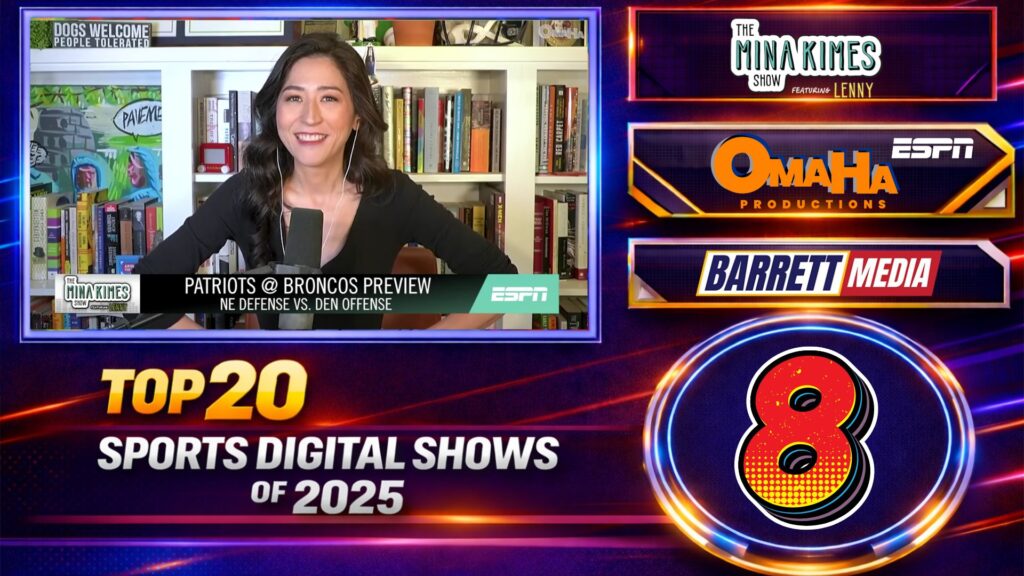
However, her — and Lenny’s — efforts recently earned the project a top-10 ranking in the Barrett Media Top Sports Digital Shows.

Mina Kimes Show
Photo Credit: Dylan Barrett, YouTube, ChatGPT, Canva

“It’s very generous and very kind,” said Kimes. “The digital show ranking I really appreciate. Over the last year or so, I’ve put a lot of work into it with incredible help from my partners at Omaha Productions toward trying to grow the podcast on YouTube. I understand how important that is for our industry, and I really appreciate that recognition.”

Kimes’ work earned further recognition when ESPN named her a full-time NFL analyst on NFL Live in 2020. Over the past five years, Mina Kimes said the show’s audience growth has fueled expansion. She noted that NFL Live now explores angles other daily NFL programs often avoid.

“When we rebooted the show five years ago, one of the things we all agreed upon was we wanted to trust fans to meet us where we were instead of talking down to them. Also not talking about the same topics everyone else was discussing,” noted Kimes. “Our producers trust us to do topics that are pretty complicated and detailed. We have found that fans really respond to that and tell me all the time they feel like they’re learning something when they watch.”

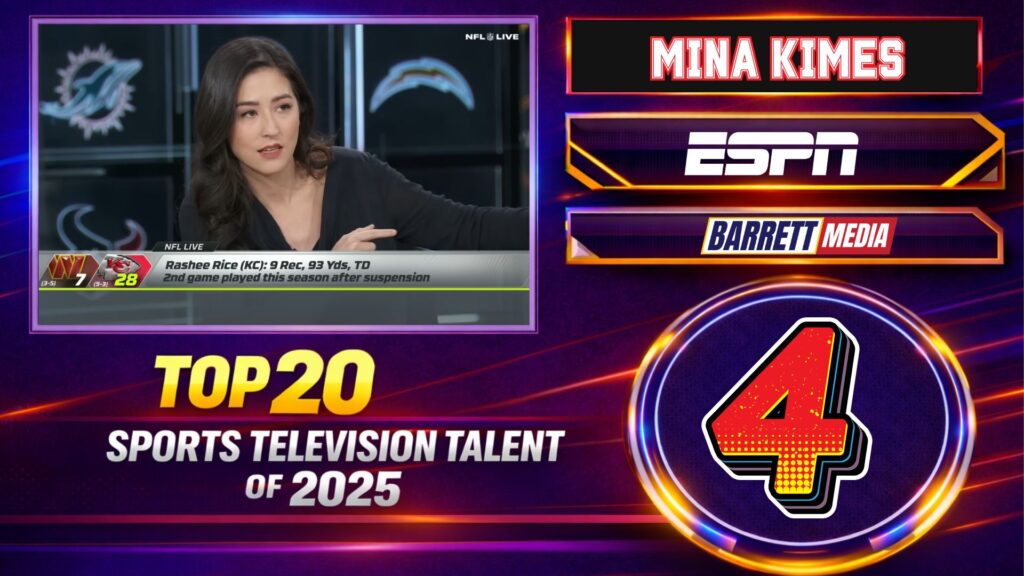
Barrett Media also recognized Kimes, ranking her the fourth-best sports television talent of 2025. The honor carries special meaning for Kimes, who hopes more women continue to earn national recognition from executives for the inroads they have made in sports media.

“I don’t even think my mom would rank me fourth,” joked Kimes. “You’re seeing women in bigger roles, certainly at ESPN. I hope to see that number continue to grow and hope to see more women on rankings like Barrett Media’s. Also, more women in different types of roles like mine, which is pretty unique.”

An All-In Approach

Kimes’ approach to content mirrors her passion for the entire league. Podcasting provides greater flexibility than television, which operates within a more structured format. Her focus centers on covering the league in a way that gives every team real estate on The Mina Kimes Show Featuring Lenny. Kimes says she pays close attention to analytics, which often reveal which topics resonate most when she dives into the data.

“Our audio numbers this year kept going up in addition to the digital views. That really speaks to how much people want really detailed football talk,” said Kimes. “I really try to cover the whole league. Podcasting can be a complement to television. If you feel that your team nationally is not getting enough analysis, come listen to my show.”

Another metric Kimes monitors is engagement in the comments on each episode. She views that feedback as coming from listeners who genuinely consume her work. She contrasts it with traditional social media reactions. As digital engagement and YouTube views continue to climb, she sees distribution growth as a primary focus for the year ahead.

“I find the digital engagement for the show is one of the few places on the internet I will look. Too often on social media, it’s people who aren’t consuming your work. It’s just people with opinions that have nothing to do with the content of what you’re providing. For my show, these are people that are listening and sometimes they’re really mad with me, and that’s okay as long as they’re listening and care to share their thoughts,” explained Kimes.

An ESPN Super Bowl

With ESPN preparing for its first Super Bowl broadcast in 2027, Mina Kimes said she is energized by the opportunity ahead. She praised the network’s football coverage as best-in-class. Kimes expects that commitment to become even more visible as the countdown to game day intensifies.

One element Kimes believes sets ESPN apart is the number of voices contributing to the network’s NFL coverage. That depth will only increase with added programming, further promotion and an all-gas, no-brakes approach to football’s crown jewel in Los Angeles.

“If you don’t already watch NFL Live, and know the way we talk about the sport, then I hope that more people will learn about us and watch,” said Kimes. “We’ll have a lot of exposure as we get closer to the game. I think our show [NFL Live] is a great representation of what our network can do. The Super Bowl will be a great opportunity for us to welcome people in and see that.”

ESPN has yet to reveal details about how it will present the Super Bowl. In the past, the network has housed the College Football Playoff and presented several alt-casts designed to cater to different viewer preferences for game day coverage.

Kimes believes an alt-cast approach to the Super Bowl could appeal to some viewers. However, it may not resonate with others.

“There are people who want more detailed football talk during games. One of my favorite things about The Manningcast is when the brothers get nerdy,” said Kimes. “As long as there is an understanding that success isn’t massive numbers for every single alt-cast. Instead, find a passionate audience. That’s how an alt-cast can thrive.”

As ESPN barrels toward its Super Bowl moment in 2027, Mina Kimes is not chasing the spotlight — she is building something sturdier. Trust from viewers who want to be challenged, and from listeners who crave depth over decibels. Trust from an industry still learning that authority in football does not have to come from a playing résumé, but from preparation, perspective and passion.

Mina Kimes carved out her lane by refusing to talk down to fans. She also refused to shrink herself to fit an outdated mold. Whether on NFL Live, hosting her podcast alongside Lenny, or dissecting the league’s most complex matchups, her approach remains steady. She respects the audience, and she respects the game.

“I just want to be better at things I’m already doing,” said Kimes. “I don’t even think the things I’m doing will be different [in 2026] but just do them better. On the digital side, I hope to continue to learn and figure out what my listeners and viewers want but not being overly responsive to that. I’m still chasing ideas. Trusting that my audience will be interested in it is something I would like to continue to do.”

Mina Kimes did not grow up under stadium lights. She built her platform one smart rep at a time. As the biggest event in sports inches closer, she stands as proof that in modern football media, the most powerful lanes are not inherited — they are created.

Barrett Media produces daily content on the music, news, and sports media industries. Sign up for our newsletters to stay updated and get the latest information right in your inbox.
State of the Union Showcases How Much Streaming Has Changed the Landscape

0

The State of the Union address has always been a made-for-television moment. It’s the Super Bowl of political programming, the one night each year when every news outlet knows viewers will show up.

What’s different now isn’t the speech itself. It’s how many screens are ready for it, and how early they’re turning the lights on.

On Tuesday night, CBS News 24/7, NBC News NOW, and ABC News Live will all roll out special coverage around President Trump’s address to Congress. These aren’t half-hearted simulcasts or placeholder shows, either. Major network figures are playing central roles, lending the same authority and familiarity viewers expect from linear television. The message is clear. Streaming isn’t the side dish anymore. It’s part of the main course.

That reality would’ve felt foreign during Trump’s first address to Congress in 2017. Back then, streaming news channels existed, but they weren’t appointment destinations. They weren’t promoted heavily. And they certainly didn’t feature the major players of the network news ecosystem. Most coverage still revolved around the traditional 9 PM ET linear window. Viewers tuned in, watched the speech, maybe stuck around for analysis, and called it a night. Digital extensions were there, but they were just that — extensions.

Fast forward to today, and the entire rhythm has changed. While linear television coverage on most networks still won’t begin until 9 PM ET, streaming platforms will be deep into wall-to-wall programming hours earlier. Some channels are gearing up as early as 4 PM ET. That’s a major investment in broadcasting context, anticipation, panel discussions, and audience engagement long before the president ever steps to the podium.

The evolution says a lot about how news consumption habits have shifted. Audiences don’t want to drop into a moment cold. There’s now a buildup expected. They want the storylines, the stakes, and the personalities laid out in advance. Streaming allows networks to meet that demand without blowing up their linear schedules.

There’s also a branding play at work here. By putting recognizable faces from the broadcast side front and center on streaming coverage, networks are signaling that these platforms matter. CBS News 24/7, NBC News NOW, and ABC News Live aren’t training grounds or overflow channels. They’re places where serious journalism happens, with serious talent attached to it.

That’s a far cry from the media environment of 2017. At that point, the idea of spending five straight hours watching pre-speech coverage on a free streaming channel would’ve seemed excessive. Today, it feels inevitable and like an expectation. Viewers dip in and out throughout the evening. Some watch at work. Others listen in the background. Many will catch highlights and analysis later, on demand.

What’s driving all of this is simple. There’s an endless appetite for news, especially around moments that feel consequential. Networks used to be limited by time slots and channel capacity. Those limits are largely gone now. If there’s demand, there’s a platform ready to fill it.

The State of the Union is the perfect example. Linear TV still delivers the big, shared moment at 9 PM ET. Streaming fills in everything around it. Before, during, and after, there’s space to explain, react, argue, and contextualize. None of it cannibalizes the other. Instead, it all works together.

That’s good news for viewers, who get more choice and flexibility than ever. It’s also good news for news organizations, which finally have endless avenues to provide coverage. In 2026, that’s not a bug in the system. It’s a fantastic feature.

Barrett Media produces daily content on the music, news, and sports media industries. Sign up for our newsletters to stay updated and get the latest information right in your inbox.
Don’t Let the State of the Union Swallow Your News/Talk Radio Schedule

0

There’s a never-ending pregame show for the State of the Union. I swear that news talk radio will spend the next two days focusing on President Trump’s first State of the Union of his second presidency.

I am girding my loins for a pregame show that is longer than the Super Bowl broadcast for a 90-minute speech that is little more than a campaign rally. We have all done it. Yes, your station should be carrying the speech. Oh, the postgame of the speech on Wednesday and Thursday will be insanely long as well.

So, how should news/talk radio handle this? I have three ideas on how to do just that.

Don’t Get Granular

So many hosts get into every little thing without thinking about being listener-focused. Perhaps there will be some magnificent drama where the speech will be torn up by the Speaker of the House or a senator will yell out, “liar!” in the middle of the presentation.

Talk about the big stories. Because of the plethora of choices, there are many options to avoid watching the speech. Now, most P1 news talk listeners will probably be watching the speech.

Here is the conundrum: your show’s P2 and P3 listeners just want to know the themes of the speech.

Don’t Take the Day Off From Show Prep

There is a big temptation to be lazy. This is easy content and very well may not be Topic A for today and later this week. Don’t give in. Show prep like you normally do for a show without an event like this. I think that you should actually prep harder.

On these occasions, I often hear hosts give similar takes without building an actual topic. Building that topic around something in the speech could work… But, if there is an actual story that is Topic A, do it!

Be Honest About the State of the Union Speech

If you have a reaction to the speech, don’t just give information like you are a news anchor. Opinion and personal observations are essential to make this a big moment. Even if you are a big fan of the president, if there is a moment that you didn’t like or agree with, tell the truth.

Is the pregame of the State of the Union speech water-cooler talk? No! Go out to eat for breakfast or lunch today and listen to the conversations. Most people will be discussing work problems, creepy kids, traffic, etc. Are you even boring the P1 listeners with a never-ending pregame?

Postgame may have some water-cooler talk. If there is something significant in the State of the Union, it will be discussed. As news/talk radio struggles with younger demographics, the State of the Union will be prime viewing for the 65-plus crowd, along with Jeopardy! and Wheel of Fortune.

Ask the people in your office — salespeople, the digital folk, administrative team members — whether they will be watching the State of the Union. I am guessing that most under the age of 65 will not be watching the speech unless they are politics or current events people in the programming department. Always follow Topic A: the biggest story is the biggest story.

I am not saying to ignore the State of the Union.

We should all be focused on the biggest story, and that could be the State of the Union, but more than likely, there will be something else. There are so many things going on that a single 90-minute speech that is basically a campaign rally with booing should not dominate 48 hours’ worth of your station’s programming.

One of Donald Trump’s skills is that he has figured out how to dominate the news cycle in a way that presidents before him have never done. I think that it is a fair discussion about how much we take the bait as a format. Trump has figured out how to get people frothing-at-the-mouth angry while simultaneously getting people to cheer.

The rapid-fire avalanche of news and discussion can really overtake what we do. Very early in my career, there were days when you couldn’t find easy things to discuss on a show. It took imagination and creativity to build an hour of news/talk radio. Trump feeds us so much content and is always on the offense. It is so easy just to cover President Trump. There is just more to life than Donald Trump.

Be listener-focused. I can’t remember the name of the reporter from one of the big TV news networks. She was discussing that there was no time off if you covered the White House with Donald Trump. You could wake up to a social media post that demanded coverage. She said that the Biden administration was predictable and rarely broke into the weekend with a fresh news story.

Trump seemingly creates news 24/7. Don’t be overwhelmed by the information. Be focused on your station’s target demographic before anything else.

As a format, we don’t want to be considered the Trump station. You may love what the president is doing, but don’t be that one-trick pony. Your listeners are busy and just want to be entertained.

Barrett Media produces daily content on the music, news, and sports media industries. Sign up for our newsletters to stay updated and get the latest information right in your inbox.

Music Radio Must Stop Cloning Playlists And Start Creating Culture

0

If you’re a music radio fanatic and the music is a great part of why you jumped into radio, what are you waiting for? We are being outplayed by platforms that were not even a piece of code twenty years ago. Today, few of us are doing anything about it other than reacting.

There was a time when radio didn’t wait for a spreadsheet to grant permission to chase a hit. Stations — large and small — broke records because someone behind the mic believed in those hits. Music quarter hours were built in tandem by both the programmer and air talent. Many reading this wax poetic about placing certain records inside the music hour simply by the way the song felt in a clock position.

Music radio always grows when an individual is willing to risk a little discomfort for new music discovery. If radio wants to matter tomorrow — or today — it can’t just reflect pop culture. Radio has to create it.

So, when asked early last week to be a part of Barrett Media’s weekly 4-Cast discussion on music differentiation among formats, I was reminded that playlists all over the country are homogenized. Smaller-market brands without research resources are following larger-market formats. While other large markets are watching their major-market peers.

This is hardly a new phenomenon.

By format, successful brands were often echoed throughout a region of the country or, at times, the entire country. Stations in New Hampshire would watch the music activity of those in New York. Brands in Champaign would mirror large-market stations in Chicago.

In the summer of 2024, we encouraged those without solid outside guidance to use various data tools to track immediate listener acceptance. We still encourage you to maintain discipline in music list building. The “hits are the hits.”

However, aggressively looking for emerging musicians or trends free from outside label influence will create a music playlist unique to your market.

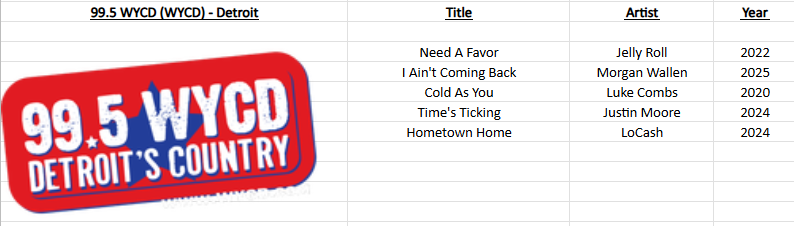
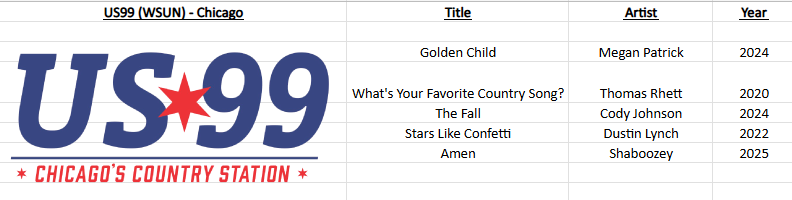
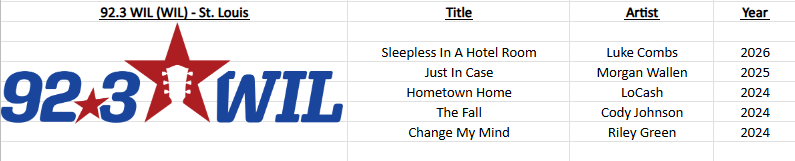
As an example, here are a few country products and their five-song snapshot — a little over a quarter hour — from their midday shows:

We could repeat this exercise for Adult Contemporary, Hot AC, Classic Rock, and nearly every rated format in America. We would find the same mentality. Find a successful example — and clone it.

Past examples of chart-toppers in the country orbit that delivered buzz for courageous programmers sensing a hit include:

Fancy Like — Walker Hayes

This wasn’t built by Nashville. TikTok takes the credit for this smash. Walker Hayes and his daughter posted a quirky dance in their kitchen that went viral. Smart marketers at Applebee’s — mentioned in the lyrics — turned it into a national ad campaign.

Country radio followed that cultural moment in time rather than creating it.

Old Town Road — Lil Nas X

Another TikTok victory. Before radio would touch it, the song exploded on TikTok with the “Yeehaw Challenge.” Far from traditional country, the re-release added Billy Ray Cyrus, forcing country to confront genre lines.

Billboard removed it from the country chart while the song continued getting monster country spins. It became the longest-running No. 1 in Hot 100 history while some blinder-focused country programmers debated whether to play it.

Cruise — Florida Georgia Line

This gigantic hit started on college campuses regionally. However, the addition of Nelly sent it into the stratosphere. Fueled by college crowds and streaming buzz, Cruise rewrote the country-pop playbook with a new, groundbreaking sound, becoming one of the biggest-selling country singles ever. Proof that another grassroots sensation forced country radio’s hand.

Music trends are being exposed and formed at lightning speed. Digital dominates, and music discovery is happening within a day. Smart country programmers will watch these platforms and even develop a Listener Advisory Board to assist in combing through the mounds of content exposed daily.

This isn’t a punitive jab at country music providers.

The above examples are just that — examples. Every format is allowing culture to pace its stations. From the late 1950s through the 1980s, music radio was a pop-cultural phenomenon. Aside from the corner vinyl store, radio was where kids unearthed new trends in music and pop culture.

Another short list of songs that built virally without record company muscle, becoming too strong to ignore, include:

The Middle — Zedd/Maren Morris

Originally written for Camila Cabello (and she sang a demo of The Middle), a deal couldn’t be put together. Demi Lovato also passed on the project. The song floated around the industry, with co-writer Sarah Aarons pitching her version.

Maren Morris eventually recorded the version that topped the charts and would not die in radio station research camps. The record also received substantial country radio exposure. Another possible early Secret Weapon missed.

Truth Hurts — Lizzo

Released in 2017, the track had early programming adopters, but that didn’t last. The bouncy, stripped-down song only blew up after being featured in the Netflix film Someone Great. A meme (“I just took a DNA test…”) went viral, streaming surged, and radio picked it up, making it a number one hit in 2019.

An industry nugget ignored by programmers and fumbled by the record label. (Also see Red Pony Club by Chappell Roan.)

Running Up That Hill — Kate Bush

This one became a pop-culture no-brainer. Top 40 programmers initially scoffed at allowing a 1985 fringe-pop ditty onto their playlists. When Max was running from Vecna in 2022’s Stranger Things, it sealed the deal. The song was everywhere. TikTok, digital platforms, and streaming skyrocketed while radio programmers scrambled to find an air-quality version, eventually adding the 37-year-old song into heavy rotation. Pop culture pushed radio — again.

Treat your playlist as a living, breathing part of your programming. Start with a weekly — or daily — peek at digital sales data. Post-Super Bowl streams were dominated by Bad Bunny, Lynyrd Skynyrd, and Kid Rock. A peek at today’s streaming hits shows that Classic Rock should be playing Free Bird several times a day due to exposure following Team USA’s men’s hockey remarkable win over Canada on Sunday morning.

What is bubbling under, and where should you look to ensure your music list is reflecting — or creating — pop-culture moments?

We Are Charlie Kirk — Spalexma

Be careful with this one because of the politics it carries. In addition, this is an A.I.-generated tune that, in some regions, is getting ear play without traditional radio airplay. Spotify and TikTok are seeing robust trends on this track.

Say My Name in Your Sleep — Maisie Peters

Released digitally in November 2025, this ghostly tune sticks in your head and ranks high on YouTube’s list of Most Replayed Songs. There’s strong streaming interest and playlisting on Spotify, but radio is largely ignoring it. Secret weapon possibly — here.

Party 4 U — Charli XCX (resurgence)

Originally recorded nine years ago, a TikTok- and Spotify-driven streaming surge is giving this single new life. The official release came in 2020, with Atlantic Records reissuing it last May. TikTok and Instagram Reels trends are focusing on the second verse, driving the growth. Radio impact remains minimal compared to online buzz.

You make a great effort to ensure your packaging is unique, your talent can’t be duplicated, and events you own connect with your community.

Regardless of the format, your playlist should be custom to your vision and the expectations of the listener. If you are fortunate to have live Listener Panels, ask your participants to read their Top 20 Most Played songs on Spotify — or any platform.

You and the panel group will certainly be surprised. Your playlist needs surprises too.

Two weeks back, Barrett Media colleague Jim Ryan wrote that music radio shouldn’t seek better research. What music radio needs to grow Average Quarter Hour with TALENT is courage.

The same goes for your playlist. Where are the courageous?

Barrett Media produces daily content on the music, news, and sports media industries. Sign up for our newsletters to stay updated and get the latest information right in your inbox.

How Moon Griffon Built a Louisiana News/Talk Radio Empire

0

Moon Griffon didn’t build his career the way radio is supposed to work. From the start, The Moon Griffon Show grew outside the traditional model you might expect.

For more than three decades, Griffon has done something most broadcasters wouldn’t even attempt: he’s never been paid by a radio station. Not once. Instead, he bartered his time, sold his own advertising, and turned a statewide talk show into a business he owned rather than a job he worked.

What started out as an insanely short trial run turned into a 33-year career.

What started as curiosity turned into opportunity, then momentum. The early shows kept getting renewed in short bursts — 13 weeks at a time — and Griffon noticed something important: nobody was paying him, but nobody was stopping him either. He wasn’t an employee. He was a renter.

“I had an hour, and then things took off from a local level,” he said. “When I started in radio with no experience, I probably sounded pretty raw. It just started to grow, and once we got going pretty well, I got a wild idea. I looked all over the state of Louisiana and noticed there was not a syndicated program covering state issues.”

That realization became the foundation of The Moon Griffon Show. Griffon didn’t want to be another local host talking about hyperlocal issues that limited growth. He wanted something scalable inside Louisiana, a statewide conversation that could live on multiple stations without being trapped by city lines.

“This is my 33rd year. I’ve done over 8,400 programs, and I’ve never been paid by a radio station. Not one check. I always bought my time. I don’t blame them — I listen to me, and I wouldn’t pay me either,” he said with a laugh. “And I realized quickly that if you wanted to make it in this business, it was better to own it than work for somebody.”

Owning it meant everything fell on him. If the show failed, there was no safety net. If it succeeded, the reward wouldn’t come from a station’s payroll department.

“I formed a company and started traveling to radio stations,” Griffon said. “When someone took us, I’d go into the market and help them sell advertising. That’s how the program grew — one station at a time — by helping them make money. We covered national issues, but we focused heavily on state issues nobody else was covering.”

That approach was strategic. Moon Griffon knew stations didn’t need another host asking for a salary and talking about national topics. They needed revenue and relevance.

“I would go say ‘Here’s what I’m going to do: You put me on, buy the time, and I’m going to help you make money. If I don’t make you money in a year, fine, don’t keep me.’ And they’d say it sounded great — and still wouldn’t move. That never made sense to me.”

Still, he kept pushing. He paid his own producer, sold his own ads, and traveled market to market, sometimes getting fired, sometimes getting traction, but always refining the model.

“I do my own research, I do my own show, I pay a producer — right now that’s my son — and I sell the advertising,” Griffon said. “I created a business model where stations buy the time, make money locally, and I help them. And I make money selling the network.”

The on-air product followed the same logic. Statewide issues made listeners feel included, no matter where they lived.

“When you cover a state issue, you make sure it affects everyone,” he said. “Roads, bridges, taxes, the governor. I very seldom touch local issues. It’s always state or national, so everyone feels included. Nobody taught me radio. It’s trial and error.”

That trial-and-error education took time. He admitted it took quite awhile before he was confident in the craft.

“It took about 20 years before I felt like I knew what I was doing,” Griffon said. “When nobody teaches you anything, you learn the hard way. I learned as I went. I was a big fan of Rush Limbaugh. Now, I didn’t try to copy him, but I believed God gave me the ability to entertain and laugh at myself.”

The grind wasn’t just on the air. It was personal.

“I’ve fallen down as much as I’ve succeeded, but I kept getting up,” he said. “My wife, Tanya, has been great behind me, always telling me to keep going.”

Today, The Moon Griffon Show airs on 10 stations across Louisiana. Recently, he earned 10th place in the Mid-Market News/Talk Midday Show category in our Top 20 series. Griffon says Baton Rouge has become one of his strongest markets, while New Orleans remains the toughest, a reminder of how much scale still matters in radio.

“If I were on one of the big stations there, it would make a huge difference,” he said. “But we’re known across the state. I travel all over — small towns, big cities. I’ve met so many people and built real relationships.”

While there are challenges to running his own show and syndicating it himself, Moon Griffon says there are good sides, too.

“It’s been very rewarding financially and in other areas because I own it. I don’t have to wait on somebody to bless me with permission.”

Still, Moon Griffon wants more. He’s open about that. The dream was never just Louisiana. He has his eyes set on expansion

“My goal was to cover about 13 southern states,” he said. “I haven’t made that, and that’s my biggest disappointment. If someone helped me get stations, I’d do the work. I’m not asking for a paycheck. I’ll make my own money. I just need help promoting and getting stations.

“I always thought I could do it on my own, but at some point you can’t move the needle alone anymore,” he admitted. “I’ve had a blast doing this and would love to do 10 more years, but I want to expand. I’m hoping a syndicator conversation helps, because I don’t think I can do it alone anymore.”

Barrett Media produces daily content on the music, news, and sports media industries. Sign up for our newsletters to stay updated and get the latest information right in your inbox.

Premiere Networks Will Continue Rev. Jesse Jackson’s Radio Show Hosted by Daughter Santita Jackson

0

Following the death of Rev. Jesse Jackson, Premiere Networks has announced it will continue his longstanding radio show, with his oldest daughter, Santita, helming the show.

Keep Hope Alive with Rev. Jesse Jackson will continue under the leadership of Santita Jackson, who has served as the executive producer of the program. The two-hour show airs on Sundays from 8-10 AM ET. Santita Jackson is no stranger to radio. She hosts The Morning Drive with Santitay Jackson on AM 950 KTNF in the Twin Cities, and previously worked as host of a show at WVON 1690 AM in Chicago.

“We’re deeply saddened by the loss of Rev. Jesse Jackson, and it has been an honor to work with him and his family throughout the past two decades of his Keep Hope Alive radio show,” said Premiere Networks President Julie Talbott. “Santita Jackson is uniquely positioned to carry forward his legacy and his unwavering commitment to community and social justice — values he championed so powerfully for listeners and stations across the country.”

“Rev. Jackson has been a transformative voice in American life, and it was a privilege to work with him dating back to The Jesse Jackson Show with Quincy Jones in the 1990s,” added iHeartMedia Chairman and CEO Bob Pittman. “We’ve valued our relationship with him over the years and look forward to celebrating his lasting impact on the national conversation and our culture—an influence that will continue to resonate for generations.”

Barrett Media produces daily content on the music, news, and sports media industries. Sign up for our newsletters to stay updated and get the latest information right in your inbox.
Mike Ryan Ruiz on Josh Pate’s Interview With President Donald Trump: “Embarrassing”

0

The fallout from college football commentator Josh Pate’s interview with President Donald Trump has continued following the release of the interview over the weekend. Some sports commentators were skeptical of the approach that Pate would take with the interview, with some of Pate’s loudest critics saying last week he is not the type of commentator that would succeed with an interview with the current President.

The Dan Le Batard Show producer Mike Ryan Ruiz was one of the most vocal critics of Pate’s approval for the interview, and shared his critique of the sit down on Monday’s program. Ryan Ruiz argued that the conversation neither delivered meaningful political insight nor satisfied the expectations of a sports audience that was promised a substantive discussion about college football issues.

“It wasn’t a political discussion. I don’t know how much was edited, but there was one moment where Trump patted himself on the back about the job that he did with Venezuela. But even for Trump, who meanders and rambles a lot, like he didn’t inject a lot of that into the conversation,” said Ryan Ruiz.

Ruiz suggested the interview feel was unusually restrained yet ultimately shallow. He also took issue with what he described as a surprising lack of college football substance, explaining that listeners who tuned in expecting a focused conversation on the sport instead heard what he characterized as an unfocused mix of soft prompts and tangents.

“There also wasn’t college football. It was actually really embarrassing,” said Ryan Ruiz. “There was one soft toss to the President. What would you do about this? He started rambling about how the Gamecocks are good and the NFL kickoff rule. It was just bad.”

Expanding on that criticism, Ruiz cited what he called a misleading pre-interview buildup. He said it positioned the segment around Name, Image, and Likeness policy. However, he argued the final interview shifted toward broader personal reflections. The discussion included questions about how Trump hires staff and lessons from his two presidential terms. It even featured a story about the Lincoln Bedroom. Ruiz contended those topics did not deliver the promised depth on NIL or the sport’s evolving structure.

“There was nothing there in terms of substantial NIL opinion,” Ruiz said, adding that he reviewed what he called a full list of nine questions and concluded the segment functioned more as a profile-raising moment for Pate than a rigorous examination of college football policy intersecting with politics.

Ruiz argued that Donald Trump benefited most from the appearance. He said the former president “got what he wanted, which was a sports platform normalizing him and bringing an audience to Josh Pate.” Ruiz added that the interview “didn’t achieve anything other than that.” His critique reflects a broader concern. He believes political figures increasingly use sports media to reach audiences who may not follow traditional news outlets.

Barrett Media produces daily content on the music, news, and sports media industries. Sign up for our newsletters to stay updated and get the latest information right in your inbox.
ABC News Sets Coverage Plans for State of the Union Address

0

ABC News has announced its plans for coverage of President Donald Trump’s State of the Union address on Tuesday evening.

World News Tonight anchor David Muir will lead the network’s coverage from the nation’s capital beginning at 9 PM ET. Joining him are anchor Linsey Davis, chief White House correspondent Mary Bruce, chief global affairs correspondent Martha Raddatz, chief Washington correspondent Jonathan Karl, chief justice correspondent Pierre Thomas, senior political correspondent Rachel Scott, and correspondent Jay O’Brien.

Additionally, contributors Donna Brazile and Chris Christie will appear on the network’s coverage on Tuesday. Former Speaker of the House Kevin McCarthy will also provide analysis on both ABC and the ABC News Live streaming platform.

The network will also feature coverage of the Democratic response from Gov. Abigail Spanberger (D-VA).

The ABC News Live streaming platform will begin coverage at 7 PM ET with a special edition of Prime with Linsey Davis. Kyra Phillips will anchor a pre-speech program at 8 PM ET, with Davis anchoring the post-speech coverage at 11 PM ET.

Furthermore, ABC News Radio coverage will be anchored by national correspondent Steven Portnoy. He’ll be joined by White House correspondent Karen Travers and other contributors and experts for analysis. The network’s daily podcast — Start Here — will feature a special edition of the program on Wednesday, February 25th, reacting to President Trump’s speech.

Barrett Media produces daily content on the music, news, and sports media industries. Sign up for our newsletters to stay updated and get the latest information right in your inbox.