

Home Blog Page 780

‘MLB Tonight’ Not Losing Its ‘Fastball’ During The Offseason

0

MLB Tonight has become a flagship program, airing nightly on MLB Network. The program provides comprehensive coverage, highlights, commentary, and opinions on all things Major League Baseball. It also offers postgame interviews and expert analysis from former players, coaches, and front office personnel. 

One thing is for sure, MLB Tonight does not lose its fastball in the offseason. In fact, it maintains a tremendous repertoire. I caught the program on Sunday hosted by Brian Kenny and Dan Plesac. These two veterans of MLB Network have become welcome fixtures. 

Kenny is the engine that makes MLB Network run. His unabashed knowledge and dedication to analytics may rankle some baseball hunch mavens, but he is ultra-prepared and always on point with his commentary. Kenny is a ‘tough out’ in terms of debate because he has statistical knowledge that brings down any flimsy argument. 

Plesac brings a whole different perspective. The former MLB pitcher has boundless enthusiasm for the game and a wealth of knowledge from his playing days and longtime broadcasting career. What I like most about Plesac is the excitement and passion he has for the game. 

During the guts of the MLB season, MLB Tonight features several hosts and analysts at the anchor desk. For this preseason edition, Kenny and Plesac were a terrific combo – more than enough to satisfy the Spring Training baseball appetite. Like a steaming hot dog on a hot summer day at the ballpark, Kenny and Plesac are the perfect snack for baseball-starved fans. 

The pair have excellent chemistry. Often times, opposite personalities click best on air, but in this case, both of these conservative, button-down, veteran broadcasters mesh very well. Kenny knows how to set Plesac up for commentary, and Plesac knows how to come back at Kenny to initiate discussion and debate. The great thing about Kenny is that he’s not just a set up guy, he has the knowledge and ability to analyze the game as deeply as any ex-player. He can act the straight man and deliver the punch line. 

Kenny teased upcoming segments on the show and then he and Plesac jumped right into Red Sox highlights. Kenny mentioned that the Sox were a .500 club last year, but have made some key off-season acquisitions including Alex Bregman and pitcher Garrett Crochet, among others. Throughout all the game highlights, Kenny sets up the action and smoothly works in a question to Plesac. 

The MLB Tonight production staff ably uses graphics to punch up the host and analyst commentary, offering a sort of electronic box score of each game. For the Red Sox highlights, a graphic worked right into the theme of new Boston acquisitions showing that 

Bregman was 3-3 with a home run and 3 RBI, and that Crochet pitched 1 2/3 innings giving up 3 hits and no earned runs. In addition to the highlights and commentary, MLB Tonight often shows images of social media posts from various MLB reporters talking about injuries, player movement, and other news. 

Coming out of the Dodgers versus Padres highlights, Plesac made a great point that MLB teams are bringing young players up more quickly than in the past because they don’t want to waste their immense talent in AA or AAA. It’s always fun to see new broadcasting talent blossom on air, but sometimes, it’s nice to just sit back, relax, and watch two seasoned pros do their work. Kenny and Plesac keep audiences riveted. They are the Maris and Mantle of MLB Network. 

The duo took a deep dive into the Los Angeles Dodgers’ pitching rotation options while a graphic displayed definite starters, pitchers battling for the fifth spot in the rotation, and overall pitching depth. It also noted that Shohei Ohtani and Clayton Kershaw are expected to return in May or June.  

When Plesac predicted that the Dodgers would win 96 games, Kenny laughed and said it was an insult. Ever the statistician, Kenny said that he would be disappointed if the Dodgers didn’t reach the PECOTA Projection of 103 wins. PECOTA, which stands for Player Empirical Comparison and Optimization Test Algorithm, is a Baseball Prospectus system that takes a player’s past performance and tries to project the most likely outcome for the following season.  

The topic made for a lively debate. 

Projections were a running theme on this edition of MLB Tonight as Kenny and Plesac looked at the Atlanta Braves pitching rotation and the Yankees’ outfield situation among other topics. 

If you are a baseball fan, there is nothing like highlights of Grapefruit and Cactus League in February. Plesac and Kenny understand this. They get how baseball is tied to the season. Even if you look outside and see gray skies and snow, a look back at your TV shows players catching pop-ups and fielding grounders, and you know that spring is imminent. 

Plesac and Kenny are dressed in conservative suits and ties. They look like they should be seated at the uncles’ table at a wedding, but they are hardly stodgy. These dudes know the game completely. They bring a traditional style, but see baseball from a contemporary perspective. They know the young players coming up as well as their collective potentials and possibilities. They also provide solid analysis during and between highlights. 

In another closer look graphic, Kenny and Plesac discussed the Cardinals’ young shortstop, JJ Wetherholt. The 22 year-old was the 7th overall pick in the 2024 MLB draft and is currently the number 23 Prospect at mlb.com. Wetherholt delivered solid stats at the single level last season with a .295 batting average, 20 RBI, and an .805 OPS in 29 games. 

Baseball, more than any other major sport, lends itself to statistics. Kenny and Plesac take these numbers and turn them into great discussion. In the ‘Digging In’ segment, Kenny referenced MLB Network’s omnipresent Shredder, talked about, and ranked his top ten relief pitchers currently playing. Devin Williams of the Yankees, Tyler Holton of Detroit, Emmanuel Clase of the Guardians, and the A’s Mason Miller were mentioned. Looking at their stats, Kenny picked Miller as the best reliever in the game while Plesac went with Clase openly spouting that he’s the closest thing we’ve seen to Mariano Rivera. 

Beyond numbers and decimal points, Kenny and Plesac have fun doing their jobs. At the end of the show, they showed video of Alex Rodriguez hitting a half-court basketball shot at a Bucknell University basketball game helping a fan to win money. They even reran the video with a voice over of legendary Yankee broadcaster John Sterling calling the shot. 

MLB Tonight is a terrific program largely because of talents like Kenny and Plesac. To put it in a statistical perspective, I love their OPS – Observant, Passionate, Skilled. 

Barrett Media produces daily content on the music, news, and sports media industries. To stay updated, sign up for our newsletters and get the latest information delivered straight to your inbox.

NFL Combine Confidential: How Sports Radio Tackles Coverage Differently

0

With the conclusion of the NFL season, football fans across America shift their focus from the biggest stars of today to the prospects of tomorrow. The NFL Combine officially begins today in Indianapolis, IN, as 329 athletes with dreams of football immortality perform in front of hundreds of team executives, coaches, and scouts. This marks the beginning of the NFL Draft hype. For the league, the combine also serves as the kickoff for another season of content, with the NFL Network providing more than 50 hours of live coverage, offering a first-hand look at the 2025 NFL Draft class. 

For fans of teams picking high in the draft, this event provides an opportunity to turn the disappointment of a losing season into future success. Teams must decide whether to select the best player available based on their scouting or choose the best player to fill a specific roster need. This is what makes the NFL Draft the single greatest reality show in professional sports, as college athletes see their dreams realized in a single moment when Commissioner Roger Goodell calls their names. 

Sports radio listeners are always hungry for football-related content, and the NFL Combine is the first opportunity of the offseason to feed that appetite. However, the challenge for sports radio talent is determining the best way to cover the start of “draft season,” particularly in markets with top-five draft picks. Since every NFL market has unique interests and priorities, the level of focus on the combine varies significantly. 

Speaking with several sports radio hosts from each of the top five draft markets, it was surprising to hear that several do not plan to place a heavier emphasis on the combine. 

“I wouldn’t say there will be a shift in focus,” said Brandon Tierney, who co-hosts middays with Sal Licata on New York’s WFAN. “We will certainly weave draft notes and other observations about the top QB prospects and potential trades into our shows. But we’ll also maintain a healthy balance with Yankees, Mets, Knicks, and NCAA Tournament coverage.” 

Jonathan Peterlin, who co-hosts Afternoon Drive on 92.3 The Fan in Cleveland, echoed Tierney’s sentiment. 

“I don’t think there will be an overwhelming amount of discussion about the combine itself, especially since the top two quarterbacks aren’t throwing,” Peterlin said. “The on-field drills, measurables, and workouts in shorts and T-shirts just don’t generate much excitement.” 

While Tierney and Peterlin plan for limited added combine coverage, Jared Stillman, co-host of Stillman & Company on Nashville’s 102.5 The Game, takes a different approach. 

“We are pretty much talking draft 99% of the time now anyway,” Stillman said. “We are virtually all Titans and draft all the time right now.” 

Mia O’Brien of 1010XL in Jacksonville, co-host of the all-female midday show Helmets & Heels, noted that the NFL Combine is always appointment radio for their audience. 

“Given the state of the Jaguars over the last 15 years, the combine is practically a holiday for our city and fanbase,” O’Brien joked. “Even with the head coach and general manager searches this year, the combine and draft still snuck up on us.” 

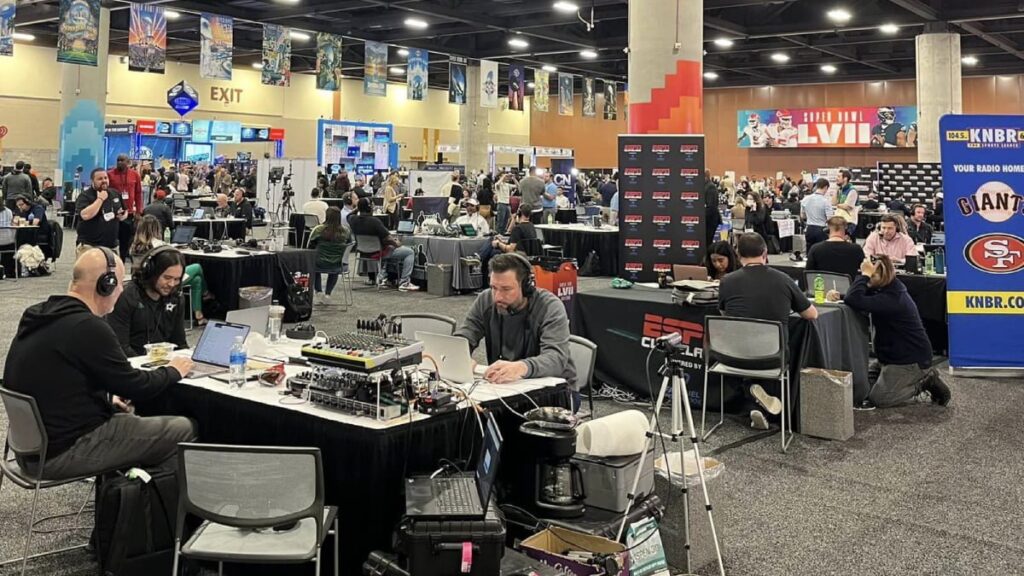
Much like the Super Bowl, the NFL Combine features its own version of “radio row.” Media outlets from radio, television, and digital platforms set up to gain exclusive access to team executives, draft prospects, and league insiders. However, the atmosphere is far less commercialized compared to the Super Bowl. 

With sports radio budgets shrinking and the demand for content growing, some wonder whether a week of live shows at the NFL Combine could provide stronger content at a fraction of the cost of a Super Bowl trip. 

Former NFL linebacker and WEEI Afternoons host Ted Johnson believes that, despite the potential benefits, the combine doesn’t compare to the Super Bowl for a radio row setup. 

“I think radio row at the Super Bowl is more valuable to attend,” Johnson said. “The week leading up to the Super Bowl attracts more celebrities, NFL players, and other big names.” 

Stillman agrees, noting that it all comes down to investing in an event with the biggest stars. 

“The combine just doesn’t have the same star power as the Super Bowl,” he said. “It has a lot of media and coaches, but not the same level of recognizable figures.” 

There is no doubt that the Super Bowl boasts more star power. However, that also means countless corporate pitches, making the week sound like one long advertisement. From a pure content perspective, the NFL Combine might be more useful for sports radio, offering greater access to team personnel and prospects that local fans care about. 

“In terms of sheer substance, I think the combine offers much more—and much more ‘inside scoops,’” O’Brien explained. “That’s exactly what our audience in Jacksonville wants.” 

Jeff Rickard oversees 93.5/107.5 The Fan in Indianapolis said his plans are to have live shows all week from the NFL Combine gathering content and interviews as they serve their local consumers. He said he understands the value of the content you could create from broadcasting live from the NFL Combine, but also believes in the current state of the industry it has to sense for the bottom dollar. 

“I think it’s important to your audience. I think they’re invested, and they want to hear what their general manager and their coach plan on doing, what their plans are going to be,” said Rickard. “They like to know that their teams are doing something, and of course we’re the conduit for that. We let them know what’s going on. I do think it’s important, if you can afford it to do that.” 

Rickard understands the challenges being both a brand manager and morning show host about expenditures being a huge hurdle for many markets considering trips like the Super Bowl or the NFL Combine. 

“Can we turn around and find somebody to underwrite that cost for us and use it as an advertising vehicle,” Rickard questioned. “I think that’s really the important question to ask in today’s world.” 

Even for some of the largest sports radio brands, broadcasting live from the combine isn’t a priority at all. 

“Broadcasting from the combine is not something we have explored, nor do I envision us doing so in the future,” said Tierney of WFAN. “Wouldn’t be opposed to it, but I just don’t see it happening on the local level.” 

Brandon Tierney
Courtesy: Derek Futterman, Barrett Sports Media

The NFL Combine features four days of on-field drills designed to test the strength, speed, and durability of each prospect. It’s the only event where a fraction of a second or a single dropped pass can heavily influence a player’s draft stock and future earnings. However, despite the high stakes, these workouts don’t always translate into compelling sports radio content. 

“The real allure of the combine isn’t the actual on-field work,” Peterlin said. 

“Too much of that info is boring, quite frankly,” Tierney added. 

NFL Network’s coverage of the combine often involves analysts raving about a player’s “great hands” or “quick feet” while comparing them to Hall of Fame legends. While this event is crucial for draft prospects, its overall significance within the draft process is up for debate. When asked to rank the importance of the combine compared to the Senior Bowl and pro day workouts, most agreed that the combine stands above the rest. 

“The NFL Combine is definitely the most interesting event,” Johnson said. “It covers the top 300 college football players. No bowl game or all-star event matches what the combine brings.” 

For sports radio hosts, knowing what not to discuss is just as important as knowing what to highlight. Some draft-related topics can quickly become listener tune-outs. 

“The constant regurgitation of draft phrases like ‘quick and loose hips, anticipation, and ability to process’—give me a break,” Tierney said. “The verbiage is tired and corny.” 

Additionally, while some prospects shine during drills, they may lack the personality to make engaging radio guests. 

“My biggest tune-out is listening to players on the air. Maybe one out of twenty college players is remotely interesting in an interview,” Stillman said. 

With 329 prospects participating in the combine, there’s a vast amount of data to analyze. For sports radio hosts, the challenge is determining how deep to go in discussing individual players and how it impacts their local team. 

“At some point, you can get too deep into the weeds,” Peterlin said. “If we’re breaking down the seventh-best player at a given position who’s projected to go in the fifth round—what are we really doing here?” 

Since 1987, Indianapolis has hosted the NFL Combine, where football dreams can be realized or shattered in a single moment. Last year, the NFL Combine had its highest viewership on NFL Network since 2018, with a 12% increase from 2023. This year’s event follows the most-watched Super Bowl of all time, which had a record average audience of 127.7 million viewers. You can expect the attention and desire for content from this year’s NFL Combine to continue to grow. 

Sports radio programmers and talent alike understand that the NFL and content surrounding every aspect of the league reigns supreme. Sports radio listeners in every NFL market expect their favorite shows to deliver content that matters—content that helps fans understand how their team is preparing for the future and chasing the ultimate dream of Super Bowl glory. 

Like any individual team’s playbook, the challenge is in the execution.  From pivoting content strategy to accessing exclusive moments with key figures that matter in enhancing the fan experience, the game within the game for sports radio talent is to meet that expectation with the NFL Combine setting themselves up for a successful path to ‘Draft Day.’ 

Barrett Media produces daily content on the music, news, and sports media industries. To stay updated, sign up for our newsletters and get the latest information delivered straight to your inbox.
Bad Commercials Can Be More Problematic Than Long Stop Sets

0

For many years, both the radio industry and listeners have complained about long stop sets. Recent research has indicated that bad commercials are just as likely to cause turnout as the long break from music.

Program Directors often cringe when they hear that commercial that has the phone number in it three times or a grammatically incorrect, poorly produced piece.  

So, what should be done about it? I spoke with a former producer for a major broadcast company who agreed to speak on the condition of anonymity.

“I think there’s a couple of boxes that need to be checked off to fix what’s wrong. One of them is to get rid of long spot blocks. Then you’re in a position where you can start to hit and run with smaller, quicker commercials.”

“And one idea per spot. I know jocks who do the same thing. How many times have we said, as Program Directors, one idea per break?” 

“Well, spots should be the same, one idea per spot. If you’ve got a client who has multiple things going on or multiple services or wants to hone in on two or three things that he thinks are pain points that he’d like to get across to his customer, then do separate spots for each one and rotate them. I don’t know how many times I see 30-second commercials crammed with two or three ideas.”

“Studies have shown that every time you introduce a new idea into a commercial and step away from your original idea, retention goes down by 60%. If you’ve added three, then it’s even worse than that.” 

“I think that’s another reason why some people hang on to 60-second spots, because they have a lot of territory they want to cover, and they can’t do it in a 30. But why it doesn’t occur to them to do it in separate spots is beyond me.”

The idea of “selling something” in the commercial is something he sees as a waste.

“Focus on people who don’t like to be sold to. Think in more macro terms; when you’re putting radio commercials together, don’t list off prices and particular products. Think about lifestyle; look at the commercials that you think are successful. People say, oh, listeners hate commercials. No, they don’t. They hate bad ones.”

“Half this country tunes into the Super Bowl, not for the game, but for the commercials. Good copy and entertaining commercials can be effective. And you look at any of those commercials that you see that are memorable; they aren’t rattling off price and features. They’re dealing with lifestyle issues.”

“You’ll hear bundle home and auto together. But other than that, it’s a comedy routine. So, you need to think about those kinds of terms to make your copy entertaining.”

He also considers it critical to have a copywriter and never lets a salesperson pick up a pen, with one exception.

“Never let a salesperson pick up a pen unless it’s to fill out an order. Don’t let clients or salespeople write copy. I don’t want a salesperson sitting at his desk writing copy; I want them out selling.”

It sounds like there might be a story there.

“I had an AE come in with a commercial written on a napkin from lunch with a client.  I looked at it and said, ‘”Did your client write this copy himself?”’

And letting them write bad copy cascades into more significant issues.

“What is this thing going to run for a week or so, two weeks? And you know what’s going to happen? You’re going to go back to him to try and get him to re-up, and he’s going to tell you, no, I tried radio, and it didn’t work.”

“And the worst part is, he’s going to go to the Chamber of Commerce golf tournament in a week or two, and he’s going to tell everybody that he plays golf with at the Chamber of Commerce that he tried radio, and it didn’t work, because you couldn’t leave $500 on the table. That’s the worst part about putting bad copy on the air for clients. But typically, I find that our problem is we have AEs who were trained improperly, if at all, by guys from the 90s who were over-glorified order-takers.”

What are some of his copy pet peeves?

“Nobody should be in this day and age when listeners have a smaller attention span than a goldfish airing 60-second commercials anymore. I hear them all the time, especially on small-market radio stations. I’m not going to cite the market, but I did some work for it.”

“Their rock star salesperson, who’s been there for 25 years, still sells 60-second commercials to her clients. She had one restaurant client who ran off every lunch special they were having for the entire week in their commercial. This commercial gets updated every Friday for the following week.”

“Now, if you’re driving along listening, are you going to retain what each special is for the entire week? No, of course not. I suggested to her that she put a 30 together and change it each day with at least that day or tomorrow’s special.”

And how was that idea received?

“They’re still airing that 60-second commercial every week, rattling on every single special for the for the week. And that’s just not effective. But that thing that you and I hate, what do you hear when you try to suggest something different? Well, that’s the way we’ve always done it.”

We agreed that the copy that says, “next to McDonald’s or Walmart” is problematic.

“You’re assuming that the person who’s listening knows exactly where you are and what McDonald’s you’re talking about. And I mean, in some smaller markets, I suppose the geography is not that complicated.”

Another idea is to use a shorter commercial as a gateway to your own platform, which will allow you to cover more territory at a lower cost.

“In this day and age, where we have the internet, where you can have a website that’s got all kinds of good stuff in it, or even send out a weekly email blast to your customers, which is a highly effective way of reaching advertisers.”

“When I first started doing websites 30 years ago, I used to tell my clients who at that time were used to buying 60-second radio commercials, or worse half, page newspaper ads for hundreds of dollars, Buy a smaller ad and sell lifestyle don’t sell price, don’t sell particular items, sell a vibe about what your business is and then drive people to your website. Because the real estate there is not being charged per agate line or 30 seconds or per minute, you can put as much stuff as you want there.”

“Use your radio, newspaper, and television as your gateway to a platform that’s not costing you as much. And I think that can be the same with social media and email newsletters that people can sign up for.

“Use your radio to entertain; there’s no reason radio commercials can’t be as entertaining as everything else on the air. You certainly wouldn’t be as apt to lose listeners when commercial breaks came on if the commercial content was as entertaining as everything else that you had on the air. And if you’re looking for radio to be in a position to charge more for spots, that’s certainly one way to do it.”

Final thoughts?

“Hire a writer, hire a writer, hire a writer, there used to be writers in radio stations back in the 70s and 80s copywriters. And they were one of the first things to go along with the promotions budget.”

“The average American spends about 15 to 20 minutes in the car in the morning or afternoon drive time. If you’re running an eight or nine-minute spot block, you’re pushing the entire drive time that that guy is spending in the vehicle. He’s going to be lucky if he hears one song.”

“Nobody wants to listen to that. I think the only saving grace radio still has is that a lot of older demographics don’t like to mess around with technology, having to hook their phone up when they get into the vehicle or having to find an app or a stream icon and put they just want to get into the car on and have the music there.”

Barrett Media produces daily content on the music, news, and sports media industries. To stay updated, sign up for our newsletters and get the latest information delivered straight to your inbox.
Promo Meeting: Closest To The Pinhead And Rethinking Remotes

0

Fools On Parade

April 1 is not far away. Does your station take part in the annual April Fool’s Day effort to trick people into believing the bizarre or absurd? One of the most fun April 1 promotions I ever did was the “Fools On Parade.”

It’s labor intensive, but invite your listeners to enter the parade with their most foolish idea. The first critical step is to design your parade route and get the proper permit from the city. Once your permit has been accepted the city will be ready with things such as blocking off streets and having police in the area.

I made the route way too long the first time I did it. That left both sparse and packed viewing along the route.

It will work best if there are first, second, and third place CASH prizes. Make sure you invite the local television stations. Another way to gain attention is to invite well-known people in your city to serve as judges.

Set up a viewing stand along the route and stream the parade live on your socials.

There are far too many moving parts to list here. If you are interested in more details, email me here.

Closest To The Pinhead

Try this if you’re looking for a different way to raise charity dollars, raise awareness, and get coverage.

First, you need to get with the local hockey team and borrow a goal-tender outfit. Then, take your marquee personality clad in hockey gear and wired for broadcast and put them about 150 – 175 yards out on a local driving range.

Invite listeners and let them have a bucket of five balls. You can charge a set amount or let them offer a free will donation. I’ve generally found that giving people that choice will cause them to give more than with a fixed amount.

Then, they drive the balls of the tee toward the pinhead. If someone hits them, and I only had this happen twice, and it was on a bounce, they win the sponsor-provided grand prize. Otherwise, throughout the event, put down a pin where someone comes close.

If someone insists on participating without a contribution, let them so as to not violate the prize, chance, consideration.

Caution: When I did this promotion, it was with smaller companies that were not heavily regulated or burdened by legal. Get a signoff from legal before proceeding.

Givin O’ The Green

If your state has a lottery, as most states now do, except where I live in Nevada, where, surprisingly, the lottery is not allowed.

Most games and states have a promotion budget, and I have found that they can be generous with their “lottery bucks.” Give them out to listeners at a St. Patrick’s Day remote. It’s a fun event. Make sure you give them away with no purchase necessary, or you will run afoul of the very people who provided the prize.

I’m guessing that a few of you rolled your eyes when I said give them away at a remote. I want to share some thoughts on that.

When I was programming, I did everything I could to persuade the sales team not to sell remotes. I was wrong.

In the CRS NuVooDoo research presentation, the value of local personalities being out in the community and connecting one-on-one with listeners stood out. In a recent feature piece I wrote about Steve Salhany, PD for Audacy in Boston and Providence, he told me, “I think if you don’t do that, you’re screwed. I tell my folks all the time it’s kind of equated to politics. It’s about your ground game. The people need to see you, and you meet people, and one leads to another. We have to win our audience’s affection and time.” (BMM 2/21)

Looking back, I had let something slide, which I had taught for years about how to do remotes. We/I had gotten lazy.

The excuse was that the Saturday car dealership remote was just a way to feed the salespeople free hot dogs or pizza or that the same ten people always came for the free food. If that is the case, you are to blame.

Every event has a vibe. It is implicant on your talent to describe or create it. In remote breaks, don’t sell, “Come on out and spin the prize wheel or grab a free hotdog.” Do you think most people will come out to spin the wheel for a free station koozie?

Instead, have the talent play to the listener’s imagination. Imagine yourself sitting on a brand-new Harley. Running down the road with the exhaust pipe saying potato potato potato. There are 40 new Harleys here at Jeff’s Harley Davidson. Come by, and we can help you make that dream happen.”

Granted, a new Harley is not exactly an impulse buy, but the point is to tap into the vibe, put the listener into the experience, and invite them to come and take part.

When you get the listeners there, you must look like the showbiz personality they think you are. A card table and a table skirt won’t do that.

Most importantly, don’t just stand behind a table looking uninterested. Don’t use the excuse of going somewhere quiet to do your break.

Many personalities are surprisingly shy and self-conscience outside their studio’s comfort. Remember, it’s show business, and people like to see you in action. Get out from behind that table, interact, and let them see you do your thing.

Look at the dealer if you have ever been to a casino and passed an empty blackjack table. You will most likely see them standing with their hands on the table with their palms up. Of course, part of that is to discourage theft, but it also serves as a subtle invitation to join.

These simple steps will create an event and bring listeners to your client’s location. It’s your job to get them there and let their team take it from there.

I would love to spotlight and share what your station is doing. Email me at jeff@barrettmedia.com.

Barrett Media produces daily content on the music, news, and sports media industries. To stay updated, sign up for our newsletters and get the latest information delivered straight to your inbox.
Social Studies: Blake Thompson and Jennifer Sievertsen, Ramsey Solutions

0

Ramsey Solutions has grown from a card table in Dave Ramsey’s living room to a multi-million dollar enterprise during its history. Two executives — Blake Thompson and Jennifer Sievertsen — have helped grow the company’s efforts on social media in recent years to bring the company to new heights.

On YouTube, The Ramsey Show Highlights channel is approaching four million subscribers. The Ramsey Show channel has just under 1 million subscribers on that platform. Individual shows like Smart Money Happy Hour (128,000), Front Row Seat with Ken Coleman (110,000), The Dr. John Delony Show (1.1 million), and channels for Rachel Cruze (508,000) and George Kamel (397,000) each have huge followings on the platform.

Additionally, Ramsey Personalities have a combined 5.1 million followers on TikTok, with Ramsey Solutions seeing millions more between Instagram, Facebook, and X, among other social media apps.

In this fourth installment of our weeklong Social Studies series, Barrett Media spoke with Executive Vice President of The Ramsey Network Blake Thompson, and Ramsey Solutions Chief Marketing Officer Jennifer Sievertsen to discuss how the company has used social media to increase the profiles of the next generation of Ramsey Personalities, as well as its digital video strategy when it comes to platforms like YouTube Shorts, Instagram Reels, and TikTok.

*Editor’s Note: Answers have been edited for clarity and length.

Garrett Searight: Blake, I’ll start with you. Can you kind of take me through the — and I realize this is an overarching question — 10,000-foot view from Ramsey Solutions, how you guys view social media, and how that plays into what you do from a content perspective?

Blake Thompson: We treat social media just as important as we do our shows. We always have this underlying core value here that in order to get what we call white space — people that have never heard of us, that need the hope and the help — in this day and age, social media is so vital because that’s where they’re at.

They’re either on social or they’re in more short-form context with their daily life. So we have this value that we’re going to go wherever they are and be the best we can possibly be on that. Whether that’s a TikTok, YouTube, Instagram, of course, so it’s very vital.

We have our Social Media Department under Jen as our CMO because it’s a great marketing tool. It not only markets our products the right way, but more importantly, it brings people down the funnel that have no clue about us. We found that we can do content on social in such a short form with just the highlights of what we do in a long-form setting to hook people. They’ll hear something and go, ‘Hey, I can relate to that.’ Or we’ll do something very entertaining or funny, and they’re like, ‘I want more about this.’

So it’s just such a vital thing for us to get people into our long-form content that we feel is where the life change truly helps. That would probably sum it up the best. At the end of the day, Garrett, we’re a content company. Wherever we can put that content, we’re gonna put it. Social media has just become a perfect avenue for content.

GS: Jen, this is anecdotal, but my wife knows who nobody is. Last week, she didn’t know who Buzz Aldrin was. But she knows who Rachel Cruze is because it pops up on her TikTok. I was watching Smart Money Happy Hour, and she was like, ‘That’s Rachel Cruze! She’s on my TikTok!’ So to that end, how important is it for the future of Ramsey Solutions for George (Kamel), Rachel, Jade (Warshaw), and Dr. John Delony to have their own social media presences to build toward the future of The Ramsey Show and of the company?

Jennifer Sievertsen: It’s huge. We very intentionally — starting with Dave very much pushing this more than a decade ago — said, ‘Hey, we need a plan for how this thing outlives Dave Ramsey.’ For over a decade, we’ve been very intentional about saying, ‘Hey, what does that look like from a forward-facing personality standpoint?’ And we didn’t want to do a one-to-one transition, because then we’d look up and be in the same situation in however many years. We said we really felt like the right thing to do was a one-to-many transition.

Then we really started pretty intentionally down the path of Ramsey Personalities, and it just feels like God’s really brought us the right people at the right time. Their stories are amazing and their experience is amazing. They have come on board, and just very quickly, it’s amazing how the audience has gravitated towards them. So Dave’s audience gravitating towards them, and then way beyond Dave’s audience, towards different ones of them. Like George, and kind of the following he has is a little different than Jade and the falling she has.

And then John Delony, gosh, his show just exploded and felt like almost overnight. Again, a totally different audience, which has been just really cool and really exciting for us. Because, like Blake said, our job is to help as many people as we possibly can. That’s what we feel called to do. And so by their platforms growing that way, that allows us to get in front of more people and hopefully help them.

BT: I thought there’d never be a day where they could even come close to it. It would always be Dave is the guy, and then we know these others with Dave. That’s how it started when we started the succession. ‘Who are these people?’ And after two years of that strategy and working hard of that succession plan Jen was talking about, it’s so cool nowadays to see how many new people we get coming to Ramsey that are even saying, ‘Oh, who’s Dave?’ So John’s bringing in a crew.

Rachel’s bringing in a crew. George is really on the YouTube strategy, bringing in a whole new audience that are younger. So part of that succession, too, is where they’re at in life and who they’re talking to, and it’s just been great.

GS: Blake, you mentioned that obviously, at the end of the day, you’re a content company and are going to put content where the people are consuming the content. How do you go about deciding what short-form video goes where? Is it a ‘We’re going to put everything on YouTube Shorts, TikTok, and Instagram Reels’ or do you have platform-specific strategies that you’ve figured out?

BT: It’s a little bit of all the above. We don’t just blast it out of a shotgun and hope it works. (We’re) very intentional. We have a team that looks at the analytics of every platform. And we can see, let’s say YouTube, on a normal show where the retention drops off, and we’ll get in a room, and we have what we call a ‘Team Health’ around that show, where they’re constantly in a rhythm going, ‘Hey, we saw a lot of drop off here or scrubbing. What were we talking about? We probably shouldn’t be talking a lot about or spending valuable real estate or time of these people doing that if it’s not resonating.

So the cool thing is, we can take what’s working on those platforms and say, ‘This has been killing it. The retention going through this, this is a topic they’re wanting.’ And then we tend to chop that up per platform on what the best amount of time is that that platform says to do it. That’s where we’ve seen the most success.

And it’s not just the time of the video, it’s also the output. Like YouTube, we saw a world of difference when we started doing three reels a day instead of one a day. And so each team, the standard bar is at least three a day. Well, we haven’t seen the ceiling of that yet, so we added another editor just to start doing more of those. It’s continuing to work.

So we might hit a leverage of way too much. It’s always that balance, too, is that the long form causes the life change. We’re trying not to create short listeners only. The cool thing about YouTube and their algorithm is a Short feels like the same as social media. It’s that quick, short video, just like an Instagram Reel. And what we’re seeing there on those shorts is it is starting to filter down into long form, because they’ll see something with that hook and want more of it. It’ll just roll into that show, or that long-form show. It’s a strategy, but that’s how it works.

GS: I don’t expect you to share the numbers with me or anything like that, but I don’t think maybe the average news or talk media company has harnessed the revenue that can be generated from social media. How helpful has that been to Ramsey Solutions in adding a ’13th month’ or a non-traditional revenue aspect to the company?

JS: It’s interesting because we do social media — as Blake was talking about — to really draw people in. We don’t do it first and foremost as a revenue-generating outlet. And yet, gosh, there are times that certain things just hit and we’re surprised, honestly, in a good way, by how much revenue something did generate.

A lot of it is not straight click-throughs from the social media platform. I would say maybe 5 to 10% of it, like on Instagram, if you’re going to click the link in the profile, very few people actually do that. They’re a little more apt to click a link in a story, but what they are very apt to do — like to the tune of 80 to 90% of them — will go direct to the website, go search, and research whatever it was that was talked about some more. And then we’ll convert from there.

But a couple of times in 2024, something hit really big on social. Like, huge, and the shares and the saves were just off the charts. We saw that same spike then happen in direct web traffic the same day, and then Google searches and click-throughs from search and it was pretty impressive. So social media, you may not always be able to directly attribute it to people clicking on the thing within social media, right? Most of them go around the system, but when you can see the correlation that’s that strong, you’re like, ‘Oh, well, clearly it wasn’t that post that drove all of that.’

GS: Blake, if you were to give advice to somebody who works in the news or talk media industry about getting more involved in social media or deepening their efforts in social media, what would be at the top of your list?

BT: I think some people who aren’t doing it yet or don’t understand it think that they have to create a new whole production path for it, or go out and film brand new stuff, separate from what they’re doing daily. But the key we found, is just taking those clips and those things we’re already in the rhythm of doing. Whether it’s the news as your example, or a PD at a station, it’s all about finding that great content and just plugging it in over there and learning how to get in that rhythm.

We don’t have a separate team that just goes out. Now, we do when it comes to outside of shows, for our personalities. They do content themselves, they can jump on and do it themselves. They work with a social team. ‘Hey, it feels like you should do a little video about this right now.’ But the majority of the growth we’re seeing is what we’re talking about — taking short to long and bringing people down the funnel — has been on things we’re already in a rhythm doing. So it’s pretty simple.

Sometimes I can feel when I talk to someone, it’s like this gap of ‘I don’t have a whole team to do it.’ It’s as simple as, if you know something worked, or it’s something content-wise that you can just chop and put up. If you just do it the right way per platform, it’s going to be way better than doing nothing what you’re doing today.

GS: Jen, same question. What would be the things that would lead off that that conversation for you?

JS: Content from our shows drives a lot of the interaction on social for sure. So you do not have to reinvent the wheel. And by doing that, you can start to learn per platform. Maybe you start with two platforms. Maybe you start with YouTube and Instagram, or Instagram and TikTok. You will find out that, ‘Hey, on TikTok, people might watch a little longer of a clip than they will on Instagram.’ You’ll start to learn the nuances and how you need to customize for each of those platforms. The same clip could be the longer form put over here and the shorter form put on a different platform.

But if you start doing it, you will see — via the interaction and the metrics and the feedback that you get on it — what’s working. You’ll see the social platforms now are less follower-driven and they’re more interest-driven. You can be a very small, new account on a platform, and you can have something go viral because your content is good and interesting. So if you’re a news outlet, you’ve got a really good story, and you can condense that down to a 60-second clip on Instagram? That can actually go viral because people care about and are served up based on their interests, not based on following necessarily.

BT: Another thing I tell them, too, is don’t base it on just the following, like she said. Nowadays, you can get so much analytics and data from the digital platforms to capture everyone that has even viewed it and how long. That’s always a good tool to know, too, going into it, versus just ‘I hope it works.’ You can really study and understand what worked and what didn’t.

Barrett Media produces daily content on the music, news, and sports media industries. To stay updated, sign up for our newsletters and get the latest information delivered straight to your inbox.

How Craig Schwalb Helped Usher WBBM Newsradio Into the Digital Age

Craig Schwalb blew into the Windy City two years ago and is bringing WBBM Newsradio to new altitudes across all platforms.

“I’m a native of Illinois, listened to WBBM growing up, and had spent a bunch of time in Chicago as a college student and have a lot of love and appreciation for the station,” Schwalb, the Brand Manager and News Director at Audacy Chicago all-news station, told Barrett Media. 

“So to have the chance to manage the station, it’s an absolute honor. It’s a privilege and I don’t take it for granted at any point at any day.”

Craig Schwalb got his start in college at Eastern Illinois University. Quickly, he found himself involved at the radio station and gravitated towards the management side of the business quickly. Schwalb had some internships and the rest is history.

“I just stuck with it and was inspired by [radio],” he said. “Inspired by working with talent and the craft and the science of ratings and generating audience.”

He’s successfully held management roles at stations across the nation including WRBZ in Raleigh, 77 WABC in New York, and WTOP in Washington, D.C. Each one with its own unique storytelling abilities. Schwalb does not develop cookie-cutter stations. 

“It’s really about assessing the needs of the station and enhancing certain parts of it. There’s really nothing that was broken or needed massive repair work [at WBBM],” Schwalb said. “It’s a great station and has been that way for many years. So it’s really about enhancing the station looking for opportunities to enhance what we do.” 

The biggest stride he’s made at WBBM is enhancing the station’s digital approach. “We’re much more aggressive digitally. We’re much more aggressive on multi-platform content than the station used to be. We really identified a lot of opportunities there.” 

Craig Schwalb went on to say, “That’s been a really great part of the enhancement of the overall brand.”

That overarching brand includes the core identity of Chicago. “It’s full of great culture. It’s full of great sports, and it’s a hard-news town. But it also has a big heart and I think you really get a sense for that living and working here.”

Hard news with a big heart is not something every station can pull off well. But there is a strategy Schwalb and his team follow. “We make sure our reporters are out in the street. We’re talking to people one-on-one within their neighborhoods. And we’re bringing that heart from the street into the station and share that with the audience overall.”

Consistency is key, which is why it’s important to not just grow journalists at WBBM Newsradio but also have a great partnership with their “heritage” journalists.

“We have a whole generation of journalists within the newsroom, which has been a tremendous asset for us,” Schwalb said. “We also have great diversity in the newsroom.”

“It’s just part of really reflecting what Chicago is and reflecting the people and the listeners of Chicago,” he added. “We want to have a newsroom that’s very consistent with Chicago, and we’ve been able to accomplish that in many ways.”

Another part of staying consistent for listeners? Not following other station’s trends. “News has evolved. The amount of different angles on news has evolved. The different ideologies within news has evolved where there are distinct factions and a lot of separation in terms of ideology within news. For us, this station hasn’t changed in that sense.”

Craig Schwalb added, “We want to bring the facts, we want to bring credibility, we want to drive trust within the market, and we want people to depend on us for news. For the facts, they know they can come to us. There’s not going to be any spin. There’s no biased reporting and that’s a great space.”

It’s what makes stations like WBBM a great space for business. “Clients know that they’re in a safe space when they put their business onto our radio station and they put their messaging onto our radio station, it’s free of bias. It’s free of spin or rhetoric. So it’s a great place to be in terms of audience generation. It’s also a great place to be in terms of business and revenue generation.”

While some outlets have moved away from straight news, Schwalb is grateful his dedicated team has not. “Throughout my career, [one thing that] hasn’t changed is, [I’ve] been inspired by the people and the projects and all the different things that come with managing radio properties.”

Barrett Media produces daily content on the music, news, and sports media industries. To stay updated, sign up for our newsletters and get the latest information delivered straight to your inbox.

What News/Talk Radio Hosts Should Copy From Dan Bongino As He Exits Westwood One

1

Westwood One news/talk radio host Dan Bongino is leaving the format — at least for now — to become the Deputy Director of the FBI in the Trump administration.

I’ve grown to appreciate the style in which The Dan Bongino Show host operates his show. And, to get right to the point, there are three things I hope other hosts take from the Westwood One host and apply to their own programs.

Passion

Dan Bongino is unabashedly passionate. About virtually everything he opines on. Which is good. Because if you’re discussing something that you’re indifferent about, your audience can tell.

But Bongino exudes passion in his topics. I think news/talk radio hosts — or people, in general, truthfully — can confuse “passion” with “anger.”

Bongino splits the difference perfectly. He isn’t always angry. Sure, there are times, maybe even more often than not, that he’s angered about a topic. But his program is exclusively built on anger and outrage. He speaks passionately about a variety of topics. Very rarely, if ever, does he talk about a topic simply because it’s what he believes the audience wants to hear.

Furthermore, the times he shares an opinion out of an obligation because that’s what the audience expects are few and far between. I’d call it almost the opposite of the attitude that Fox News famously had behind the scenes during the 2020 election when hosts shared that they had to feed the monster of an audience they built by sharing what they thought and knew were false outcomes about the election.

I don’t ever get that feeling with Dan Bongino. He’s unabashedly passionate about the topics and content of his show. I believe him when he shares his opinion. The same can’t be said for others in the format.

Authenticity

I’ve written about the need for authenticity before. It’s why — I believe — Joe Rogan has usurped Howard Stern as the King of All Media.

The digital world is full of fake. Everywhere you turn are influencers with filtered pictures, fake vacation pictures, and people saying things they don’t actually believe. It’s transparent when you see it, and it’s a massive turnoff.

So when you see authenticity — in Bongino’s case, unbridled authenticity — it is refreshing. I don’t know that I’ve ever heard him say something that I thought “He doesn’t really believe that.” I might even believe he truly thinks Patriot Mobile is a good product!

Kidding aside, the Westwood One host understands that authenticity is important. In fact, he believes it is one of the most important things a news/talk radio host can be. And he’s right.

Sure, it takes time to find your voice on the air. But once you do, you can only be yourself. Dan Bongino has only been himself, which is why his show reached hundreds of affiliates and why his podcast is routinely placing in the top five most-listened-to shows in the entire country.

Vulnerability

This is something men in general, not just news/talk radio hosts, struggle with. Dan Bongino is everything that an “alpha male” is supposed to be. Former NYPD officer and former Secret Service Agent a with buzz-cut hairstyle, he is a big muscular dude that looks like he’d kick your ass in a bar fight just for looking at him funny.

But Bongino, more than any other news/talk radio host, is vulnerable. Last year, I did a feature story on the Westwood One host. During our conversation, he opened up and shared that, more than anything, fear motivates. The fear that he’s going to fail or let someone down.

This wasn’t a therapy session. And I’m definitely not the guy to help in that department. But here was this conservative media titan opening up to me, sharing with me some of his deepest fears and insecurities using words like “terrified” and “deathly afraid.” I was struck by the conversation.

Subsequently, he went on his show the next day and admitted that the news cycle had worn him down. You could hear the depression in his voice. He took time to be retrospective on his feelings. He’s publicly shared how criticism of his show has affected him personally and how he struggled to learn to deal with the blowback from those who disagree with him. That’s vulnerability.

It’s about as foreign as news/talk radio could get. But, to me, that’s why Dan Bongino has been so successful in his podcast and media career with Westwood One. That ability to speak with unlimited candor, coupled with the vulnerability to admit that you’re affected by something is a way to build deep personal connections. And, as we all known, audio is the personal, intimate medium.

Dan Bongino has parlayed that vulnerability into news/talk radio stardom. I understand his decision to step away from the industry to go work at the FBI. On principle, he believes he is duty-bound to serve. The ability to become the Deputy Director of the FBI likely only presents itself one time. The chance to come back and do a nationally syndicated radio show or top performing podcast will always be there. And the qualities Dan Bongino utilized to get to the top will still be what listeners want when he’s someday ready to return.

Barrett Media produces daily content on the music, news, and sports media industries. To stay updated, sign up for our newsletters and get the latest information delivered straight to your inbox.

ESPN’s Jon “Boog” Sciambi: MLB Made a ‘Major Mistake’

0

The reaction continues to pour in just days after news broke that ESPN and Major League Baseball (MLB) decided to mutually opt out of the remaining three years of their exclusive broadcast rights agreement following the 2025 season. In a letter sent to baseball owners, MLB Commissioner Rob Manfred explained that the league was not pleased with the “minimal coverage” it received on ESPN’s platforms over the past couple of years, aside from live play-by-play coverage.

Manfred emphasized that it was MLB’s decision to opt out of the contract, while ESPN’s release stated the opposite, citing a focus on discipline and fiscal responsibility for their decision. Although the two parties appear to be at polar opposites right now, it remains to be seen whether they will reach any sort of broadcasting rights agreement before the start of the next baseball season.

ESPN play-by-play announcer Jon “Boog” Sciambi, who serves as the primary voice of Sunday Night Baseball and ESPN Radio, also calls Chicago Cubs play-by-play for Marquee Sports Network during the season. Recently, Sciambi appeared as a guest on Spiegel & Holmes on Chicago’s 670 The Score and shared his opinion on the opt-out, stating that he believes baseball is making a mistake.

“Look, the league (MLB) made a mistake,” Sciambi said in his first public comments on the matter. “It was a major mistake, because if they hadn’t opted out, MLB would have been locked into $550 million this year, plus two or three more years.”

Sciambi joined ESPN full-time in 2010 as the play-by-play voice for MLB on ESPN Radio. At the same time, he continued his role as a commentator for college basketball and MLB on ESPN, which he had done since 2005. Additionally, Sciambi is a featured voice in ESPN and ESPN Radio’s coverage of the MLB Wild Card, LDS, LCS, and World Series broadcasts.

When looking at both sides and considering who might need whom more, Sciambi pointed out that MLB could face some challenges with viewership if it were to lose ESPN.

“I think the league probably needs ESPN a little bit more than vice versa,” Sciambi said. “I think whatever you want to say about ESPN and how it’s changed, and even if you don’t like it as much as you used to, it is still the place that sports fans go to watch games.”

Sciambi also referenced the NHL’s departure from ESPN following the 2004-2005 lockout, when the league signed a rights agreement with NBC and OLN (later renamed Versus and then NBC Sports Network). He explained that this decision caused the NHL’s visibility to “disappear off the face of the planet,” suggesting MLB should be concerned about its own viewership.

“It’s a fact that if you put the exact same event on at the exact same time on ESPN, TBS, and TNT, it will rate higher every single time on ESPN. Because it just has more reach,” Sciambi stated during his appearance on 670 The Score.

Nevertheless, the voice of baseball on ESPN Radio expressed excitement about calling games for another year on ESPN Radio, eagerly anticipating another thrilling baseball season.

Barrett Media produces daily content on the music, news, and sports media industries. To stay updated, sign up for our newsletters and get the latest information delivered straight to your inbox.

Brian Kelly, Audacy VP of Top 40 Brands And Milwaukee Operations Manager Resigns

0

In what could be described as a shocker, Brian Kelly has resigned from Audacy Milwaukee, where he served as VP/Top 40 Programming and cluster OM. He also served as VP/Programming for Major Networks.

Kelly had been with the station for just short of 30 years. He joined 103.7 Kiss-FM in 1995 to lead the station’s flip to Top 40.

During his time, he worked for Heritage Media, Entercom, and Audacy.

In a memo obtained and first published by RadioInsight, SVP/Market Manager Jason Bjorson said:

Good afternoon, team. I have some bittersweet news to share with you.

After 29.5 years, Brian Kelly has resigned as our Vice President of Top 40 Programming and Operations Manager.

As you know, Brian’s contributions have been instrumental in shaping the success of 103.7 Kiss FM and 99.1 The Mix. For decades, these stations have been powerhouses in the Milwaukee radio landscape, led by morning shows that he created–Alley and DZ, Elizabeth and Radar, and others through his tenure. Outside of Milwaukee, Brian has also made a significant impact nationwide for all of Audacy’s Top 40 stations.

Brian was a great partner of mine this past year and a true professional. I really enjoyed learning from Brian and strategizing with him. Brian loved working with all of you and helping you grow in your careers, and I know he will miss all of you.”

Barrett Media produces daily content on the music, news, and sports media industries. To stay updated, sign up for our newsletters and get the latest information delivered straight to your inbox.

Dan Bongino Announces Plans for New Media Company, Guest Host for Show After Joining FBI

0

Dan Bongino is set to depart his Westwood One podcast and nationally syndicated radio show to join the FBI as its new Deputy Director. That doesn’t mean his media endeavors are over, though.

During The Dan Bongino Show on Rumble, the host stated his plans for the future as his departure looms.

“I’m not going to leave you without high-quality content,” said Bongino. “We’ve always had this production company, whether it involved books, whether it involved movie projects, whether it involved the podcast, the business side was always run by y wife, Paula. I don’t think you guys even understand the depth of how involved she was in building out this media, whatever, empire, I don’t want to be self-congratulatory. She is going to be taking over as president of the new company. The new company will be divorcing itself from me and my business interests because of obvious ethics rules.”

The new media company will be called Silverloch, which Bongino explained grew to be a synonym for the word “dreams” for he and his wife after wanting to purchase a house on Silverloch Drive when the couple lived in Maryland.

Included under the Silverloch umbrella will be its current stable of shows, including The Bongino Report Early Edition with Evita Duffy-Alfonso, Nightly Scroll with Hayley Caronia, as well as The Dan Bongino Show.

Bongino’s final episode of his podcast, national radio show, and digital video show is currently scheduled for Friday, March 14th.

However, in his announcement of the creation of Silverloch, he stated the the company is working on coming to an agreement with a guest host for the program to continue as he serves at the FBI.

“These shows will continue. We are going to get a guest host,” he revealed. “I will leave that surprise. We’re working on this person right now. We’re very excited. (It is) a very, very, very talented individual. We are hoping to seal this deal soon. The guest host will be in this specific time slot while I’m gone.”

Dan Bongino added that he has long been interested in moving to a broader stable of hosts and talents and his business not being so self-reliant. And he believes taking the step away from the media sphere to work at the FBI as its Deputy Director allows Silverloch to do that.

“It’s going to be divorce for me, but we’re setting the foundation for something that’ll last. We’ll have some big announcements coming soon. So please, please keep watching … We’ve been putting a ton of work into making this transition away from me and into this new business I have to separate from. So I hope you enjoy this.”

Barrett Media produces daily content on the music, news, and sports media industries. To stay updated, sign up for our newsletters and get the latest information delivered straight to your inbox.