You don’t have to be a programming genius to know that the most dangerous product you can play is new music. After being in the research end of the business for almost half of my career, I was always surprised how young programmers misunderstood the dangers lurking in the waters of “new music.”
For so many, new music represents the essence of what their format is all about. It gives them a cutting edge and a “hipness factor” that conservative stations don’t get to experience.
In my research days, it never really mattered what format we were discussing; to them, it was a simple way to keep the core happy. There is a good deal of truth in all this since the core grows tired of repetition quickly and more than any others.
However, it’s important to understand that growth comes from building cume and converting that cume to core – without alienating your already existing core. That balance is truly a tightrope walk and will separate the adults from the children quickly!
The process must weave the core and cume together, satisfying both without losing the other. I remember one discussion at a major market station playing six new songs an hour. That was half the product! This became rather heated when the PD told me that I didn’t understand the format, to which I replied, “The format doesn’t matter, and I understand you’re going to ‘new music’ this station down to a 1.0 share.“
The art of clock construction must not only avoid playing too many new songs but be conscious of placement and what they are surrounded with. When I was PD, I always played powers around new songs, and I never came out of a stop-set with a new song. I never played more than two brand-new songs an hour. I was confident in the philosophy that hit songs have greater mass appeal than new songs, with the exception of highly anticipated songs from true mega artists!
My old friend Guy Zapoleon, one of the smartest programmers and consultants in the industry, spoke often of his “spokes theory”. To me, though, it was way more than a theory – it was an axiom. Like the wheels on a car, every clock requires strong spokes, and every quarter-hour needs at least one of those spokes (i.e., powers).
The more new music you play, the weaker your spokes become, so minimize that possibility by being careful with what you add as well as where and how often it is played.
One of the other danger zones to mention is the desire for programmers to add “depth and diversity” in an attempt to offer more variety. “Variety” can be a dog with different fleas. Variety doesn’t mean more songs. It means more favorite songs. No one will ever say, “You know what I hate about your station? You play my favorite songs too much!”
In all the focus groups and one-on-ones I have ever done (and that adds to hundreds and hundreds) when asked about repetition, it’s clearly about “too many songs I don’t like!”
If you have a format that plays current music, the best advice I can offer is what my various heroes throughout my career told me… “Don’t be distracted by those who complain about repetition. When they stop complaining, you know you have a serious problem!
Let the other programmers make all the mistakes and take all the risks. You just play the hits, Bob!”
Barrett Media produces daily content on the music, news, and sports media industries. To stay updated, sign up for our newsletters and get the latest information delivered straight to your inbox.
Welcome to our first sales meeting of December. Hope everyone had a nice Thanksgiving holiday and re-entry back into the real world on Monday wasn’t too much of a struggle.
Right off the bat, I will admit before I go any further that I am a bit of a Scrooge. Ok, maybe more than a bit. And, the truth is, most of why I am that way has to do with work more than anything else. I am a workaholic. I am that guy who if I won a huge lottery tomorrow, I’d be at work the next day. I wouldn’t know what to do with myself anyway. I work. My hobbies include working and checking in on work things.
So, when everyone else decides that because the calendar hit the last week of November into December, it is time to turn work off for a month or so, I struggle. I’d rather be in the office coming up with new ideas to sell or new people to meet with to figure out how we can partner up to help grow their business.
Unfortunately, we know what is coming. Several different versions of ‘Let’s talk after the holidays’ or ‘Call me after the first of the year’. It’s maddening really. I mean who doesn’t want to talk about advertising the day of Christmas Eve? I’m working, where’s everyone else?
As I have gotten older, I have realized I’m fighting a losing battle and need to come up with other things to keep me occupied as we get closer to the December holidays. About a decade ago when I was a Market Manager, it hit me that this was the best time of the year to do certain things. One of those is to reflect on the past year and how I can be better the next year. The other is to pull in the other people in the office who also don’t have as much work as they normally would and spend time brainstorming in groups.
As far as reflection is concerned, if this isn’t something you do, how can you get any better? The beauty of sales is that there is a scoreboard, although the most important one is your own score. How did you grade yourself against your own expectations for the year? Did you do same, better or worse financially than you did the year before?
The key here is to dig in. Hopefully you have some good notes you have taken throughout the year to refer back to but at the very least, go through all six steps of the sales process and judge yourself in each step. How was your prospecting this year and what can you take away from that prospecting this year that can help you for next year?
Look at your success rate booking appointments with the people or businesses you tried to reach out to. Then, think about the meetings you had this year. What was your success rate on meetings run versus sales closed? Was there anything you noticed, specifically, about the ones where you had the CNA, made a presentation and did not come away with a sale? If you could run any of those meetings over again, what might you change?
Lastly, how have you done servicing your clients this year? Did you make time to visit your clients at times when you weren’t trying (directly) to sell them something? Did you entertain them at all this year by taking them out to dinner, to a game or to a station event? It is so crucial these days to keep the clients that you have, as we all know how difficult they are to replace.
As for the second part, I am a big fan of getting small groups together to talk things out together. For example, as a GM, I would like to do small groups of people from various departments. Mix sales, content and office staff together in groups of 8-10 and talk about everything from the office itself to what they think or hear about the programming of your stations.
For sales, specifically, gather a small group of your colleagues and talk through challenges you faced this past year and how you overcame them. I know role-playing is despised by most but just think of it as you are a sports team and this is your practice (yes, we are talking about practice!) – how can you get better without practicing something?
Salespeople can also pull in others from the staff to brainstorm new business targets or talk about creative ideas to present to clients. Get with air talent you haven’t spent much time with and get to know them, ask them where they shop, where they eat, what their hobbies are.
The bottom-line is don’t just shut down because decision makers won’t take meetings with you the next few weeks. Use this time to your advantage while you have it. If nothing else, it will help pass the time to the real most wonderful time of the year – when clients start buying again.
Barrett Media produces daily content on the music, news, and sports media industries. To stay updated, sign up for our newsletters and get the latest information delivered straight to your inbox.
Charlie Cook’s career in Country radio began in 1972 at WSDS in Ypsilanti, Mich. From there, his stops included KLAK, Denver, and WHN, New York. In 1980, he flipped KHJ in Los Angeles to Country before joining KLAC.
From there, he spent 12 years with McVay Media as the senior vice president of Country programming, consulting more than 40 stations. Cook also served as Westwood One’s vice president of Country Programming.
Most recently, he was Cumulus Media’s VP of Country, based in Nashville. He also served as cluster OM and Program Director for WKDF and WSM-FM 95.5 NASH Icon.
He was inducted into the Country Radio Hall of Fame in 2011. Cook retired from the business on May 31st of this year.
I caught up with him to discuss life after radio, reflect on his remarkable career, and look to the future of Country radio.
I started by asking what it was like to retire and step away from day-to-day operations after a 54-year career.
“So, my first thing would be don’t retire. And I don’t mean that 100%, but I will say that I miss the cowboys, but I don’t miss the rodeo. If you leave the town you were recently working in, you really do miss all the connections.”
“You miss the door jamb conversations, the coffee machine, just getting caught up about what you did over the weekend or what your friends did over the weekend, and I miss that.”
Cook and I shared time in Nashville, where invitations to concerts, showcases, and industry events could keep you busy every night. Does he miss that?
“It is special, but when you’re in the middle of it, I always thought, well, I’m not going to miss this because, for both of us, it could have something to do every single night if we wanted to. And so, I thought, well, I won’t miss that. I don’t miss the backstage access as much as I just miss the people and seeing in concerts or clubs; I miss the excitement on the listeners’ and viewers’ faces.”
“That’s what I miss. I miss seeing them loving this music so much and just kind of standing aside and watching them enjoy themselves.”
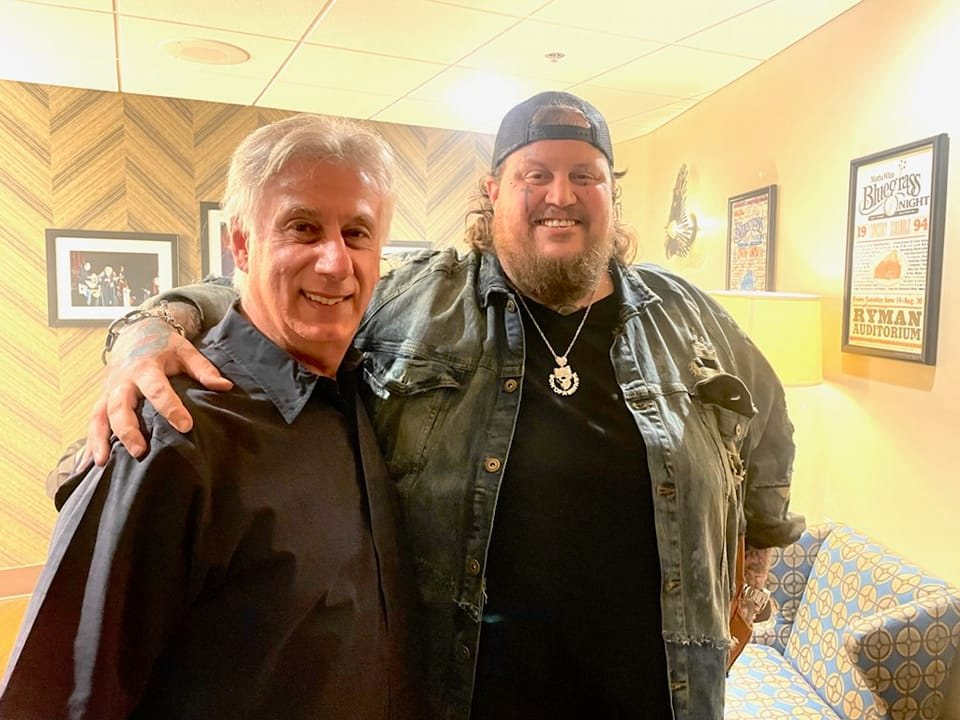
Charlie Cook With Jelly Roll
Cook remains bullish on radio and Country music but is surprised by recent radio ratings.
“I look at the ratings, and it looks to be pretty much flat across the country. I’m amazed at that because of the huge success of some of our superstars, like Jelly Roll and Lainey Wilson and Chris Stapleton.”
“When you see the huge concert success, I’m surprised that Country radio isn’t just exploding. But I guess radio’s being used differently today than it has been in the past, and maybe that’s why.”
Country radio has traditionally been an artist-driven format, but with the volume of music released on Music Row, does Cook see it becoming more song-driven?
“It is, yes. In the old days, there were nine acts. And you cycle through those nine acts on the radio, and you throw in a couple of new ones, and that’s how you get to your 14 songs an hour.”
“But that’s kind of gone, and the reason it’s gone away is because those nine acts broke down so many barriers that new acts said, oh, I want to be like so-and-so. This person led the way. I’ll just make an artist like George Strait my model. I love George Strait’s music, and that’s what I want to do.
“Well, if ten people say that, and we could do ten people right now that have said that, and all of a sudden, you’ve got 11 acts that are George Strait-like. I think that’s why, but who’s got the staying power of 61 number ones? Probably not those other 10.”
But will those ten young acts have the staying power to make it to a Nash Icon format, which Cook created for Cumulus?
“I can’t see Shaboozey on Nash Icon at any point, as an example. I can’t see even Dasha, who I love, and I love Austin; I think she’s a great talent. But some of these acts are going to be five-year acts, eight-year acts, and not 20-year acts because they don’t want to be. And I’m not holding that against them.”
“I just think they’re going to strike now, be hugely successful, and then move on to other things, or just the flame dies. And I don’t mean to pick out those two acts for that being a possibility. I just think they’re not doing the kind of music that might be around in 20 years. I may be 100% wrong.”
What is the biggest threat to Country radio?
“Probably DSPs, frankly. It’s interesting, and I’m a believer in tighter playlists. I’m not going to be a hypocrite and say, oh, I think Country radio should play 50 records on the current chart because I never did.”
“I believe that radio is an instant gratification. Somebody pushes that button; they want to hear what they want to hear.”
“DSPs have the advantage of allowing me to skip a song I don’t want to hear. The only way you skip a song on the radio is you go to another radio station, and that’s not the alternative you want to present.”
“When you look at DSPs and how many songs they’re playing on their current list, it’s 50 or 60 songs. It’s a whole different animal, and maybe somebody under 35 is looking for other things from their entertainment.”
Cook thinks there is at least one advantage that the DSPs can’t compete with.
“I think there’s nothing like the companionship that radio provides and even commercials. They’re a window to what’s going on in your town, and I think people want to know that. They want to know where the Cyber Monday sale in town is, which you don’t get from DSPs. And I think if you have a really good morning show or an afternoon show, or if you have a talent that provides companionship, friendship, and information, DSPs can’t beat that.”
I asked Cook about Patrick Thomas, who, until recently, hosted PickleJar’s “Up All Night With Patrick Thomas,” a show Cook developed.
“Love him. He was one of the most talented people on the radio because he loved talking to listeners and knew his listener base. The listeners were ecstatic about having someone live they could call in the middle of the night.”
“And a lot of people, and I’m not talking about guys leaving bars, I’m talking about people cleaning parking lots and moving trucks around, and they appreciated Patrick, and Patrick appreciated them. I think he’s as talented as anyone on the radio.”
I wondered if Cook could highlight one or two things from his remarkable career.
My highlights, seriously, are the friendships I made. It’s a fraternity, for sure, and I appreciated making all those friends. That’s probably the best part of the 54 years. Because some of them I am still friends with, going back 50 years.”
“Lon Helton and I have been friends for 50 years. He probably doesn’t want anybody to know that he would be my friend for that long. But he has been. So, yeah, I think that’s the highlight of my life.”
And what else is Cook working on these days?
“I thought this would be kind of funny – what am I doing in retirement? I am taking Spanish lessons at a local school. I can conjugate the hell out of a verb, but I can’t speak the language yet. I’m working on it.
Barrett Media produces daily content on the music, news, and sports media industries. To stay updated, sign up for our newsletters and get the latest information delivered straight to your inbox.
As Curt Menefee approaches the desk to host Super Bowl coverage for FOX Sports, he understands the eminence and prestige the stage holds. After all, the NFL routinely draws strong viewership throughout the year, but there is usually just one company that has the U.S. television rights for the coveted championship matchup.
FOX Sports will present the game for the third time in six years, which is taking place from Caesars Superdome in New Orleans. In previous Super Bowls, the network has aired a five-and-a-half hour pregame show in addition to extensive halftime and postgame coverage. The content surrounding the live game broadcast traditionally contains opinions, insightful interviews and sponsored elements as a comprehensive group of viewers tune in for the action.
Menefee, who has been the host of FOX NFL Sunday for nearly two decades, has learned the importance of endurance for the assignment over the years. Whereas he usually works eight hours in the studio during a Sunday in the regular season, the Super Bowl broadcast effectively involves him and his colleagues in front of the camera for that duration. Exhibiting strong rapport and congeniality, Menefee and his teammates on FOX NFL Sunday seek to bring viewers onto the gridiron through a show premised in football but rooted in entertainment.
“I just learned to be myself, and I’ve been fortunate enough that I learned that early on is that you can’t go out and try and pretend you’re somebody else, you can’t go out and try to do the show for somebody else,” Menefee said. “You got to do what feels natural to you, what comes natural, and also I think that helps you get through a long day as well and pace yourself.”
When Menefee first landed the job to host FOX NFL Sunday in 2006, he remembers speaking with FOX Sports executive David Hill about what he should do on the show. In response, Hill told him not to screw up the program, leading Menefee to think that if the show did not extend its sublime 12-year run, it would ultimately be his fault. Refusing to rest on his laurels, he approached the job with a keen focus and avidity towards crafting a stellar studio program.
“Bill Richards is our executive producer – he is a large, large part – but Eric Shanks and Brad Zager and all those people that are involved behind the scenes, I think they look at it the same way,” Menefee said. “And it’s not just a football show – I think you see that when you look at the baseball studio show or Big Noon Kickoff or all the other things that we do that nobody ever just sits back and goes, ‘That’s good enough. Why don’t we just keep doing the same thing?’”
As he continued hosting the program, Menefee went back to college and obtained a Master’s degree in public policy and administration from Northwestern University in 2022. Upon his graduation, he engaged in multiple conversations with company executives, including FOX Television Stations chief executive officer Jack Abernethy, about potential opportunities with the entity. In the end, Menefee agreed to expand his role and serve as the co-host of Good Day New York on WNYW FOX 5.
The new venture has resulted in Menefee having to take cross-country flights between New York and Los Angeles on a weekly basis, a 2,400-mile commute. After all, Menefee has a penchant for travel and exploration and has currently visited 97 countries across all seven continents. Menefee’s global odyssey has been fueled by an insatiable curiosity for discovery and storytelling, inherent characteristics that he has demonstrated across both enterprises in different genres.
“I love talking to people and having conversations and picking their brain, and when you’re doing a football show, it’s everything centered on football,” Menefee said. “This provided an opportunity for me to kind of explore some different things and maybe scratch some different itches and dabble my toes in a couple of different arenas because with Good Day New York, we’re doing hard news, we’re doing political interviews, we’re doing celebrity interviews, we have musicians on.”
Due to the heightened workload, Menefee has had to alter his routine of preparing for episodes of FOX NFL Sunday, but he is able to carve out significant time while confined to the airplane cabin. While traveling the country, he dives into preparation, so he is ultimately more informed and ready to execute his role. Before he arrives at cruising altitude though, Menefee takes part in a call with producers to gather an idea of the direction in which the show is moving. Ahead of that discussion, he is communicating with personnel from around the NFL to gain a more intricate pulse of what is taking place.
“I don’t want to compare myself to a player, but it’s like being an athlete in that you can’t wait for gameday to get ready, so my preparation goes through the week, and it’s been an adjustment by adding Good Day New York duties to it,” Menefee said. “I don’t have as much free time to sit back, and whether it’s to make phone calls or text people now a majority or watching games, I still do some of that stuff, but it has to be more condensed.”
Amid his tenure on the show, Menefee has primarily worked with the same studio team of Terry Bradshaw, Howie Long, Michael Strahan, Jimmy Johnson, Jay Glazer and Rob Gronkowski. On Saturday afternoons, he watches college football games with Bradshaw and Johnson while also discussing the forthcoming show. In describing their chemistry, Menefee references how the show abstains from “tall poppy syndrome,” a phenomenon connoting that if one wildflower has grown too high, the others will kill the root, so it does not surpass the aggregate.
“I think the fact that we have a genuine relationship, all of us, we don’t do that,” Menefee said. “We don’t worry about who’s shining this segment [or] who’s shining on this day. We all just kind of go, ‘Okay, we’re in this as a team.’ You know when they say, ‘A rising tide lifts all boats,’ and I genuinely think that’s how we look at it, but that’s because we’re really friends.”
Developing and conveying talent while also establishing and maintaining a professional network has been instrumental in Menefee’s success within the business. When he speaks to aspiring professionals, he emphasizes the importance of demonstrating an indefatigable work ethic and how it encourages established veterans to assist others. Growing up in Atlanta, Menefee took a leap of faith by cold-calling CNN Sports broadcaster Fred Hickman to ask about his experience at Coe College. After the discussion, he ended up attending the school and kept in touch with Hickman, who helped him land an internship at CNN Sports in the summer following his freshman year.
“I logged the games, and I would stay late at night, learn how to edit, hang out with the editors [and] hang out with some of the producers and writers,” Menefee recalled, “and [I] took the initiative to kind of use the opportunity of being in a place that had all the resources that CNN had at that time.”
Graduating college with three years of reporting experience at KCRG-TV, Menefee traveled to various markets around the country to cover sports. The journey eventually brought him to Dallas where he served as sports director of KTVT-TV and was also one of the first hosts on 1310 The Ticket. From there, he moved to New York contributing sports content on WNYW-TV news coverage while also reporting on broadcasts of Yankees, Jets and Giants games.
FOX Sports approached Menefee in 1997 and decided to assign him to call NFL games in Europe despite having no play-by-play experience. He worked alongside Brian Baldinger over the ensuing decade and started calling games both domestically and abroad on a full-time basis just before the turn of the century. The national endeavor propelled Menefee into the spotlight as he became a regular presence on FOX Sports programming, and he eventually made the transition to studio coverage in 2006.
“My job is to facilitate and put the people that are knowledgeable in the best positions they can be and to keep things moving along,” Menefee said, “and that’s how I’ve always approached it because I’ve always looked at myself as just a member of the team, no matter what.”
Effectuating the success of his colleagues comes through being aware of the configuration and sources of contributions. For example, Menefee will notice if analysts are providing a surfeit of expertise in a given segment and aim to make adjustments as necessary. Furthermore, if there is a salient topic meriting extended conversation, he will allot more time and make it up later on.
“You’re doing Good Day New York and you’re like, especially at the end of the show, ‘How much time’s left in this segment?,’ and you just have a feel for it, and so I don’t look at it as a problem [or] anything that’s hard,” Menefee said. “I’ve been blessed, look, that I have the ability to talk while someone’s talking in my ear and counting backwards from 10, so it’s not the most difficult thing to do in the world.”
The show recently continued its tradition of visiting a US military installation for Veterans Day in an episode honoring former and active-duty military. This past November, the show aired a two-hour special from Naval Base San Diego, recognizing the troops and putting things in perspective. Menefee hopes that the program conveys the earnest venerability and appreciation for military members, who display bravery and sacrifice to protect liberty and freedom.
“I’m on a set with a bunch of Hall of Famers,” Menefee said. “They get to see them in person and play catch with them and talk to them, and so it means a lot to them, which amazes you because you don’t think of it that way. I’m just thinking, ‘Oh, we’re a silly football show, and we’re here just trying to give them love and they give us twice as much back.’ It’s such a great experience – it really is.”
Since 2013, the FOX NFL Sunday program has been preceded by the hour-long FOX NFL Kickoff program, which has bolstered the overall coverage of the league on Sundays. Having a lead-in program covering the same subject matter ultimately serves as an advantage for Menefee and his colleagues in that it enhances the football atmosphere at the company. The show also provides opportunities for athletes who are recently retired to become immersed within the FOX Sports universe.
“I just think that, again, it’s been a great chance for FOX to kind of expand its football footprint because it is the bread and butter of our network,” Menefee said. “Yes, we do the World Series in baseball and we do the World Cup and ‘FOX Sport,’ as it started out in ‘94 and John Madden used to joke, is now ‘FOX Sports’ legitimately, but it is about football. Between the NFL and college football, that is the identity of our network, and that’s one of the reasons I love it.”
Thinking back on the debut of the show, Menefee acknowledges that FOX Sports wanted to be edgy and something different. As time has progressed, the company has imparted a sense of family, and he hopes that the audience cares about their discussions. Through feedback gleaned amid his worldwide voyages, Menefee has gained a more elaborate understanding of the show’s impact and the indelible legacy it has built in sports television.
“I’ve never had anyone say to me, ‘You guys did a great job of breaking down the Cover 2 last week,’” Menefee articulated. “It’s always that, ‘Hey, you guys were really funny when Terry did this and you guys busted his chops, or when Michael said this and you guys laughed it off.’ Those kinds of things are what people enjoy, and I think that only happens because of the relationships that we have with one another both in front of and behind the camera.”
While Menefee does not take any opportunities for granted in the media business, he hopes to retire someday and look back on his career with pride. Until that presumptive occurrence takes place, he hopes to present no reasons for the company to replace him or move in another direction. As Menefee takes the air with a wealth of experience and dedication, he aims to illustrate his skillset without demanding the spotlight, instead opting to illuminate those around him with effervescence grounded in humility and gratitude.
“One of the great lines I always go back to – I think it was the first time I [saw] U2, which would have been in Düsseldorf, Germany while I was in NFL Europe – but back in 2000, and I remember Bono during an encore saying, ‘Thank you for giving us a great life,’ and I always remember that because this job and this career has allowed me and my wife to have a really, really special life,” Menefee explained, “but so many people are a part of getting me here that I think I owe it to the universe, to karma, to whatever you want to chalk it up to, to try and help somebody else do the same.”
Barrett Media produces daily content on the music, news, and sports media industries. To stay updated, sign up for our newsletters and get the latest information delivered straight to your inbox.
I feel like a broken record, but I’ll keep saying it until I’m blue in the face: YouTube needs to be a priority for news/talk radio hosts going forward.
A video platform is now the primary source for an audio medium. That’s the power YouTube has and it’s only getting bigger.
In 2023, 28% of those surveyed responded similarly. Which means YouTube, which is one of the most popular sites on the internet and most popular mobile device apps, is growing.
And yet many in the industry have still eschewed the platform. Some — like Dave Ramsey, Megyn Kelly, and local stations like 1210 WPHT and SuperTalk 99.7 WTN — have fully embraced video. They’re positioned for the future.
But if you, your show, or your station aren’t embracing YouTube, you’re already a step behind. It is the second-largest search engine in the world. If you do not exist on YouTube, to a large portion of the world, you do not exist period.
You aren’t likely to utter the words “Google doesn’t matter”, right? Then why in the world would you argue — as someone who’s in the content business — that the world’s largest content platform doesn’t matter? It does! It absolutely does! And yet, so many stations don’t have even the slightest idea that they should take the dozen or so hours of fresh, original, can’t-get-anywhere-else content they produce and put it on YouTube.
Furthermore, look around the industry recently. I don’t know how many times — unfortunately — I’ve reported on someone losing their job in recent months, whether it be from iHeartMedia, Cumulus, Audacy, Alpha, or any other number of radio companies. It continues to happen in droves.
By having a presence on YouTube, you’ve already begun the process of expanding your reach outside of the news/talk radio space. Which will likely come in handy when — not if — you find yourself on the beach wondering what’s next. I don’t know how many professionals I’ve seen embrace digital video — to varying levels of success — only after being let go from a job they thought they’d retire from.
Digital video is everything radio loves. It’s cheap, it’s easy, and it’s an easy revenue source. It’s literally never been easier or cheaper to start a video simulcast.
The cost to start streaming your shows is unbelievably low for what the potential revenue can make up in return. If you don’t have a sales team that would be eager to go out and try to sell a shiny new product, then you’ve got bigger problems than digital video. But I’d bet you dollars to donuts that if you walked into the sales meeting and said “Hey, we’ve got a cool new product to offer. We’re streaming the shows on YouTube now, and we’ve got the ability to showcase (X) amount of sponsors in graphics, in product placement, in video commercials. Who wants in?”, you’d be hard-pressed to not find that elusive 13th month of ad dollars.
Maybe YouTube isn’t the platform for you. Maybe Rumble is more your style. I understand it, but if you like relevance, exposure, and an extra revenue stream — and who doesn’t? — you need to put effort into YouTube.
Embracing YouTube doesn’t make you a bad radio host. It doesn’t make you a bad conservative. It makes you a smart content creator and a smart media professional. Prioritizing anything else feels like media malpractice in 2024. So, as we head into 2025, when you sit down and re-evaluate where you are, where your show is, and what tweaks you need to make, I implore you — for the future of the format — embrace YouTube. I doubt you’ll regret it.
Barrett Media produces daily content on the music, news, and sports media industries. To stay updated, sign up for our newsletters and get the latest information delivered straight to your inbox.
In the fall, the PPM market ratings for Classic Hits and Classic Rock continued to perform extremely well in most markets.
There may be more to it than just some of the best music ever made.
Recently, my wife asked me why I insist on watching reruns of “Seinfeld,” “King of Queens,” and “Everybody Loves Raymond” over and over when I can recite the episode line for line.
Seinfeld wrapped production in 1998, but it is what I fall asleep to most nights.
My go-to music choices are Classic Rock, Classic Hits, Country, and often Classic Country.
When I combined the two things, it occurred to me that the shows and the music transported me to a time when the country wasn’t as divided. Social media hadn’t allowed everyone with a keyboard to spout whatever they felt in a random stream of consciousness.
It’s comfortable.
For many, it includes college, days of fewer responsibilities, and times of less stress.
When I listen to Classic Country and hear Johnny Cash, George Jones, and the Statler Brothers, I am transported to the backseat of my dad’s car. We are going to Grandma’s house for lunch on Sunday. All was well in my world.
It makes me happy, and it makes your listeners happy.
Stations would do well to embrace nostalgia. Include drops in the imaging and create memes on social media.
One of my favorite meme series on Facebook recently was JJ Kincaid of The “Kincaid & Dallas” Morning Show and his Grandpa Simpson “Tell the Kids How Radio Used to Be.”
You’ve already got some of the best music ever made. Packaging it or, as they say, “what goes on between the songs” will only extend the life of the music and make your brand feel more comfortable to the listener. Even if they don’t consciously know why.
Barrett Media produces daily content on the music, news, and sports media industries. To stay updated, sign up for our newsletters and get the latest information delivered straight to your inbox.
The United States is about to enter a situation only seen once before: a new, but actually returning President, as Donald Trump will return to the White House in 2025. But what will that return mean for the radio industry? We asked three radio leaders what and how they expect the second Trump administration to affect the industry.
Our industry leaders were each granted anonymity to speak more freely on the topics.
One item many marketers will use during the lead-up to an election is they want to avoid placing large buys until after the results of the election. One radio group owner — with clusters around the Midwest — told us that they are often told that by advertisers, but they almost universally see a bounceback after the election.
“That is a phrase I’ve heard for decades, long before Donald Trump was involved,” the owner told Barrett Media. “The companies we hear that from the most always come back. Or at least end up continuing their relationship in some capacity with us. It really is not a concern we spend much time worrying about during campaign season.”
Incoming FCC chair Brendan Carr has been vocal in his support for looking at suspending the licenses of stations. One high-level executive we spoke with, overseeing operations of a medium-sized broadcast company, believes that is political grandstanding.
“Empty threats,” they said of Carr’s calls for examining the licenses. “Politicians aren’t interested in losing. Fighting the battle of revoke a station’s license is a long and drawn out process. Any assertion that this is a viable option is, quite frankly, misleading. I could throw a rock and hit a dozen stations that deserve to have their licenses revoked. Some because they’re completely voiced out of market by syndicators and never approach reaching their public service obligations. Some because of a failure to disclose paid programming. Numerous issues are out there that, by letter of the law, should require a hearing or an investigation. But it never happens, because it’s not a winning proposition.”
We also reached out to a Public Radio executive for their thoughts. When asked about the overall outlook and future of public media during a second Trump administration, they said it could ultimately be a net positive.
“There’s a lot of news fatigue right now that’s made some listeners (including me!) take a break from the news,” they said. “But come January, I think people will seek out trusted news sources to cut through the political rhetoric. Perhaps public radio will end up doing better under Trump than other media. Folks really are tired of all the yelling on cable news, as evidenced by the hemorrhaging of viewers over at CNN and MSNBC. And talk radio is at its best when they have a foil to rally against.
“I suspect much of what they’ve been talking about the last five years will fall flat now that Trump is back in the White House and has both houses of Congress. The qualities of what make public radio valuable to its current listeners might just attract additional audiences who want factual news without all the noise.”
Public media could potentially be the most threatened of the media ecosystem. Many prominent Republicans have called for the defunding of PBS and NPR in recent months.
The public radio executive we spoke with, however, downplayed any potential concerns facing their stations.
“I think Capitol Hill either has a fundamental misunderstanding of the economics of public radio, or they choose to actively misrepresent it. NPR gets less than 1% of its revenue from the federal government through the Corporation for Public Broadcasting,” they said. “Locally, more than 90% of our revenue is locally sourced — i.e. donations from listeners, corporate underwriting, grants, and the like. Local NPR stations then pay programming fees to NPR, which represents a big portion of their revenue.
“So ‘defunding NPR’ really means defunding CPB, which will cause local stations some financial pain, and we’ll lose some of the services CPB provides the local stations, but it’s not the end of the world. We’d have to work harder to find other ways to make up that lost revenue, but your local public radio station and the NPR programming we air isn’t going away.”
When asked about comments made by incoming FCC chair Brendan Carr, the public media executive stated that questions from critics could be a good thing for public radio.
“All stations – public and commercial alike are required to ascertain and address issues that are important to the communities we’re licensed to serve. Public Radio, by design, does an exceptionally good job at that. Public Radio stations are held to a much higher standard by our listeners and those who choose to support us financially, not to mention the employees who take a lot of pride making sure what we put on the radio is verifiably accurate,” they concluded.
“I think questions from our biggest critics could actually be a very good thing. It’ll shine a light on the vital public service we provide and perhaps expose some areas of improvement that will make us even better in the long run.”
Barrett Media produces daily content on the music, news, and sports media industries. To stay updated, sign up for our newsletters and get the latest information delivered straight to your inbox.
Black Friday was give for Amazon Prime Video, which said about 13.51 million viewers streamed its NFL game between the Kansas City Chiefs and the Las Vegas Raiders.
Black Friday Football viewership was up 41% from last year, when Prime Video streamed its first Black Friday game, between the New York Jets and the Miami Dolphins. The NFL Champion Chiefs, in addition to being Taylor Swift’s favorite team, have been drawing big ratings all season.
Prime Video is looking to turn Black Friday, once one of the biggest shopping days of the year, into a sports destination. Next year, Prime will also stream a National Basketball League game on Black Friday as part of its new deal with the NBA.
While Amazon aims to keep people from wrestling for bargains at crowded stores on Black Friday, it still wants shopping. The company said ads during the game were sold out and many of the commercial touted Black Friday deals available at Amazon.com and some featured interactive features that let viewers get special discounts, more info, or put items in their Amazon Prime shopping cart with the push of a button on their remote controls.
The big viewership for the games was also a sign that big sporting events are shifting to streaming. In addition to Amazon’s Black Friday game, last year saw NBCUniversal’s Peacock stream an exclusive Wild Card Playoff game. And this Christmas, Netflix will stream to NFL games. (Netflix is working to ensure that the glitches that marred its telecast of the fight between Mike Tyson and Jason Paul. Netflix claims the fight drew a peak of 65 million concurrent streams, including 38 million in the U.S.)
With the Chiefs holding on to win a close game, Amazon Prime Video’s Black Friday Football peaked at 17.43 million viewers between 6 and 6:15 p.m. ET, up 56$ from last year.
Viewership among viewers in the 18 to 34 year old demographic averaged 2.53 million, up 43% from last year’s Black Friday game. In the 18-49 demo, the game averaged 5.72 million views, up 34%.
The postgame show, Nightcap, following the Raiders and Chiefs, garnered an average viewership of 3.85 million viewers, a gain of 60%.
Prime Video noted tha Black Friday Football drew more viewers than any of its competitors on broadcast or cable Friday night, just as its Thursday Night Football beat all of the shows that appear on Thursdays.
The ratings figures are from Nielsen, based on its panel data. Data from Nielsen’s Big Data + Panel system should be available later this week.
Barrett Media produces daily content on the music, news, and sports media industries. To stay updated, sign up for our newsletters and get the latest information delivered straight to your inbox.
Throughout the last several months, Stephen A. Smith has discussed the impending expiration of his contract with ESPN and value to the company, expressing that he believes he should be among the highest-paid talents at the network. The current deal Smith works under expires in July, which sees him serve as the featured commentator and executive producer of First Take and an analyst on NBA Countdown. Smith and ESPN have been in the process of negotiating a new contract, and the two sides are reportedly closing in on reaching an agreement. Brian Steinberg of Variety reported the news of a potential contract, and he elucidated that both parties are “hopeful they can reach a deal over the next several weeks.”
If a deal is ultimately finalized, The Walt Disney Company’s general entertainment properties may attain a “first-look” agreement for concepts that Smith backs. Smith has developed his own company, recently renamed Straight Shooter Productions, that has taken part in original projects, including a documentary series about sports debate television that premiered earlier this year on ESPN+. The entity also houses Smith’s eponymous podcast, The Stephen A. Smith Show, which has a distribution agreement with iHeartMedia and is also available on YouTube.
Andrew Marchand of The Athletic reported late Tuesday that no deal is currently completed, but that discussions are taking place regarding a contract in the range of six years and $120 million. Smith is reportedly making $12 million per year with ESPN under his current deal, $8 million of which is a salary and the other $4 million for his production company. When Marchand asked Smith if a deal was close via text, he replied “False” and later added that he never talks about his contract negotiations.
Smith has stated that he has prepared himself mentally and emotionally to be able to move on from ESPN. Furthermore, he expressed an interest in contributing to the Monday Night Football broadcast property and a potential foray into late-night television. While at the BSM Summit in New York City this past March, he spoke about the launch of his podcast and why he decided to produce content in that domain.
“What you see me doing on my podcast is who I am,” Smith said. “I just wasn’t able to show those things on a sports network. You knew me on a sports level, now come over here and see the rest of who I am. But, I will never do anything that works as a detriment to anyone else that I work for. I owe it to them to be consistently reliable on who I am.”
In his role on First Take, Smith currently welcomes a panel of ESPN commentators with whom he debates several topics across the world of sports. The show has also had several remote broadcasts on the road from HBCUs, including Smith’s alma mater Winston-Salem State University, and added weekly contributors such as Shannon Sharpe, Christopher “Mad Dog” Russo and Cam Newton. Earlier in the summer, it was reported that Smith was offered a five-year, $90 million deal to remain with ESPN.
“I expect to get paid, and I’m not apologizing for that to anybody,” Smith said during an interview at the Tuned In event for Front Office Sports. “I’m going to work my tail off. I’m striving to be the best that I can be or put in the hours [to] produce results [to] the best of my ability, and those results are what I’m going to look at to define my worth.”
Barrett Media produces daily content on the music, news, and sports media industries. To stay updated, sign up for our newsletters and get the latest information delivered straight to your inbox.
Brian Berger featured former ESPN personality Kenny Mayne on the most recent edition of his Sports Business Radio podcast. Mayne, who was part of SportsCenter from 1994-2001 has been promoting a new documentary, Wiffle Ball, which can be seen on FUBO TV. Additionally, Mayne and Berger discussed several other topics including the current state of sports media.
“You worked for the big corporate structure of ESPN and now you get to pick and choose your projects,” Berger said. “How have you transitioned to that?
“There was sort of a nice soft landing in between that,” Mayne replied. “Right after I left ESPN in May of ’21, that’s a long time ago now. At the time there were a whole bunch of opportunities that just kind of came my way. And we took that summer to figure out what made the most sense…I didn’t want to stop working. Because it’s funny, people will say, ‘oh, hey, how’s your retirement?’ I was like, I’m not trying to be retired. I don’t want to be, I don’t really ever want to be.
“Given what I do, I don’t know why I’d ever quit. You know, it might be much smaller at some point, but, it’s just me saying stupid stuff and taping it. That’s been my job for a number of years.”
Mayne went on to explain the role he had with Caesars upon leaving ESPN as an ambassador.
“And then that ended,” Mayne said. “And the last year, I’ve just sort of been experimenting. I’ve done a few small projects, but I also wondered what do I want to do that’s just mine, that I don’t need bosses to approve? And that turned out to be this little movie that we’re promoting called Whiffleball.”
Mayne explained the project and how it is based off of a time he threw wiffle balls with Ken Griffey Jr. who was then a Seattle Mariners rookie. Mayne was starting out in TV and got Harold Reynolds to bring Griffey along for a piece they were taping, and he has held on to the tape of that story since 1989.
Berger then asked Mayne about the state of sports media. “What do you make of where the sportscasting landscape is going?” Berger asked.
“Sometimes I’m puzzled by it,” Mayne replied. “You’ll hear companies cutting back all sorts of so-called nonessential people that, you know, built the place or most of us think are necessary to execute everything. But then they throw a pile at individuals. But they’re probably thinking, well, doing that is to our long-term benefit because that individual has such a following that it will bring the audience that we need in order to pay the price for what we have to give to get that person. But I have no answer. I don’t really know anymore.
“A lot of times people will think because you work somewhere for a long time, you know why they think how they think. And it’s like, I don’t know, I think a lot of people are guessing and they’re going quarterly. I don’t know how many people have these visions for the next five years, we will do it exactly this way.”
Mayne continued saying, “I think they react, it’s like stocks, they react to occurrences in the market and there’s a little bit of a copycat notion, they’re doing this, we better do this. But for the consumer, it’s actually quite a great time.”
Mayne talked about how few programming options he had growing up versus the landscape today and added, “And now, you just can’t turn anywhere without information hitting at you, some of it not good information. So that one you have to piece through a little bit…I think for the consumer, it’s been a benefit because there’s just so many more choices, so that’s a good thing. And I think the quality is really strong.”
Barrett Media produces daily content on the music, news, and sports media industries. To stay updated, sign up for our newsletters and get the latest information delivered straight to your inbox.