

If you were to ask a general sports content consumer where they go for their sports content, you’d get a range of answers. Social media, podcasting, sports radio, and sports television are just some of the ways fans now search for and consume content.
Each industry’s silo attempts to branch its content into the others. Sports television shows podcast their on-air content to distribute it in audio form. Sports radio does the same, transferring audio to on-demand platforms. Both television and radio also attempt to capture video of those same segments for streaming platforms. In the end, podcast and streaming video distribution hubs, along with social media, earn the traffic based on content created by television and radio.
The one panel at this week’s NAB conference that grabbed my attention focused on the future of podcasting through the lens of video. The discussion brought together representatives from Amazon and Audacy to explain why now is the time for radio to combine video presentation with its podcasting strategy. If their words and data reflect reality, sports radio must get to the party sooner than later.
According to the IAB, the podcasting industry has grown into a nearly $3 billion business. That represents a 17.6% increase from the prior year. This growth has also appeared in the local revenue lines for most sports radio stations.
Digital advertising buys are now the biggest driver of local revenue, with 24.4% of an average station’s total ad revenue coming from digital. Meanwhile, traditional broadcast revenue continues to decline year after year.
Ready for Your Close Up?
The need for local sports radio stations and talent in the podcast space has never been higher. New analysis from S&P Global Market Intelligence shows that sports is the most popular podcast genre among men in 2026.
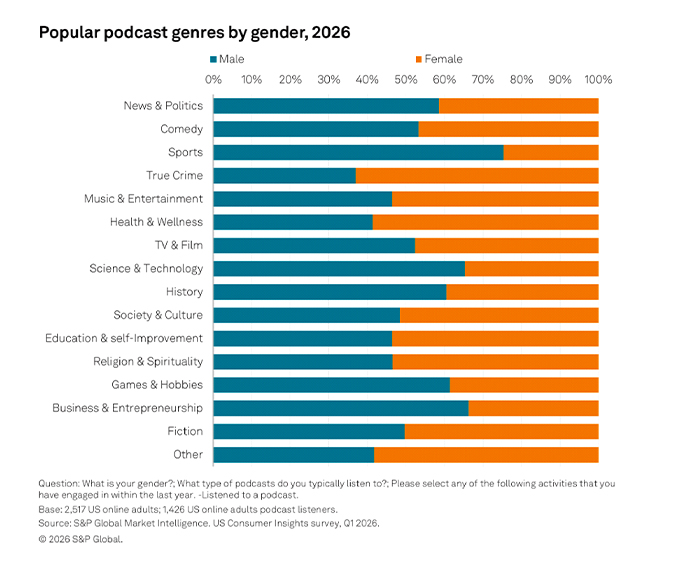
However, most sports radio stations don’t package their show content for a podcast audience. Many talents don’t create individual content separate from their daily programs. Too many part-time employees recognize limited growth potential at sports radio brands and leave early, often pursuing other opportunities.
Sports radio needs a reset. If advertisers believe in your digital product, that’s where talent and programmers should focus.
“Why wouldn’t you want to extend what you’re doing?” said Andy Slater, Head of Partnerships for Amazon’s Art19 at NAB this week, referring to how radio companies should rethink podcast discovery through video platforms. “You’d be going from a $3 billion market to getting a piece of a $78 billion market.”
That quote alone should motivate programmers to push for cameras in their studios and invest in technology that supports a video-driven podcast strategy. Some sports radio brands have moved ahead by investing in video capabilities. Many have not and risk missing what could be the single greatest revenue opportunity available.
“If you want to grow your revenues — add cameras,” said Michael Biemolt, President of Digital Sales at Audacy. “You will grow audience from discovery that exists within the YouTube ecosystem.”
With that larger reach comes more ad impressions, which leads to additional revenue.
Video Needs the Radio Star
Recent S&P Global Market Intelligence data shows that six in ten (62%) podcast listeners watch video podcasts on YouTube, followed by Netflix at 34%, Spotify at 23%, and Apple at 11%. That data clearly shows how video options are reshaping podcast consumption habits.
Yes, video extends beyond YouTube. Apple announced this year that it will offer options for consumers to watch video versions of podcasts. Spotify introduced that capability two years ago.
Netflix is investing heavily in proven, high-performing podcasts, placing video versions behind its paywall. The company is betting that exclusive video content will drive more subscriptions.
iHeartRadio became the first broadcast company to partner with Netflix on this initiative. That should signal what’s coming next.
Meanwhile, many sports radio podcast products remain audio-only. They rely on RSS feeds, assuming that flooding the audio space will drive digital growth.
For everything podcasters have borrowed from what made sports radio special, the format shouldn’t allow them to dominate this new era of content.
“There’s a perception that video has to be super polished and has to look perfect, and the barrier to entry is perceptively high. But the reality is, it doesn’t matter,” said Neha Taleja, Senior Product Manager for Podcast Consumer Experiences at YouTube. “Capture that natural, authentic recording and that builds connection with your audiences.”
Read the Signs
There are signs everywhere that sports radio must pivot. More people are consuming sports radio content digitally than ever before. Sports content leads all podcast categories among men. Since the pandemic, sports radio has adapted long-form content for video distribution across live and on-demand platforms.
Now, the format must connect those pieces to catch the next wave as audiences shift from audio to video. Ignoring these trends is no longer an option. It’s now on sports radio to lead again and set the standard for winning in the next generation of content.
And that’s the choice facing the format: evolve with intention or fade through inertia.
Sports radio already has the voices, the relationships, and the daily discipline required to create compelling content—the hard part is done. What’s missing isn’t talent; it’s alignment.
Alignment between where the audience is going and how content is delivered. The next generation of listeners isn’t choosing between audio and video; they expect both, seamlessly and on demand.
If sports radio treats video as an extension instead of an afterthought, it won’t just stay relevant—it can reclaim its position as the engine driving the entire ecosystem.
The window is still open, but it won’t stay that way forever.
Barrett Media produces daily content on the music, news, and sports media industries. Sign up for our newsletters to stay updated and get the latest information right in your inbox.
