Home Blog Page 782

Prime Video Adds 21 New York Yankees Games for MLB Season

0

Several New York Yankees game broadcasts will once again be available on Prime Video for the 2025 season. Amazon announced Wednesday that 21 regular-season Yankees games will stream exclusively on Prime Video at no extra cost to subscribers.

This marks a return to Prime Video for the organization, with 18 of the 21 games airing on Wednesday evenings. The YES Network’s broadcast team remains intact, featuring play-by-play announcer Michael Kay, who enters his 34th season as the voice of the Yankees. He will be joined by YES Network analysts David Cone, Paul O’Neill, Joe Girardi, John Flaherty, and Jeff Nelson.

None of the games on Prime Video will be shown on the YES Network.

Prime Video also confirmed the return of its 30-minute pregame show. YES Network host Meredith Marakovits will lead pregame coverage for home games, delivering key insights, stats, and game previews. For away games, Bob Lorenz will handle hosting duties, while Marakovits provides on-site reporting and live interviews from the field.

The Yankees’ Prime Video schedule includes matchups against seven teams that reached the 2024 MLB postseason: Baltimore, Cleveland, Detroit, Houston, Kansas City, Philadelphia, and San Diego.

The first broadcast on Prime Video will feature the Yankees hosting the Arizona Diamondbacks on Wednesday, April 2, with a 7:05 p.m. first pitch. Start times for the 21 games will vary between 6:35 p.m. and 8:05 p.m. ET.

Prime Video continues to expand its live sports lineup in the U.S., which includes the NBA, Thursday Night Football, NASCAR, the Yankees, the Seattle Kraken, Overtime Elite, Premier Boxing Champions, the NWSL, the WNBA, and ONE Championship.

Barrett Media produces daily content on the music, news, and sports media industries. To stay updated, sign up for our newsletters and get the latest information delivered straight to your inbox.

Cumulus Media Inks Partnership with Quu for In-Dash Visual Messaging

0

Cumulus Media has announced a deal with Quu to bring in-dash visual branding opportunities to automobile infotainment systems.

The partnership will allow Cumulus to enhance advertising opportunities for its 400 stations across the country. The company will utilize the content management system from Quu. Additionally, some markets will utilize the Content Partnership efforts from Quu, which will bring new advertising opportunities for marketers.

“Visual content solutions generate sustainable revenue growth and significantly enhance in-car engagement, where listeners spend the most time with our stations,” said Cumulus Media President of Operations Dave Milner. “This expansion underscores Cumulus’s commitment to delivering premium content and sales experiences that meet the evolving needs of our audience and clients.”  

“Quu is thrilled to empower hundreds of Cumulus radio stations across the country with Visual Quus to reinforce their brand identity, boost TSL, and make more money,” added Quu CEO Steve Newberry. “We look forward to the transformative results this partnership will bring.” 

A statement from the radio company adds that the expansion will allow advertisers to “have an even more effective way to reinforce brand identity and drive action while audiences are tuned in.”

Barrett Media produces daily content on the music, news, and sports media industries. To stay updated, sign up for our newsletters and get the latest information delivered straight to your inbox.

Kyle Matthews Set To Join Q104 Kansas City

0

Kyle Matthews, WOW Country 104.3 KAWO Boise Brand Manager, is leaving to join Country Q104 KBEQ Kansas City.

There, he will serve as Music Director and fill a to-be-determined airshift. Q104 has a morning vacancy with the departure of Jenny Matthews (BMM 2/10) and former PD/morning co-host Todd Nixon. (BMM 12/29/24)

Matthews’s previous stops include Froggy 98 KFGE and K-FROG KFRG Riverside/San Bernadino and two tours of duty at Froggy 98.1 KFGE Lincoln NE.

No word on a replacement for the Boise position.

Congratulate him here.          

Barrett Media produces daily content on the music, news, and sports media industries. To stay updated, sign up for our newsletters and get the latest information delivered straight to your inbox.

MSNBC Planning to Cut Nearly 100 Jobs in Round of Layoffs

0

After announcing a revamp of its daily lineup earlier this week, MSNBC is also set to begin a round of layoffs that will affect roughly 100 employees.

According to The Writers Guild of America East, “mass layoffs” from “at least nine different shows” will be enacted in the coming days. The union says 99 of its members are expected to see their positions eliminated.

“This devastating news comes after the slow, painful trickle of announcements regarding a near-total overhaul of the network’s broadcast line-up,” a statement from the union said.

The MSNBC Union called for an immediate end to the cuts.

“The MSNBC Union demands the Company not lay off any of the employees it has slated to be laid off but rather reassign them as needed,” the group wrote. “In the event that any employees are not retained, we demand the Company follow the layoff provisions of the collective bargaining agreement that it entered into with the Union.”

If 99 members of the union are indeed laid off, it would be a large portion of the network’s employees inside that organization. When the contract between the network and the union was enacted, it featured nearly 300 employees under the MSNBC Union banner.

MSNBC has stated that employees who will be let go can reapply for their jobs to remain with the outlet.

The changes at the network come as new President Rebecca Kutler takes the reins from Rashida Jones. Jones, who led the organization since 2020, announced her departure earlier this year. Kutler was subsequently named interim President before the network made her appointment permanent. She joined in 2022 after spending the bulk of her career with CNN.

Barrett Media produces daily content on the music, news, and sports media industries. To stay updated, sign up for our newsletters and get the latest information delivered straight to your inbox.

Breaking Barriers: What ESPN Did That Sports Radio Couldn’t

1

One of the most difficult tasks in sports radio is to build, grow, and fortify a partnership with a professional franchise. Where station and team work together, coming to an agreement to enhance each other’s brand. Much like any marriage, it takes mutual trust, communication, commitment to collaboration, respect for each other’s strengths, and the ability to navigate challenges together.

That’s what defines a true and lasting partnership.

Last week marked the end of one of the longest partnerships in professional sports as ESPN and Major League Baseball announced a “mutual” end of their broadcasting agreement. This means at the conclusion of the upcoming 2025 MLB season, ESPN and ESPN Radio will no longer broadcast a package that includes Opening Day games, Sunday Night Baseball, the Home Run Derby, and the Wild Card round of the postseason. ESPN Radio also will cease carrying the entire LDS, LCS, and World Series radio broadcasts following a new crowning of baseball champions later this fall.

A partnership beginning in 1990 is now over after 35 years, and the divorce was messy.

MLB Commissioner Rob Manfred released a note to owners around the league stating that ESPN was trying to reduce the current $550 million it spends with MLB per season, citing the other agreements baseball reached with streaming properties such as Apple and Roku as reasons for the request. Manfred then went on to cite how MLB was displeased with the “minimal” coverage that baseball received on ESPN’s platforms over the past several years outside of the games themselves, plus the network’s “dwindling” subscriber base.

MLB on ESPN
(Illustration) MLB on ESPN Logo – Courtesy: ESPN

ESPN released a statement following the news becoming public, saying they were grateful for the longstanding relationship with MLB. The network said they applied the “same discipline and fiscal responsibility that has built ESPN’s industry-leading live events portfolio” when coming to their decision to part ways with MLB. ESPN closed out their statement by saying they are open to exploring new ways to serve baseball fans across all platforms beyond 2025.

Looking at the way those two statements were presented, it goes without saying there were two very different ways in how both the network and baseball approached the messaging of the news. One side was thankful for the 35-year marriage and looking forward to moving on, while the other took a hammer, looking to do damage to the reputation of their partner.

It doesn’t take a rocket scientist to figure out that there was trouble in baseball paradise.

Observing how the two sides handled the news of the divorce, what can sports radio brands relate to with what happened between these two scorned lovers?

In my previous experience as a brand manager for over thirteen years, I dealt with building, growing, and fortifying partnerships with both professional and collegiate sports franchises. For sports radio brands, these franchise partnerships bring listening cume, brand marketing, exclusive access, and rights to use the franchise’s marks as assets for revenue generation.

Every successful sports radio brand needs to have some partnership with a professional or collegiate franchise in order to survive in an ever-changing landscape of how the consumer absorbs content. Just looking over the recent Barrett Media Top 20 for major and mid-market radio stations, there wasn’t one brand in either ranking without a college or professional sports team broadcast partnership.

While sports radio partnerships may not cost the likes of television partnerships, the cost is still quite pricey for most sports radio brands. The luxury for the franchise is that their broadcast assets are not going away anytime soon and are in demand more than ever before. Franchise values continue to rise, and revenue projections are skyrocketing each and every year.

Can you say that about sports radio or broadcast radio in general? Probably not.

#image_title

The challenge for most sports radio brands is how much more they are willing to ‘give up’ in order to secure the rights to survive. It’s a constant battle of ‘who needs who more’ when deliberating moves within your partnership and the costs you’re willing to pay.

We see the headlines every year as broadcast companies find ways to cut costs, cut people, and cut investment in local brands due to declining revenues and consumption. Radio continues to innovate much slower than competing digital brands, and the shift of the advertising dollar shows it. Digital revenues continue to rise, while broadcast radio does not.

With that said, less local programming, lumped with less revenue generation and the desire to keep listening cume, forces sports radio brands to negotiate from behind the eight ball in most media rights discussions. Broadcast radio companies are essentially surrendering leverage to sports franchises more and more each and every year.

Looking at what ESPN did with MLB, they surrendered nothing and stood by the strength of their brand as they continue to innovate with their DTC product ‘Flagship’ set to debut this fall. ESPN didn’t need MLB within the parameters of its current agreement, but MLB will need ESPN to promote the franchise. ESPN will survive without their former franchise partnership and is in good standing to find a new deal with baseball in the coming months.

You can’t say the same about sports radio. Without partnerships, it’s nearly impossible for sports radio stations to survive and advance.

So how does sports radio adjust to ‘stay together for the kids?’

Programmers lose their lunch over the term ‘added value.’ What are brands willing to sacrifice in unused inventory or programming assets instead of fitting the full cost of a rights agreement? How many minutes of commercial time will the brand ‘add value to’ a partnership so the franchise can line their pockets with advertising revenue instead of the brand cutting a check every year to the team?

In some instances, franchises will sell this ‘added value’ to competitors of their own partner’s advertisers, leading to some very interesting conversations between the radio seller and the client.

How about programming ‘assets’ such as a weekly, franchise-produced and sold broadcast featuring dignitaries of the franchise discussing the week that was? A franchise considers this type of programming ‘exclusive access,’ whereas many brands would consider it an extended advertisement for the team. It’s also likely that the franchise would not just own the content in the programming but would own the inventory as well.

Speaking of the digital space, would sports radio brands be willing to sacrifice their own digital platforms to be an added marketing arm for the franchises themselves? Digital real estate and following are becoming the most valuable assets any sports radio brand can own as the consumer flocks to more digital consumption over the traditional method. Would brands be willing to offer posts for team ticket deals and merchandise, which the brand wouldn’t make any revenue on?

These examples may seem very one-sided in favor of the franchise, and you may question why any sports radio brand would even consider items like this in the first place. The sad reality is these concepts are now more the norm than the exception in sports radio.

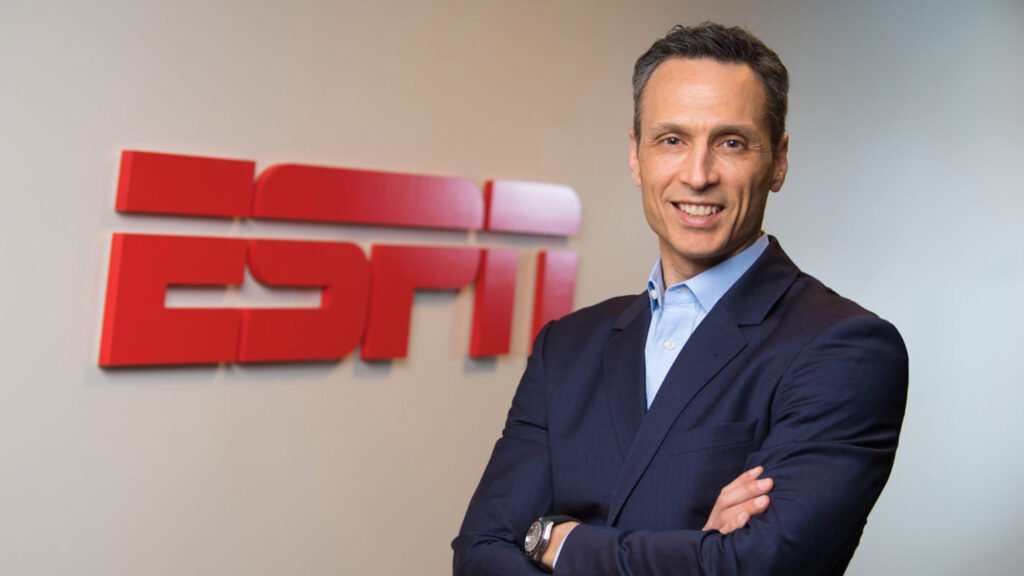
Jimmy Pitaro
Courtesy: Joe Faraoni, ESPN Images

You have to give a lot of credit to ESPN chairman Jimmy Pitaro’s forward vision to continue innovation and constantly find avenues to build on the network’s brand value in the sports media landscape. By following his vision, ESPN has set the foundation for dynamic programming content, emerging business opportunities with ESPN BET, industry-leading social media engagement, and soon the launch of ‘Flagship’ as the network’s direct-to-consumer product. ESPN has been, still is, and is looking to forever be the sports leader.

I challenge any radio broadcasting company with any media rights partnership to attempt to replicate how Jimmy Pitaro built and positioned ESPN and show that you believe your brand’s value is worth more than any sports rights partnership.

I won’t hold my breath.

It’s very simple. Baseball needs ESPN now more than ever. ESPN doesn’t need baseball like it once did, hence why Manfred took the path he did with his statement. Typically, the one who cries foul reveals a lot more about themselves than the one against whom it is being used.

Sports radio brands need franchise partnerships for survival and will continue to ‘bend the knee’ a little more every day to the opportunities that franchises bring to stay alive. It’s unfortunately no longer about building, growing, and fortifying partnerships.

It’s about keeping the lights on.

Barrett Media produces daily content on the music, news, and sports media industries. To stay updated, sign up for our newsletters and get the latest information delivered straight to your inbox.

Media Salespeople with Great Ideas Always Win

0

Happy Hump Day everyone. Welcome into our sales meeting for this week. Where I live, just went from snow and ice to high 60’s. That means spring is around the corner, baseball is getting ready to start, and my sinuses are a mess. Today’s topic is great ideas. Is there anything media salespeople like more than selling something you have so much belief in you want to come out of your skin?

One of my first as it relates to our business came in March of 2004 after Mizzou student Mike Hall won ESPN’s Dream Job contest. What a great idea by ESPN to have a contest that was wildly popular. It had the added benefit of thousands of wannabe anchors sending their stuff in and letting ESPN talent scouts see what was out there.

You see, here was the real kicker to the idea – it sounded HUGE! Win a freakin job at the Worldwide Leader in Sports?!? Where do I sign up? Other than, ‘win a spot playing for the (insert your favorite sports team)’, I can’t think of something bigger a sports fan would have wanted, killer idea. Yet, ESPN had so many anchor hours to fill in those days with all of their networks doing studio shows. They weren’t so much having a contest as they were looking to fill man hours!

At that same time, after it ended as this big national contest, I had been hired to run 1380 ESPN in St. Louis. It was a brand-new station you couldn’t hear clearly across the street. The station had been so many different formats through the years nobody knew what it was anymore. The sports program that was airing when we took over was below-average at best. Essentially, we launched a completely new station on a bad signal.

But I had a great idea. If ‘Dream Job’ could work on a national level, why couldn’t it work on a local level? I needed staff help and could use an extra host. All I had to do was find a sponsor. So naturally I went to one of the biggest ones in the market.

Whatever made me think I should pitch this idea first to the ad agency for McDonald’s is beyond me. But we did. I had so much confidence in this idea and the attention it would get I don’t think I cared if anyone said no. I was selling this to a big sponsor no matter what. Someone was going to say ‘Yes!’.

And you know what the funny thing was, as much as the McDonald’s guy kind of knew our station was a big risk and this could be so much better with a ‘good’ station – he didn’t let us get out of his office without him committing to at least pitching it to the marketing committee. The idea was that good and they ended up buying the title sponsorship.

Fast forward now to last week. I had one of those ideas again. It came as I was looking for a way to get in to see a particular company and I knew it wasn’t going to come just from my good looks and charm. I either needed a content tie-in or something that would make the person on the other end of the phone, email or text go, ‘Wow! Let’s talk.’

It was one of those literal middle-of-the-night thoughts based off a conversation I had earlier that day with someone about another subject altogether. But it hit me that this could be something this particular company I wanted to talk to would really like. It has sizzle, it’s different, and to the right client – this client – it would be a home run.

I couldn’t just lay in bed and think about it. It was 3:15 in the morning and there I was typing at my computer, trying to get it all out of my head and written down.

The next morning, I woke up and decided I would reach out to my contact no earlier than 8:30 am, but man it was hard to wait that long. At 8:31 am I sent a text, and it took everything I had not to put it all in the message, but I held back and simply said this:

“I was going to reach out to you today to see if we can set up a time to talk in the next week or so, but I HAVE THE BEST IDEA FOR YOU GUYS AND IT CANNOT WAIT! Do you have time for a quick call/zoom today?”

Now, I am not suggesting you do that to everyone and certainly don’t do it if you don’t really have a great idea. But c’mon – there was no way he wasn’t getting back to me with at least some curiosity. And he did, quickly. We were on the phone within two hours.

For context, I have not spoken to this person in two years. This wasn’t someone I knew well. I just had the confidence in the idea. It’s that good.

When we talked, he shared my excitement. At one point in the conversation, he stopped and said this, “Let me tell you, the best part of this is that you brought the idea to me and are willing to help execute it. We never get ideas and certainly never ones that are really good, mostly about us and doesn’t involve us doing all the work.”

Guys and gals, this is what this whole column comes down to. Ideas win. Ideas sell. Having good ideas gives you more confidence as a seller than you can get from just about anything else. Confidence makes selling EASIER and there aren’t many things that actually make sales easier.

Want to be different? Do you want to be better than other salespeople? Want to make a lot of money?

Come up with better ideas than anyone else.

Barrett Media produces daily content on the music, news, and sports media industries. To stay updated, sign up for our newsletters and get the latest information delivered straight to your inbox.

KUZZ’s Brent Michaels Brought the Country Radio Seminar and California Wildfire Relief Together

0

CRB and The Country Radio Seminar have always been philanthropic partners. They have partnered with Gibson Gives, Samaritan’s Purse, Manna Food Bank, Second Harvest Food Bank, and this year California Wildfire Relief thanks to KUZZ Bakersfield‘s Brent Michaels.

The California Wildfire Relief shirts were the brainchild of the KUZZ Program Director and host. KUZZ and Michaels are no strangers to charitable causes. The station supports many in Bakersfield as well as an annual St. Jude Children’s Research Hospital Radiothon that raised nearly a quarter million dollars just last month. (BMM 1/31)

I asked Michaels how the idea and the shirt came about.

“I reached out to RJ Curtis because CRB is known for giving back and doing things for communities. Humanitarian efforts are part of the CRB and have always been something that’s important to us. Whether we team up with St. Jude or different charities.”

“We were talking about California wildfire relief. I had the idea of creating shirts with The Shop Forward, which I know has done different things with the radio. One of their hallmarks is what they call a four things shirt, which is four lines of different context, for lack of better words, four things that are themed towards something. The Shop Forward is a charitable organization. They donate their proceeds to charity.”

“I reached out to them, and they were willing to help us create a couple of CRS-themed four thing shirts. And we put them on sale for California wildfire research.”

And what were the four things?

“So, one shirt is radio, records, streaming, CRS. The other shirt was Ryman Lunch, Acoustic Alley, New Faces, and CRS.

Michaels has not seen the total sales but is open to repeating the idea next year.

“It might be something we do again in the future. It was kind of something that we came up last minute with CRS, but it’s something we’re open to kind of make it bigger for next year.”

The shirts are still available here and sell for $30.

While I had Michaels, I asked for his thoughts on this year’s seminar.

“It’s always a great thing. There’s nothing in the industry quite like CRS. It’s just the perfect meeting of all the different parts of the Country music industry. It always reminds me what a community it really is. I thought it was a great event. I think Country is really having a moment right now.”

“We kind of saw that over the last year with some of the crossover stuff. I think with some of the new artists coming up; we’re poised for the format to be in a good place here for a while.”

How about a couple of top takeaways?

“We’ve known for some time that with radio talent is key. You can find music in a lot of different places. It’s the way that personalities engage with their listeners, the things they talk about, and the way they live in their communities. That’s what separates radio as an entertainment medium from other audio sources of entertainment. So that was a big takeaway.”

“Another one of the other big takeaways is social media, which again is something we’ve known for a while, but there are more opportunities there than there’ve ever been. If you can engage people on your socials, it’s just another place to grab them. Then, hopefully, funnel them back to the radio station and your show. There’s a great platform to be entertaining on social media as well.”

How about the top music performances?

“I thought Tucker Wetmore at UMG at the Ryman was really good. I think Tucker Wetmore will be a star in our format for quite some time.”

“I think the two new faces that really stuck out to me, I mean, Zach Topp is just a guy on the rise. Dasha really impressed me as well. I thought she was great.”

Barrett Media produces daily content on the music, news, and sports media industries. To stay updated, sign up for our newsletters and get the latest information delivered straight to your inbox.

ESPN’s Sal Paolantonio Learned Television Skills ‘On the Fly’

0

As Sal Paolantonio walks into a football locker room, he places his notebook in his pocket and tries to forge connections with athletes, coaches and executives by having natural and authentic conversations. Rather than congregating among the cadre of journalists striving to gain insight from star players, he likes to reside near the back of the room and find offensive lineman and defensive players who are sometimes unoccupied at their locker. Talking to them on background before asking permission to interview them for pieces to air on ESPN platforms is a formula he has found to engender success over the years rather than ambushing them with a microphone and camera.

Working as a national correspondent for NFL coverage on ESPN, Paolantonio aims to show up to every assignment prepared, conveying professionalism and not being afraid to make his reporting personal for the audience. Paolantonio has been articulating salient information developing in real time surrounding the sport for several decades, and he executes the role with poise and aplomb based on principles gleaned from his multifarious portfolio.

“The real estate is shrinking on TV for reporters, so what you have to say has to be concise, it has to be very clear and it has to be compelling, and that sometimes is just through a gimmick,” Paolantonio said. “You show a football, you show a cleat, you show a newspaper headline – I like to do that all the time. Television is show and tell, and so I kind of learned that skill sort of on the fly.”

While viewers yield the final product of Paolantonio’s reporting, a concealed facet of the job is in establishing and maintaining invaluable connections with personnel. Throughout his broadcasting career, Paolantonio has allotted time to author handwritten thank-you notes to every interview subject and person who helps him in the role. The distinctive messages are crafted on ESPN stationery and delivered by mail, a vintage practice rooted in kindness and appreciation that has elicited plaudits from recipients. One of these occurrences took place shortly after New York Giants defensive end Michael Strahan collected a pick six in overtime to defeat the Philadelphia Eagles in Week 8 of the 1999 NFL season.

“He was running back from the end zone and I was on the field with a camera, and he stopped and said in front of everybody, ‘I’m talking to Sal because he wrote me a thank-you note,’” Paolantonio explained. “That happened, and Tom Brady, Bill Belichick, many guys have said to me, ‘I’m only talking to you because you wrote me a thank-you note.’”

Paolantonio seeks to gather intel, interviews and other original content to create enterprise stories that generate interest and supplement NFL on ESPN coverage. With the Eagles in contention and vying for a second Super Bowl championship in seven years, he primarily covered the NFC East team during the year. Paolantonio had the chance to conduct exclusive interviews with players while also collaborating with other network field reporters from around the country as a regular presence on Sunday NFL Countdown. The show recently completed its first year under new host Mike Greenberg and averaged 1.34 million viewers per episode, indicative of an 8% rise from last season.

“We have a great cast, we’ve got some fantastic producers,” Paolantonio said. “I thought the show was great in every respect – I thought it had a lot of snap, crackle, pop [with] a lot of information. I love the way the guys break down film, [and] I love being part of the show.”

As the football world descended on New Orleans, La. for Super Bowl LIX, Paolantonio noticed a continued exponential proliferation of media outlets covering the championship event, but he arrived prepared to fulfill his role and serve the audience. While on the ground, he discovered new storylines around the game and reported on the synergy among the team, aligned in its goal of winning the league championship.

“[It] felt like it was unfinished business from Super Bowl LVII and they wanted to get it done this time, and talking to them prior to the game about just how much it wasn’t about emotion, it was about determination,” Paolantonio discerned. “I thought that was pretty clear – the attitude they had going into the game from the top down.”

There were many ESPN reporters assigned to provide coverage pertaining to the game, several of whom have reporting presences within print and audiovisual mediums. Over the years getting to know and collaborate with many journalists, including Chris Mortensen, John Clayton, Brooke Pryor and Mike Reiss, has paid invaluable dividends in his profession. Even though there are occasions when Paolantonio will break news, the preponderance of reporting on transactions, injuries and other league matters is generally communicated by ESPN senior NFL insider Adam Schefter.

“I would always let him go first,” Paolantonio said. “I think that’s really important that the audience hears one voice, but if he said to me, ‘Hey, this is your piece, you do this,’ and a person like Adam is extraordinarily good at sharing and has been terrific.”

Paolantonio has been the host of NFL Matchup for the last 20 years, a studio-based program produced by NFL Films that explores fundamentals through astute film study, esoteric conceptualization and perspicacious forecasting. The show tapes new episodes every week from Mount Laurel, N.J., and it has endured through several iterations, the current of which includes analysts Greg Cosell and Darius Butler. During his debut on the show in 2004, Paolantonio started to watch film with former quarterback Ron Jaworski and started to recognize deficiencies in his football knowledge.

“I started with Merrill [Hoge] and Jaws, and [they] could be somewhat free-wheeling and the interplay between them,” Paolantonio recalled. “I always like to say my job at that time was to make sure that I landed the plane after 30 minutes and to keep them out of trouble between the two of them, but they had great personalities [and] had been together for years before I got on the show.”

Paolantonio feels that hosting NFL Matchup has made him a better reporter, granting him a cognizance of the sport extrapolated through synthesizing film and conversing with those who have tangible playing experience. The program attained its best regular-season audience since 2019 with an average of 320,000 viewers per episode, representative of a 7% year-over-year increase. Although the personalities on the show have changed, the format has stayed relatively consistent and looks to meet audience expectations of detailed film pieces and extensive breakdowns.

“When you watch it and you do study it and you do begin to understand what goes into NFL practice and NFL plays and how to do them correctly and how to correct them when they’re wrong, you really begin to understand what players go through in a weekly basis,” Paolantonio articulated, “and you get a greater understanding for the game and for what the players have to do, the challenges that they have in order to get it right and stay professional football players over the long term.”

Paolantonio recognizes ESPN coverage of the NFL spans beyond his work and is able to effectively work with others on a team. The network has brought him to its Bristol headquarters to speak with NFL Nation reporters about the job, and he also occasionally teaches at a scholastic broadcasting school in the Philadelphia metropolitan area. Moving into sports reporting in the first place was a decision made for him by an editorial team at The Philadelphia Inquirer led by executive editor Gene Roberts.

In an effort to produce stellar journalism with new perspectives on matters, he often experimented with beat reporters and ended up transitioning to the Philadelphia Eagles beat after reporting on two presidential campaigns and a mayoral race. Upon becoming an Eagles beat reporter, he quickly thrived in the role by leveraging the skillset gleaned through other ventures.

“During the week of the football season, you have a gameplan that you put together, and that gameplan is pretty secretive, and it’s the same thing as covering a political campaign,” Paolantonio said. “You have a gameplan, you put it together, you try to keep it a secret from your opponent, and it’s your job as a reporter to sort of unearth what’s really going on in the political campaign, as well as during the week leading up to a football game, so there’s a lot of similarities.”

While he did not struggle to network or develop sources, the difficulty was in getting people to trust him against veteran reporters in the space. Drawing an analogy to the job, he depicted the work as visiting a neighbor’s kitchen, sitting down and asking them to divulge all their secrets to later be revealed to the masses. The plight therein is in obtaining an invitation to come back, but the inexorable pursuit of accurate, verifiable information is an assignment towards which journalists remain staunch.

“You have to go into the locker room and ask these players and these coaches to tell you things they probably don’t want to share with the world and then go back the next day and do it all over again and be welcomed back there,” Paolantonio said. “It’s not an easy thing to do.”

Paolantonio is thankful to the Eagles organization for allowing him to report from the NovaCare Complex as he continues to work in the region, and he has covered four trips to the Super Bowl for the franchise. Whenever he travels around the country, primarily on the east coast, he contacts reporters and other personnel in the locales to collect information and ultimately benefit the audience. Paolantonio has become closely associated with the league and network, never taking an appearance on any show for granted and staying on air virtually until kickoff with Sunday NFL Countdown.

“I was given a lot of chances to do some features this year that were kind of interesting,” Paolantonio said, “and I’ve got to tell you, just following the ups and downs of the Eagles season, which was in the news quite a bit, that was enough.”

Even though Paolantonio has been with ESPN since 1995, the luster of appearing on platforms owned and operated by the venerated broadcast entity has not faded. Every time he travels to a game, he looks to obtain at least one piece of information that no one else possesses, something that he acknowledges has never been harder to achieve. Embedded in a panorama endowed with an assortment of content creators, the specific platforms of dissemination notwithstanding, Paolantonio holds immense credibility with a substantial track record. In spite of that, he does not equip highfalutin logic or display a condescending attitude towards the viewing public.

“I enjoy the interaction with fans for a lot of reasons,” Paolantonio said. “They’ll always ask me a question, like, ‘What’d you think of the game?,’ and I go right back at them and ask them what they thought because I don’t believe that I have a monopoly on what’s important.”

Less than two weeks after the Eagles hoisted the Vince Lombardi Trophy victorious as Super Bowl champions, Paolantonio was still jotting down thank-you notes and mailing them to impart his unfeigned gratitude to those affiliated with the game. As the football offseason commences with conventional activities such as the NFL Scouting Combine, free agency and the NFL Draft, he remains invigorated and energized to cover the league and its teams. With an avidity towards consumers and the league, Paolantonio is not yet ready to figure out why he keeps going as he remains part of a media rights partnership dating back 45 years.

“My goal is to make sure that the audience responds positively to what I’m saying or reporting on TV or radio,” Paolantonio averred. “I think that’s the most important thing, and to do the job the right way”

Social Studies: Elly Rowe, WTOP

0

WTOP in Washington D.C. has been at the forefront of innovation in the radio world for years. Social media is no different — led by Marketing Director Elly Rowe — as the Hubbard Radio station has seen expansive growth on the social side.

On Instagram, WTOP has nearly 65,000 followers. The WTOP Facebook page has more than 200,000 followers, which trails its X account which is over 300,000. Even a relatively new platform like Threads has seen the station perform well with nearly 15,000 followers.

Digital video efforts from WTOP have also grown in recent years, with the all-news radio outlet featuring just under 30,000 followers on TikTok and just under 25,000 subscribers on YouTube.

In this conversation with Elly Rowe, Barrett Media asked about the overall strategy of the platform, how it views “legacy” social media platforms like Facebook and X which no longer value publishers, and how WTOP enhances its digital video offerings.

*Editor’s Note: Answers have been edited for clarity and length.

Garrett Searight: For WTOP, what are the things that you guys prioritize on social media?

Elly Rowe: There are a couple of things. The first is really video in general. That’s something that historically has been a struggle for radio organizations, just because we don’t naturally have that ingrained video content in the same way that maybe some other media organizations do. But it was something that we certainly can do.

Over the last two years, it’s been something that we really prioritize. We’ve changed our reporter workflow to incorporate more video. Myself and one of my colleagues, Giang, actually created an entire Video 101, training module that we’ve been rolling out to staff over the last year or so to really get people in the mindset of thinking visuals. So video has really been first and foremost what we’ve focused on.

I think the other thing that kind of goes hand-in-hand with that is looking at platforms that really have that growth potential. When you think about platforms like TikTok, YouTube, or Instagram, those platforms really prioritize that video content, and it jump-starts the algorithm in a way that allows more visibility to all of our content. Those are places where we’ve really focused our efforts and made a really concerted effort to attract a younger demo than what we might historically have attracted on air.

Because we really feel like a lot of the time, the first touch point for specifically younger generations — like millennials, or even Gen Z — will be that digital touch point. Whether or not they go from our digital platforms back to our terrestrial radio platform, it’s important that we have a presence on the places where those individuals are, so that we’re really getting in front of them as soon as we possibly can with the content that they need at the time that they need it.

So I think it’s a combination of all those things: video, prioritizing video in a way that we train staff and the way that we talk to staff about our needs, and then also the platforms that we’re on, and making sure that we’re delivering content on those platforms that people need in the time frame.

GS: How much platform-specific content do you do video-wise? How much of that is strictly for TikTok, or for YouTube, etc…?

ER: That’s a good question. Right now, we have a social media team of three people. It’s myself — and I oversee all of social — and then my colleagues, Michelle Goldchain and Erron Franklin. We work primarily on all of the social platforms.

So we don’t necessarily create content specifically for one platform, although there are times when we do things, for example, we’ve done Instagram Lives, and our goal is to start doing like, more YouTube Lives and things like that, where we are doing platform-specific stuff. But our goal right now is actually to streamline the process so that we’re able to post more content versus posting less.

But platform-specific, that’s just kind of by the nature of the team that we have and the resources that we have, how we’ve had to do it.

Although that being said, there are times when specific things come up. For example, the other day, one of our reporters, Dan Ronan, did an interview with BBC about all of the aviation stuff that’s been going on with plane crashes and the FAA. He did an interview with the BBC. He sent that to us. It was about six minutes.

Generally, our social media content is somewhere between 40 seconds and 90 seconds, so it was a bit longer than what we traditionally do. Instead of chopping that up and putting it on all of our platforms, we decided, ‘Ok, what we’re going to do is we’ll take a still shot from that, we’ll post that screenshot on all of our platforms, and we’ll promote the full video on YouTube.’

So there’s times when we take content and we specifically decide ‘This will be best served on this platform and we’ll promote to that platform as a way to grow our audience there.’ But on the day to day, we’re typically taking content that we get and trying to repurpose that for as many platforms as we can.

GS: I love the Matt About Town series. What goes into the decision-making of what fits into that series?

ER: Matt specifically is one of the only reporters on our team at this point who thoroughly edits and produces his own video content. It’s something that he’s given special time to do. He has more time in his day when he’s going out on these shoots and these interviews than your typical reporter. He also has more video and social media expertise, and he just has more time to think that through.

He really thinks about his video content in a way that I think is unique, and he builds out his on-air pieces and his web stories like he’s building out his video first, and that is the bones everything else, which is kind of the opposite of how you would think of a typical radio reporter.

Usually, they’re thinking about the audio first, and then they’re thinking about web and the visual aspect after that. The way that Matt has built out his programming is that he spends at least four or five days during the week really focused on his specific content. So he’ll go out and he’ll spend three hours, four hours at an interview or a video shoot. He’ll come back to the office. He edits all of that video himself. And then my team is involved in adding what we call the brand elements, or the brand templates that add those finishing touches on his video content.

But we’re really collaborating with Matt because when he talks to people, he’s asking them for their social media handles, and he’s asking them, ‘Ok, do you want to be a collaborator on Instagram?’ And we’ve really grown his personal social media presence over the last two years that he’s been doing this. I think he’s been doing it more for like, a year and a half where we wanted to be able to give him the capability to have a broadcast channel on his Instagram so that he can speak specifically to his followers and ask them questions and make sure that he’s engaging with his community.

He also — when we post things to social media — is really, really good about engaging with people. So he’ll usually go through and respond to comments. He asks people questions. So he’s super, super engaged in the social and video portion of what he does in a way that is probably not possible right now for all of our reporters. But we give him the dedicated time to do it. So he does a really good job of that in terms of finding his topics and things like that. It really runs the gamut.

Sometimes it’s something that someone like a listener or a viewer has recommended to him. So he does take those suggestions into account. Sometimes it’s something that us as managers have sent and said, ‘This is something that we feel like would be really good for you.’

It just kind of depends on the situation. But there are so many of those slice-of-life stories throughout the DMV that, if anything, he has too many ideas that he can follow up on.

GS: In the past couple of years, platforms like Facebook and X have made it really difficult for publishers to get their content. Is that just a ‘The strategy becomes we don’t prioritize those platforms going forward, we prioritize the platforms that do allow us to see our content more freely shared’? What’s the thought process/strategy of platforms like Facebook and X in 2025?

ER: I think Facebook and X are interesting because, to your point, they really have de-prioritized publisher content. We’ve seen that in a really big way on Twitter, specifically, and also, certainly on Facebook. Twitter is interesting because we have a really big audience there. We have a lot of followers on Twitter, but the algorithm has really changed a lot, and so we’ve lost followers over time instead of gaining them. Facebook, we’ve just seen a drop in engagement over time that’s pretty significant.

What we do is we allocate our time according to the engagement that we’re getting on those platforms. For Facebook, a lot of time our strategy has been — and we post a lot of video content there too, probably not so much on Twitter. Twitter, we feel like it’s important as a news organization to be there. There are a lot of organizations that put out their news on Twitter first, and use Twitter as a place where you know breaking news happens. So we do feel like it’s important to have a presence. However, we kind of allocate our time according to much engagement we’re getting there, which right now is not a lot.

So we are posting consistently there, but we don’t necessarily have a Twitter-specific strategy. We’re just kind of posting the bare minimum, if you will. And then with Facebook, we are posting just as much on Facebook as we always have. But we, again, don’t have, a Facebook-specific strategy, because really what we’re looking to prioritize, in general, is growth, and also video views and engagement.

When we see a platform that’s not providing any of that, we kind of tailor our strategy accordingly. And so it’s not to say that we won’t post there, or, you know, we don’t, we don’t, we certainly do. It’s just that we’re kind of prioritizing our time based on the platforms that allow for growth, allow for engagement and allow for video views, if you will.

GS: If there’s anything that I didn’t ask you or anything you want to include or share your opinion on, I’ll give you the floor.

ER: The biggest thing for us as a news organization, is really for people to know that we are a digital news operation and we are a news operation in general whose goal is to put out information as simultaneously as possible across all of our platforms. That includes radio, that includes website, and that includes social media as well. I think that’s something that we’ve really been striving towards over the last year, is to ensure that we’re reaching audiences wherever we can, across as many platforms as we possibly can, in the places that they’re consuming most.

That’s going to continue to be our goal over the next however many years is to be that community resource for people and providing them the information in the ways that they consume it. We’ll continue to strive towards that. I think social media is a really cool place to do it, because it gives us an opportunity to approach things in a different and new way than what people might expect from a legacy news organization.

It’s been really fun to experiment with it. I’m really excited to see where it goes and I’m really proud of the team, and all the time, effort, and enthusiasm that they’ve put into it. We couldn’t do it without them.

Barrett Media produces daily content on the music, news, and sports media industries. To stay updated, sign up for our newsletters and get the latest information delivered straight to your inbox.

The Watch: The ReidOut with Joy Reid on MSNBC

0

MSNBC created headlines this week with the announcement that the show hosted by Joy ReidThe ReidOut — was ending.

Reid has hosted the program since 2020 after the departure of Chris Matthews from the network.

The reaction to the news that Joy Reid would be exiting the daily lineup at MSNBC — from conservative media members — was akin to when the citizens of Munchkinland found out that The Wicked Witch of the West had died. It appeared to be a joyous occasion, as dozens of prominent figures danced on Reid’s proverbial grave, while her body was still alive, let alone not even cold.

Reid has been a loud and prominent critic of President Donald Trump, the MAGA movement, and conservatives in general during her time in primetime. And if you know anything about the supporters of any of those three, they can be a bit — what’s the best, least offensive way to put this? — “fanatical” in their support, which is why Reid was so often in their crosshairs.

Truthfully, I was/am not intimately familiar with Reid’s content. The show isn’t geared toward me, I’m not the ideal target and demographic, and that’s ok. So, to become more familiar, I watched the final episode of The ReidOut on Monday night to see if I can understand why she was viewed as one of the chief villains in the Trump sphere.

As her show began, I couldn’t help but think the attire she was wearing — a zip-up hoodie with the MSNBC and The ReidOut logos on it — was funny. Why dress up like today was any other day when you can just accept and admit the fact that it wasn’t? You ever had a final day at your job? Did you act as if it was any other day? Of course not. Now, couple that with the fact that Joy Reid had been so publicly removed from her timeslot, I can’t blame her for showing up with a laissez-faire attitude.

But almost immediately, you can see why Reid was a popular target of conservatives. Her opening monologue consisted of claiming that fascism isn’t coming to the United States, it’s already here. She also highlighted the unpopular fact that America hasn’t always been a free country for everyone.

She then turned her attention to criticizing Elon Musk, who now rivals only Trump as the most unassailable person on the planet in the eyes of her detractors. Reid shared her opinion that the government looks like a mess under Trump and Musk’s directives.

“Nobody voted for this. It’s a mess. And not just a mess, a fascistic mess,” she said.

Maybe she was extra hostile due to it being her final show or maybe that was her program every night, but yep, I can understand why she would be unpopular to those within the MAGA movement.

Later in the show, Rachel Maddow, Nicolle Wallace, and Lawrence O’Donnell joined the show to discuss DOGE. And in those moments, it was clear that Reid had the admiration and support of her colleagues. Each sidestepped questions from Reid in favor of sharing their deep disappointment that The ReidOut is ending.

Which, I think, matters. If you disagree with someone politically, fine, whatever. But when the people you work with every day have high praise for you as a person, I think that’s a good indication of someone’s character. Work — no matter how fun, exciting, purposeful, or entertaining — can be a soul-crushing enterprise at times. And those people you work closest with having good things to say about you, publicly, in a position that likely puts them in hot water with the highest-placed executives inside a company, says plenty to me about Joy Reid.

Which brings me to my final point. I want to address the reaction to Reid’s firing. I couldn’t help but think the reaction was crass, crude, and classless from so many people. We often forget that the people — especially those we disagree with — on our television screens are real people. They, just like us, have real thoughts and feelings. I’m sure being told she was being removed from the daily lineup at MSNBC was a difficult message to hear for Joy Reid. And then, undoubtedly, to see so many people celebrating the demise of her show couldn’t have made the situation any better.

I often see conservatives argue that they are the party and people of Christian values. Few, if any, of the reactions to Reid’s exit showed that. I must have missed the bible verse where it was acceptable to revel in someone else’s misery because they have different political views than you.

Nobody feels good when a job or show they’re hosting ends. Failure is a difficult emotion to handle to begin with. I was disappointed to see the complete lack of empathy in a situation such as this. I’m certain the rebuttal probably sounds like “She was so hateful to Trump supporters, Elon Musk supporters, conservatives, and anyone who believes in the America First agenda.”

And even if that’s the case, it doesn’t cost anything to be the bigger and better person. You can’t — in my opinion — continually argue that you deserve to be treated with respect and shouldn’t be treated any differently for having conservative political beliefs, and then act the exact opposite way to the other side of the political aisle when it suits you. If you view someone’s conduct as “disgusting,” what do you think it means when you respond in a similar way?

I hope that’s something others remember in the future.

Barrett Media produces daily content on the music, news, and sports media industries. To stay updated, sign up for our newsletters and get the latest information delivered straight to your inbox.