Last week, ESPN announced that NFL analyst and Pro Football Hall of Fame member Randy Moss is stepping away from Sunday NFL Countdown for an extended time to focus on a personal health challenge. In a statement, the network expressed the value Moss brings to the ESPN team with the insights and passion he demonstrates on the air. Furthermore, the company offered its full support and expressed that it looked forward to welcoming him back once he is ready.
Larry Fitzgerald Sr., while attending the induction ceremony for the National Football Foundation Hall of Fame in Las Vegas, Nev., learned that Moss has liver cancer. Fitzgerald, a sports reporter and host on KMOJ Radio, disseminated the news on X and emphasized for people to “show the power of prayer and pull Moss through this.” Moss has not confirmed Fitzgerald’s report, and ESPN has not issued any comment beyond what was previously stated regarding his absence.
Moss’ son, Thaddeus, addressed this report from Fitzgerald on social media, affirming that he has “no right to try to make private matters public for the sake of engagement.” He added that he did not believe Moss spoke to him and told him to check his sources. Replying to a social media post issued by former Green Bay Packers quarterback and Pro Football Hall of Fame member Brett Favre, he expressed gratitude for his support but added that the report from Fitzgerald is not true. Moreover, he added that Moss “will address the world when he is ready to.”
Moss is the longest-tenured analyst on the ESPN Sunday pregame show, working alongside colleagues Mike Greenberg, Adam Schefter, Rex Ryan, Tedy Bruschi and Alex Smith. During an episode of Sunday NFL Countdown in late November, viewers noticed that Moss’ eyes appeared to be yellow. The next week, Moss explained that he was wearing sunglasses on the show because he was battling something internally, also adding that he has a great team of doctors and family around him that will get him through the situation. Amid his message, he also encouraged men to get their blood work done as well.
“Throughout the week of the holidays, your boy has been battling something internal,” Moss said, “and I just ask for all the prayer warriors to put their blessing hands on me and my family during these hard times.”
Moss joined ESPN in July 2016 working as an NFL analyst and has appeared on Sunday NFL Countdown over the last nine seasons. For the first six seasons he was working at ESPN, he balanced the responsibility with taking part in Monday Night Countdown from the site of the prime time matchup. Additionally, he has also contributed to other ESPN studio programming throughout his time with the company and was nominated into the Pro Football Hall of Fame as part of its Class of 2018.
Barrett Media produces daily content on the music, news, and sports media industries. To stay updated, sign up for our newsletters and get the latest information delivered straight to your inbox.
What goes up must come down, unless you’re talking about sports rights fees.
Looking at the future of sports on television, former Turner Sports and Turner Broadcasting President David Levy told Barrett Media that as more games move to streaming, it’s inevitable that rights fees rise.
“Fees will continue to go up, absolutely. I don’t see how they’re not,” Levy said.
Levy knows a bit about TV sports. At Turner, he helped launch Inside the NBA on TNT, brought March Madness to cable in partnership with CBS and staged The Match with Tiger Woods and Phil Mickelson. Now he’s co-founder of Horizon Sports & Experiences, which has produced events including the Pickleball Slam, which appeared on ESPN and the Shark Beauty Women’s Championships on Fox.
Like cable networks before them, streamers are finding they need sports to add and keep subscribers, Levy says.
It is a lot easier to unsubscribe from a streaming service than it used to be to drop cable. That’s good for consumers but it makes churn a big problem in streaming.
Consumers can sign up to watch Yellowstone and then drop out. When you have sports content that lasts over six to seven months, people tend to subscribe and then stay. They may stay longer if they like the entertainment content. It eliminates the churn,” Levy says.
At the same time, with all the eyeballs going to streaming services, “you have to fish where the flash are and you have to build a new generation of fans, so if you’re a sports league, you have to figure out how to put your brand there.”
And guess who can afford to pay big rights fees. “These streaming services have better balance sheets and better cash flow in order to pay for these rights,” Levy added.
Levy believes that leagues will continue to want some of their games on broadcast. The NFL’s current deal has most games on broadcast because that still has the most reach. . At the same time, while the new NBA deal puts more games on Amazon Prime Video and Peacock, it also gives the league two nights per week on NBC, in addition to games, including the Finals, on ABC.
As for cable, if Levy had still been there, he would have loved to have kept the NBA on TNT. But he thinks the business decision made by WBD CEO David Zaslav could still work out. “He didn’t get dropped from Charter. He didn’t get dropped from Comcast. He maintained those subscribers and he maintained, for now, the rate” the cable operators were paying for TNT.
And as long as ESPN exists, sports will have a home on cable, even as ESPN evolves and puts more of its programming on streaming.
Losing the NBA put the Hall of Fame studio show Inside the NBA in jeopardy. WBD made a deal under which TNT Sports will continue to produce the show, but it will appear on ESPN.
Levy, who has been involved with Inside the NBA–bringing in Shaquille O’Neal and keeping Charles Barkley from retiring–for 30 years, hopes the show will continue.
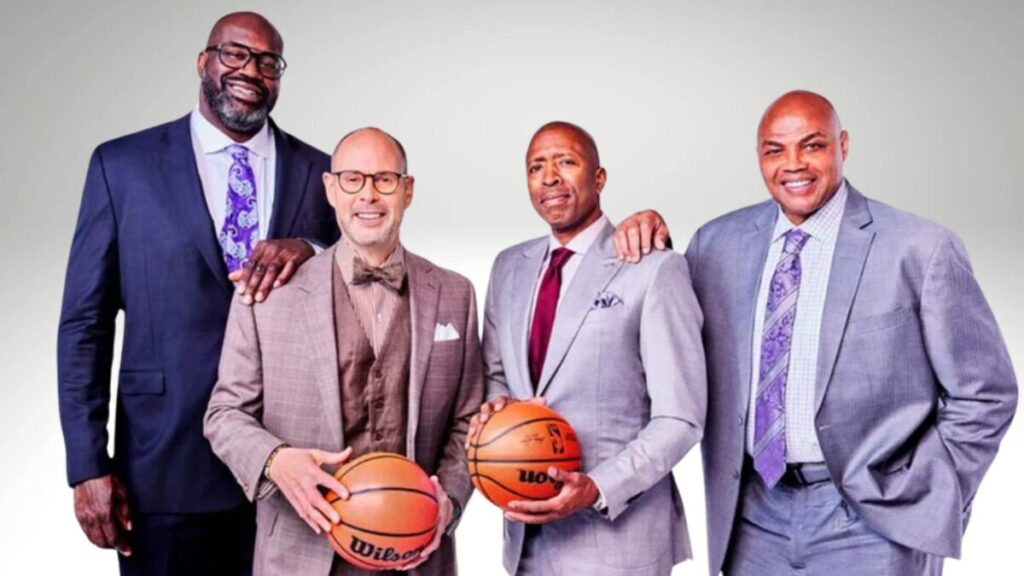
“Does Shaq need to continue to do this? Does Charles get a big paycheck if he goes somewhere else? Do Ernie and Kenny still want to do it? I think there are a lot of question marks, but from a pure fan perspective I obviously love that show. I hope they all figure it out how have it go on ESPN,” Levy said.
Photo Courtesy: TNT Sports
Having TNT produce the show, rather than ESPN should keep the vibe that Turner execs Tim Kiely and Craig Berry have built over the years, so that might be the right model, he said. “But just like M.A.S.H. and Seinfeld and all the great shows that eventually ended, they end. And you know, maybe this is where [Inside the NBA] ends, maybe this is where it doesn’t end.”
Looking ahead, Levy says that if he was in his old seat as a network exec, “I would be investing heavily in women’s sports right now,” Rights fees are still cost-efficient and WNBA games out-delivered NBA games. “That’s a pretty bold statement. I would never have thought in my lifetime that the Women’s Final Four would out-deliver the men’s.”
In his current role at HS&E, Levy just oversaw the inaugural Shark Beauty Women’s Women’s Champions Classic at the Barclays Center in Brooklyn. He said 11,000 people turns out, merchandise sold out and the event turned a profit. A priority was getting a sponsor in the beauty category, and Shark Beauty had a dry bar on the premises that girls and their mothers packed.
The launch of Unrivaled is coming in January and Levy is trying to get a women’s volleyball event going.
Levy is also keeping his eyes on a couple of upcoming events for more clues about the future of sports on TV.
He wonders whether the streamers who have gotten into the sports market will build or buy their own production facilities? Where will UFC’s rights land? How will NIL and players being paid affect college sports? Will players get their fair share of revenue under the WNBA’s new collective bargaining agreement.? And will the NFL opt out of its long-term rights deals later in the decade?
Levy remember when sports shifted to cable. And he also saw sports shifting to streaming–a process that has taken longer than he thought it would, he said. Revenue has flowed from linear to digital. Now he wonders, is live the next digital. Now he wonders if live is going to be the next digital
“Now you’re going to see a lot of brands shift their money into live content and sports is live,” he said.
Barrett Media produces daily content on the music, news, and sports media industries. To stay updated, sign up for our newsletters and get the latest information delivered straight to your inbox.
It is time once again for our weekly sales meeting, hope everyone has survived the first third of December, the part of the month where not everyone has completely shut down. This week we are going to talk about the role of the sales manager and the relationship salespeople have with their manager.
As with any relationship, the sales manager – salesperson partnership takes a bit of work from both sides in order to truly be successful. And also like any other relationship, there has to be trust that both parties are doing what is best for the other. The salesperson has to trust that the manager is going to be there for them, that they can talk with them about any struggles they might be having doing the job and expect to get help and coaching on how to fix the problem. Managers need to trust the salespeople are putting in the necessary work to get the job done.
Unfortunately, I have witnessed some managers who are great unless they are bothered. They run a great meeting, have earned the trust and respect of the other managers and can work magic with a spreadsheet making projections. What they aren’t good at, however, is working one on one with their sellers to get the best out of them.
Now, sometimes this isn’t all the manager’s fault. Salespeople have to want to be better, have to ask for help and have to listen to the advice given and then put it into practice. Too many times, as a manager, I have worked with salespeople who are only really trying to work hard to sell one person, the manager. They can come up with every excuse in the book as to why something is not working or how it is someone else’s fault but really aren’t willing to put in the effort to do the whole job and improve.
I write about this a lot because I believe it to be one of the most important things to always keep in mind about media sales. There are six key parts of the job: prospecting, appointment setting, the client needs analysis, the presentation, the close and the servicing of the account. I spent most of my career as a media sales manager repeating this over and over and over again. Usually, I didn’t have to go anywhere else but this list to evaluate what was happening with any one seller on the team.
After determining which part or parts of the sales process the seller is struggling with, the manager has to put an action plan together to both figure out how to correct the problem and get the salesperson to buy into the solutions. The best way to do that is to set measurable goals and track the performance while figuring out anything else that could be done to help the seller, such as articles or videos on the subject or even practice sessions.
For example, so many salespeople struggle with prospecting the right businesses to begin with. If that is where the breakdown is for the salesperson, you will need to nip that problem in the bud immediately, or you might as well tell the seller to start looking for new work.
Of all of the steps in the sales process, the first two – prospecting and setting appointments, is really what the salesperson is there for. Those are the two parts of the process the manager cannot do for everyone. I have always believed that if my team of sellers can get appointments set with the right decision makers at the right companies, as the manager, I could help them through any of the other steps even if I had to do them myself. While I can certainly train them on ways to be better at prospecting and setting appointments, if in the end the seller is not willing to put the work in, it isn’t going to work. The manager doesn’t have the time to help the whole team with steps 3-6 and set the appointments.
So, this is where the seller really comes into play as far as the relationship with their manager. Some managers are really good, and I have even worked with some who I would consider great. However, none I have ever met are able to actually read minds. If you are not communicating your struggles or hesitancies about the position with your manager, it is almost impossible for them to really help you.
Being honest with your manager is incredibly important, they are there to help you, but as the saying goes, ‘Help them, help you.’ And as managers, we have to willing to be honest with the salespeople, even if it leads to uncomfortable conversations.
One tip for managers is to always ask the salesperson their opinion of what the problem might be and see if they have anything to offer as a solution. Ultimately, you want the seller to see what the problem really is and work through/talk through the possible solutions. Most will know the answers to these questions, they just don’t want to be the one to say it. Use your sales manager skills to flip that around. Help them come up with the answers, but make it their answers.
Now, agree on some steps to work on the problem that are measurable. In this case, it might be coming up with a list of 100 businesses and challenge the salesperson to tell you why each is or isn’t a qualified lead or prospect. Have them do this over a few different weeks or until you are happy they know how to decide who fits and who doesn’t. Hopefully this then becomes a habit for the salesperson to think this way and to make weekly target lists.
Other times, the manager really has to dig in and see the seller in action. As mentioned, some salespeople are great at selling managers, but maybe not so great at selling clients. I had an example one time of a salesperson who was phenomenal at most of the steps, one of the best I ever had. I couldn’t figure out why she struggled to close more business until I went on a few different appointments with her.
I realized that while she was in my office, she talked a good game about being aggressive, asking for the business and closing the deal. Then, after a few times in the field, I saw she was great with everything, however, when it came time to actually ask for the business and get it done, she was hesitant. She put a lot of energy into the pitch and clearly at times was able to get people to say yes before she even asked. But when that didn’t happen and she had to make the move to go for the close, she locked up.
Now it was easier for me to see firsthand what the problem was. She was a great relationship seller with all the right relationships. The issue was she would be so close to her clients she now was thinking of it as asking a friend to spend money rather than a client making a good investment in their business.
Just helping her realize this by saying it out loud was one of the solutions. And keep in mind, this was a person who was a top biller, so anything I could do to help make her just a little bit better, paid off big time for the station’s revenue.
The truth is, most of the time it comes down to the salesperson, or the manager, not wanting to do the work and put the effort in to be better or to help someone be better.
If you are a salesperson struggling and looking for answers, think about how honest you have been with your manager. Have you asked for help? If you are a manager, rate your sales team on the six steps of the sales process and see if you have addressed the areas where you feel each seller is lacking a bit. If not, that may be a good way to spend the next couple of weeks.
It is a two-way street in order to be a successful partnership between sales manager and salesperson. It takes time and effort from both sides in order to work. Managers should always be thinking of ways to make each individual better. If you have tried with someone and it isn’t getting through, perhaps that means it is time for a change with that particular person.
If you are a salesperson, take this time to evaluate your relationship with your manager and let them know what you need more of or what you need less of. Get everything you can out of your manager or even the other managers in your building. Any amount of business it may lead to is more than you had before.
Barrett Media produces daily content on the music, news, and sports media industries. To stay updated, sign up for our newsletters and get the latest information delivered straight to your inbox.
As we approach the new year, we often consider those perennial New Year resolutions that require the breaking of poor habits and/or creating new ones. This often presents some of the greatest challenges in life.
We all experience the pain involved in breaking bad habits, whether it’s dieting, quitting smoking/vaping, nail-biting, or the plethora of other bad habits, from chewing tobacco to swearing too often. Creating new habits can be just as difficult and time-consuming. A marathon runner started with a slow jog.
It is surprisingly difficult to create new habits, even though they will very likely help you live and perform more optimally. We are all quick to judge other’s poor habitual behavior or fail to understand why some continue down that same path. Regardless of your role, here are some tips that may help you create new habits that serve you better – hopefully, both personally and professionally.
First, make the proverbial list of what you think will benefit you most, and understand that it does take a minimum of 21 days to create a new habit. However, it could take 3 times as long.
Perhaps you want to be better at time management, or you desire to improve your use of some software or CRM or take better notes, etc. Whatever you decide needs change, remember to give yourself time and start small. It’s virtually impossible to take on too much at once. So, focus on one at a time. Pick one habit and start small.
Manage the change by breaking the habit into small steps. Instead of committing an hour every morning, start with just 15 minutes. It’s no different than trying to hit the treadmill for an hour a day when starting with 15-20 minutes will prevent you from becoming overwhelmed.
Actions only become habitual through repetition. Consistency helps reinforce any behavior, even when your motivation may be low. Committing to your plan will get you through the most difficult part. Make your new habit part of your daily routine at a specific time. This helps make it a regular part of your life.
Pair the action with existing habits that serve as triggers. Linking a new habit to an activity you already do creates a positive connection in your mind. For example, if you want to begin using your planner first thing every morning, it would be an easier habit to create by doing it right after your first morning coffee.
Place reminders and/or visual/audio cues where you’ll see and hear them. These days, we have so many apps that remind us about events and chores via a ding, ring, chime, or beep that prompt us to follow through. Do the same for your new habit. Remember learning about Pavlov’s dogs in school and how Pavlov rang a bell whenever the dogs were fed? Eventually, that sound caused them to salivate before ever getting the food. Try the same idea with your new habit.
Just as we use exercise trackers like Fitbit and Apple Watch, keep track of your new habits via a calendar or an app that will help with your consistency. Seeing progress is a terrific motivator and helps with personal accountability.
Remember to reward yourself for sticking with the habit for a certain period (like a week or a month), even if the rewards are small. Don’t “reward” yourself by not doing the action. Building a habit takes time, so be patient. Trust the numbers… It really DOES take anywhere from 21 to 66 days to establish any new behavior.
The time frame depends on the individual and how complicated the habit is, so be forgiving. Avoid being too hard on yourself. Don’t give up on the habit if you slip up and forget. Get back up and move forward.
It’s often a challenge to make a new behavior fun, but if you enjoy the process, you’re more likely to succeed. For example, we all know that listening to the radio makes exercising a lot easier. Find something you love and enjoy doing along with your new action, and keep thinking about the positive results you expect once your new activity becomes a habit.
Finally, share your efforts with family, friends, and coworkers who will be supportive and hold you accountable. Finding others who share your goals can also help you succeed.
Very often, the new behavior you desire is difficult. Remember, it can be extremely arduous and time-consuming to create a new habit.
My stepson has completed some IRONMAN competitions. If you aren’t familiar with them, they consist of a long-distance triathlon race that includes a 2.4-mile swim, a 112-mile bike ride, and a 26.2-mile run. The race is considered one of the most difficult one-day sporting events in the world. He started his journey with a short run and a 2-mile bike ride.
Take your time, start slowly, and be consistent!
Barrett Media produces daily content on the music, news, and sports media industries. To stay updated, sign up for our newsletters and get the latest information delivered straight to your inbox.
The end of 2024 marks the final chapter of a remarkable 49-year radio career for Tom Oakes, SummitMedia Springfield, MO, OM. Oakes also serves as PD for KTTS Springfield and Interim OM/PD for KFDI, Wichita.
He plans to retire near his family in Minnesota, but even he wonders if that retirement will last. More on that later.
I caught up with Oakes to reflect on 49 years of radio and consider the future of the business that he is passionate about.
Oakes began his career at the University of Wisconsin Superior. Other stops along the way included Duluth, MN; Stevens Point, WI; Madison, WI; Des Moines; and Anchorage, AK.
“I started when I was 17, and I’ve been doing it ever since. I feel fortunate to have spent my entire career in something I love, as deeply as I love radio. I’ve never worked in another industry.”
With the changes the radio industry has gone through and continues to go through, to what does Oakes attribute his longevity?
“Willingness to change. There have been a couple of different waves of technical advancement. A lot of people, great people in radio just said, you know what, I’m checking out. They didn’t want to change or just felt they couldn’t handle the kind of changes we’ve gone through.”
“To be doing this job as long as I have, I have learned that if I want to stay relevant for my employer, relevant to keeping the radio station in touch, you have to change. You have to be willing to adapt and change because it’s the only constant we have going on.”
Will we see radio people put together nearly 50-year careers in the future?
“Not in the future. Because you have so many people who are plugged into podcasting or this or that or something else that’s been brought to us over the last 20 years and more so in the last 10 years.”
“They just move on to other things they’re more comfortable with. And that’s not a slam against anybody at all. I mean, some people adapt and change, and they thrive on it more than others. They only go find new things of interest to them.” Oakes said.
So, how do we find the next Howard Stern or Ryan Seacrest?
“Well, I think you have to look for it. In our cluster here in Springfield, in the last several years, my fellow workers and my fellow program directors in the building have kept an eye out for people. And we’ve had a couple of people just pound the door saying, I want to be a part of this.”
“We have a young woman who grew up in Russia, immigrated to the U.S. with her family, and learned the English language. She has completed her college education and is a full-fledged American citizen, having passed the citizenship test, which we supported her through the process. But she loves being on the radio. But she is also smack dab in the middle of the technology age.”
Oakes has pioneered a concept that he calls “rent an OM.”
“Beverly Brannigan approached me after Mark Granton passed away. And she approached me with the idea. She knew I wanted to be in Wisconsin or Minnesota, where the family was. Missouri, well, it’s an M state. It’s not that far away. She had an idea that she and Steve Wexler had come up with.”
“It was basically rent a cop. Or, in this case, rent an OM. And I agreed to come in for six and a half months to help with the transition after Mark’s passing to program KTTS and help refine the operations.”
“I wound up staying seven and a half months. They hired a new OM. Before I left, they asked me, ‘Hey, would you be interested in sitting in the PD chair at WCYQ in Knoxville for a couple of months while we look for a new PD?’ Sure. I’d never been to Knoxville or lived in Tennessee.”
“Before I was all done doing that job. They asked me to go to Omaha. To be the OM and oversee KQCH. Which is our Top 40 while helping them through a transition to a new OM. So, I got to see the country.”
“So, it was a fun concept. I went home thinking, Well, I’ll go find a permanent job. They wound up calling me two months later, asking me to go back to Knoxville and then eventually Springfield when they offered me the job full-time.”
And therein lies the potential for part-time retirement.
“My sister-in-law is betting I’ll be bored in six and a half months. And I’ll go looking for something. The concept of rent an OM or rent a PD. If somebody needs some short-term help to get through some changes. Or while they’re looking for somebody new. Or they’re launching a new format. I’ll entertain any ideas.”
Having myself left day-to-day programming and finding it difficult to listen to the radio as a consumer and not criticize every break I hear, will Oakes be able to step aside and turn off the programmer’s head?
“No. I don’t think I can turn it off. But I certainly can take a break. And you know it’s kind of funny. It’s about a ten-and-a-half eleven-hour drive from Springfield to the Twin Cities. In all the years I have spent driving back and forth going up and seeing the family. And spending time up there. The one constant in my life. Has been my radio in the truck.”
“I listen to radio. I love radio. I like hearing what people are doing. I want to hear a different music mix. I want to see what other stations are doing. In the format I love. Country. Or experience news talk.”
For Oakes, it’s always been about doing what he loves.
“Passion is what it’s really about, passion about what you do, passion about how you do it, passion for who you’re serving, who you’re working with, and just trying to lift everybody up. I wish I was this smart back in 1976.”
Now, spending time near family will move to the front burner.
“I’m happy to be getting close to my family and spending time with them. Because I’ve been far apart, and boy, you can’t get much further apart than living in Alaska.”
“Over the years. I got to see one of the most tremendous places in the world to live. I love what I do. I have loved Country music. It’s really been the format that I’ve keyed in on. I’ve done a lot of other formats, including beautiful music. But I learned from that. I’ve learned from everything I’ve done.”
“I think the future is very bright for Country music. I think what radio becomes we have yet to know.”
In order to prevent repetitive conversations surrounding the same teams from taking place on his digital podcast, Kevin O’Connor keeps a spreadsheet where he tracks the topics discussed in each episode. Even though the indomitable cadence of breaking news often resonates throughout the content ecosystem, O’Connor recognizes the importance of giving credence to every NBA team while discussing the game for a national audience.
If six weeks has gone by without talking about a specific franchise, he will try and introduce the organization into the topic rotation for an upcoming episode. In addition to safeguarding against imbalance, something O’Connor refers to as being inevitable, he tries to think about what conversations would interest him and resonate with the audience.
While hosting a recent episode of his show, O’Connor spoke about Los Angeles Clippers point guard Kris Dunn and his ability to lock down his opponents with strong effort and execution on the defensive end. The rationale for holding this conversation, aside from not having spoken about the Clippers in some time, pertained to the fact that he had just been to a game and observed Dunn’s defense against Orlando Magic forward Franz Wagner. Rather than discussing superstar guard James Harden or the potential return of forward Kawhi Leonard, O’Connor opted to canvass the topic and lean into his inquisitive psyche.
“Sometimes simply finding a topic is about, ‘Well, it’s been a while since we talked about this team,’” O’Connor said. “Naturally, of course, there are some teams you’re talking about more often. Especially as the playoffs approach, those become the teams of higher importance.”
As O’Connor is in his inaugural season covering the NBA for Yahoo Sports, he is focused on appealing to the audience and bringing honest insights and opinions predicated on journalistic integrity. Creativity and ingenuity are at the core of his approach within sports media, and he has also been able to exhibit deft versatility along the way to becoming a credible multiplatform presence in the space. In being granted an ostensible auditory pulpit on which to glean his perspectives twice per week, O’Connor maintains the mindset of a journalist and editorializes with factual evidence to back his claims.
“I think mostly, you’re serving the fan,” O’Connor said. “I think honesty is what matters most. Being honest in your thoughts [and] honest in your opinions on players and teams, and ultimately, you’re doing fans a disservice if you don’t do that.”
Beyond excited about what we’re building together @YahooSports.
More details to come on my NBA podcast, and much more.
Thank you @ryanspoon and @samfarber13 for the opportunity to join such an incredible team.
In delivering digital content surrounding the personnel and teams in the NBA, O’Connor ensures that he takes part in networking and attends different matchups and league events. Rather than doing all of his work remotely, he is on the road for proceedings such as All-Star Weekend and will hover around the sidelines before a game begins. There are instances where he meets up with sources, but he nonetheless frequently remains in communication with those around the game and values transparency.
“I’m not somebody who’s in the business of trying to newsbreak at all – it’s not a priority for me one bit,” O’Connor said. “It’s obviously good to be in the know, but that comes with developing trust over time and that comes with maintaining a friendship, relationship – whatever you want to call it – with those people over the course of time.”
O’Connor never thought he was going to leave his job at The Ringer writing and podcasting about the NBA, and he ostensibly rendered himself a pillar of the startup company. Having the chance to work under the leadership of founder Bill Simmons and other experienced reporters, he envisioned himself continuing to grow with the brand and becoming immersed as a podcast host.
Over his eight years with the company, O’Connor gained eminence and prestige in the sports media landscape, and Yahoo Sports made it known that there was interest in his services. Meeting with Yahoo Sports president Ryan Spoon and head of content Sam Farber, along with other leadership at the company, helped convince him to make the move.
“Sam and Ryan just have a vision for me and for the company as a whole that just spoke to me in ways that I’m really, really excited about,” O’Connor said, “and plus the opportunity to host my own show, and to do that twice a week for Yahoo right now allows me to talk to different types of people and have certain conversations that I really want to have about the NBA [and] talk to players. And I think right now, we’re still in the early phases of that, but I’m very excited about the way we’re going to build out my show in the months and the years to come with Yahoo.”
Over the last several months, Yahoo Sports has expanded the scope of its sports media coverage through adding established professionals across several areas of focus. Before O’Connor signed on to join the brand, the outlet welcomed Ariel Helwani, Damien Harris, Nate Tice and Russell Dorsey among others to contribute their expertise and showcase their fluency in respective niches. In the end, the means by which O’Connor envisioned his career evolving matched with the intent expressed by Yahoo Sports of establishing and building out his own show.
“I like the way it looked, I love their social presence and now being part of it, getting to call it, ‘Our social presence, our videos,’ it’s been really nice working with the team and making some of that stuff – the ideas that we have – into a reality,” O’Connor elocuted. “It’s still early – I think it’s going to get even better in the years to come.”
“I just think this is an awesome roster.” 👀@KevinOConnorNBA and @_JasonLT discuss why Dallas could be the team to beat in the NBA Cup.
As someone who focused on writing early in his career and later added podcast hosting to his repertoire, O’Connor understands the importance of a multiplatform distribution strategy. Situated within a fractionalized media landscape, he does not discern significant overlap in the audience across different verticals. On the contrary, he feels that consumers will remain loyal to the outlets towards which they are most comfortable. Because of this empirical proclivity, it is incumbent on O’Connor and Yahoo Sports to meet the consumers where they are and create informative, compelling content.
“A lot of people, they might just watch podcasts on YouTube and they might not even have Spotify downloaded on their phone, and they might never read anything,” O’Connor hypothesized. “They might just watch YouTube, and there might be people who only scroll X all day, and they otherwise may never discover that you have a podcast, but they might see that 15-minute clip you put out talking just simply about the Pelicans.”
Over the years, various studies have demonstrated a diminished aggregate attention span, subsequently leading brands to emphasize the creation of short-form content catering to these trends. Yet O’Connor grew up reading in-depth stories on Grantland and subsequently thrived in the space, producing a yearly NBA Draft Guide that accumulated plaudits and feedback from industry professionals. Even so, he feels there is still a large market for longform podcasts; however, they are oftentimes supplemented by other content strategically created and placed in other domains.
“If I record a 90-minute sitdown interview with LeBron James, there’s going to be a large chunk of people who watch that entire 90-minute interview, but then there’s going to be probably even a larger chunk of people that are only going to see the one-minute clip on TikTok, the three-minute clip that I put out on X, the 20-second clip that someone clipped themselves and posted on Instagram Reels,” O’Connor explained. “So I think the short form content is massive in its own way, but so often, short form content is cut from that longform piece of content.”
When O’Connor was a college student studying psychology and communications at Bridgewater State University, he landed an internship with NBC Sports Boston and excelled at the regional sports network. Writing for SB Nation within its CelticsBlog, he began to discover his lane in the content sphere and demonstrated an unwavering work ethic in the venture.
Even though he did not have the confidence to join an upstart venture such as The Ringer when it was founded in 2016, he gave it a shot since the opportunity was available. O’Connor was hired because the company liked his NBA Draft Guide that he had been producing independently and wanted him to bring it to the outlet. Later in the year, they had him appear on a podcast with Chris Vernon, which eventually turned into an eight-year partnership.
“I don’t think I really did any podcasting prior to The Ringer, now that I just think about it off the top of my head,” O’Connor said. “I think that was really the first podcasting I had ever done.”
O’Connor rapidly became comfortable discussing basketball in the podcast setting, but he learned more about hosting through watching Vernon in particular. Being able to work alongside someone with two decades of radio experience was fortuitous, witnessing the preparation, foresight and aptitude required to effectively guide a program and the topics it covers.
Through his first few months with Yahoo Sports, O’Connor has welcomed a variety of colleagues onto his program in a guest rotation, including Adam Mares, Tate Frazier, Dan Titus and Tom Haberstroh. There is no specific co-host that is affixed to the show, and O’Connor is still trying to determine the people with whom he has rapport and synergy, intangible characteristics that can be bolstered through repetition.
“I kind of look at it right now as its extended preseason in some ways where it’s figuring out who’s going to be that rotation over the course of time,” O’Connor said. “Who are the people that I really enjoy talking to where I feel like there’s a natural chemistry? People who aren’t afraid to disagree with me or call me out if they say something that I think is stupid.”
Since O’Connor is giving his opinions about basketball, he has been subjected to criticism and backlash for some of his takes over the years. While he has relationships with people who are within the fabric of the league and connected to the news cycle, he safeguards against investing his time into those who are duplicitous or not able to exercise mutual benefit. In previous years, an agent liked O’Connor because he spoke positively about one of his clients. When O’Connor was critical of another client years later, the agent communicated his displeasure using an expletive and ultimately stopped talking to him.
“If that person did that to a 21-year-old kid right out of college, that person might be influenced by that,” O’Connor surmised. “Like, ‘Oh no, no, I didn’t mean it,’ but again, you need to be honest to the fans, and that means being honest with your own thoughts and opinions.”
According to a recent report from Acast, 38% of podcast listeners plan to increase time consuming on-demand audio in the next six months. This same research also divulges that 72% of respondents have watched a video podcast. As O’Connor considers the future of his multiplatform endeavor, he hopes to have more conversations with players, coaches and executives, giving listeners access to the inner workings of the sport. Through deliberation, debate and discourse, he seeks to advance stories on the program.
“Podcasts are edited at a very high level on the video side of things, [and] the social stuff is very impressive,” O’Connor said. “My editor, Matt Wong on the NBA side of things, he’s been great to work with on the editorial side, so I’ve been very impressed with the team that’s already been assembled by leadership with Sam Farber and Ryan Spoon and working with them so far. It’s only been – what, it’s December right now – it’s been about two full months. It’s exceeded my expectations for sure so far.”
Within his new role, O’Connor has a consistent multiplatform presence with Yahoo Sports and has been blown away during his early time with the company. Viewing its social media pages, he was amazed at the three-minute turnaround of learning news, creating a graphic and posting everything online. O’Connor has observed that things move quickly at the company, and he has thoroughly enjoyed working with colleagues in production, editorial and management. Through the whirlwind of the offseason and familiarizing himself with Yahoo Sports, O’Connor looks forward to a bright future replete with innovation in digital media and continued proliferation of basketball.
“I never dreamed of being able to have this career in sports media,” O’Connor expressed. “I didn’t think it was possible. It always felt distant, and so the fact that I’m in it is something that I don’t ever take for granted. So it’s always about continuing to try to do your best because I love what I do and I would never want to give it up.”
Barrett Media produces daily content on the music, news, and sports media industries. To stay updated, sign up for our newsletters and get the latest information delivered straight to your inbox.
Whether it be personally or professionally, I firmly believe in the mantra “Say what you think, say what you mean, mean what you say.” Some news/talk radio hosts and stations don’t follow that as closely as I do, and it shows.
I know that you know the story of the boy who cried wolf. So I won’t rehash it. But I truly believe there are a few different areas where the news/talk radio industry features a similar situation.
First of all, and this isn’t specific to the format but one where the news media can be a leader in shaping the change needed, is the insanely hyperbolic talk on virtually every topic. If you were to poll how many conservative news/talk hosts said the phrase or some variation of “We have to save this country from the Democrats!” before the 2024 election, it feels like it would damn near be 100%. While calling each time Americans go to the ballot box “the most important election in history” makes the news media feel good, big, and important, phrases like that lose their luster at some point. And I’m not alone in thinking that.
Not everything happening is the most consequential, most important, biggest, etc…the constant self-aggrandizing can be and is a turn-off to listeners. It’s almost insulting their intelligence by saying “We’re not sure you’ll actually tune in, so we have to make this sound bigger and better than it actually is.”
Have you ever felt misled? No matter the situation, it’s not a feeling you’d like to have all that frequently. So why in the world would you ever want to do that to your most valued customers?
Similarly, I think the bigger epidemic in the news/talk radio space is the use of the term “major announcement.”
At the risk of writing roughly 10,000 words on the subject, nothing in the industry frustrates me more than seeing a station promote a “major announcement.” Because, legitimately, 85% of the time it is only “major” to the people working at the station.
Earlier this year while scrolling social media, a post caught my eye promoting a “major announcement in (insert show here’s) history,” on the following Monday. Naturally in my line of work, it caught my eye. It was absolutely something I needed to keep on my radar for the following day as we continue to provide the best news media coverage.
Do you know what the “major announcement” was from one of the top-rated local shows in the country was? What did this show spent all weekend promoting to its large listener base? That, for the first time in the show’s history, they would announce who they were endorsing in a local political race…on Wednesday.
So, for the duration of Friday, Saturday, Sunday, and until the show hit the air on Monday, there were promos, liners, social media teasers about the “huge announcement” which ended up being an announcement in itself.
Do you know what happens the next time a listener hears that the station has big news to share? They likely don’t tune in. Why? Because you wasted their time the last time. Now, this station and show aren’t alone in this. Several others are guilty as well. It’s why when I saw that 1130 WISN in Milwaukee had a “huge announcement” scheduled for this week, I was skeptical. But kudos to them, because the announcement of a lineup reshuffle after the retirement of longtime host Mark Belling is, in fact, a major announcement.
But to spend time promoting that you have big news to share just to say you have a new sponsor or are endorsing a new product is a waste of your time. It burns the credibility and trust you’ve built with your audience. You — as a host, producer, program director, sales manager, market manager, or executive — might be excited about your “huge announcement”, but if your audience doesn’t view it with the same energy, it’s a detriment beyond a shadow of a doubt.
I can remember once sitting at a radio conference and hearing a distinguished leader say of air talents, “If you’re going to try to be funny, you better be f—ing funny.” And I feel it’s a similar message to sharing news about your station. If you’re going to promote it as a “major” or “huge” announcement, it better be f—ing major or huge.
Listeners believe what we tell them to believe, to a point. But when you cross that line and they become defectors of your product, you only have yourself to blame.
Words matter. Word choice matters. Say what you think, say what you mean, and mean what you say. If you stick to those values, you won’t be left wondering why nobody believes you any longer when the wolf is actually at your doorstep.
Barrett Media produces daily content on the music, news, and sports media industries. To stay updated, sign up for our newsletters and get the latest information delivered straight to your inbox.
Local advertisers are almost always apprehensive during an election year. But Gordon Borrell of Borrell Associates believes 2024 could be the year that serves as the precursor to a big 2025 in the advertising world.
Much of the advertising market in 2024, logically, was centered upon the presidential election. More than $11 billion was spent on the presidential race, key Senate battles, and other issues-based ballot initiatives.
And that uncertainty led to an anxious advertising market throughout the calendar year.
But from Borrell’s perspective, it likely means 2025 will be a big year in the marketing realm.
“While overall it was a good, it wasn’t a bad year, but there was just this tightness about it that made it uncomfortable,” Borrell said. “I’m more eager to put 2024 in perspective by looking at what that did to 2025 or what that is likely to do in 2025. I think you have kind of a reserve and desire to increase advertising budgets, and very high potential for the floodgates to open next year for that advertising. So I think 2024 was a big setup for what may be a banner year for advertising, at least on the local side and I’m sure the national as well.”
Borrell added that the cycle of advertisers being reticent during an election year before returning to normal or even increased levels of spending the following year isn’t unprecedented. However, he believes the intensity in which local marketers will return to the scene in 2025 will be unique.
“In late November, we did another survey and the optimism went through the roof. It was right after the election, so there was this feeling — put the politics aside for a moment — the cold hard facts are that local businesses really don’t give a rip, they just want some level of certainty and good feelings before they invest their advertising dollars … so now that the decision has been made, they’re feeling really good about the economy and the future. We got this sudden burst of optimism for the end of the year, November on, and that will really characterize 2025 for us.”
Borrell Associates focuses its research and data specifically on local advertisers. And its findings suggest that new marketing opportunities will be what many of those in the sector are seeking out in 2025.
“I’m looking at the results for social media in terms of the advertisers saying they bought it, not just fiddle around with it for marketing purposes,” said Borrell. “On social media, a significant increase in the percentage saying that they’re going to either buy next year for the first time or increase their spending. So the net interest is 24%, so that’s roughly a 1/4 increase in in usage. We also saw slightly more in search engine marketing. It’s still there and it’s still deemed extremely effective. It’s phenomenal. Our advertisers felt the effectiveness of social media and search marketing.”
Gordon Borrell added that other avenues like banner ads and streaming audio were also primed for growth in 2025.
Absent from the list was radio. Borrell shared that its likely in large part related to the fact that there aren’t any new shiny innovations with the medium like there are in other sectors. But there is one place that radio companies can capitalize with local advertising in the coming year.
“If you look for the past 10 years, the number one used and purchased medium has been social media,” shared Borrell. “It’s always been at the top. It beats out everything else, usually social media and search marketing. That’s what attracts the most individual advertisers.
“In 2024, event sponsorships passed it for the first time. Event sponsorships — outdoor events, indoor events, cocktail parties, whatever — as a marketing method, surpassed social media. And that really gave us whiplash. Because if you think of the two, they’re same. They’re interacting with people. One is virtual, one is real. The advertisers and businesses think that social media is great, but I just want to get a way to supplement my virtual stuff and get out and shake a real hand and see somebody possibly come over to my booth or my table, get my name out there … that’s really taken off and that’s just an interesting phenomenon of 2024, how events have become a big deal.”
Barrett Media produces daily content on the music, news, and sports media industries. To stay updated, sign up for our newsletters and get the latest information delivered straight to your inbox.
Ahead of its broadcasts within the College Football Playoff, The Walt Disney Company registered strong viewership for its presentation of conference championships across several entities. ABC and ESPN presented the Southeastern Conference championship game amid its first year with media rights for this entity and averaged a combined 16.6 million viewers, marking the third most-watched regular season game across ESPN platforms on record. Moreover, the average viewership accounted for the largest audience of the college football season.
The game peaked at 19.7 million viewers, according to data from Nielsen Media Research, and the matchup was the fourth most-viewed SEC Championship Game on record. The Georgia Bulldogs ended up defeating the Texas Longhorns in overtime by a final score on 22-19, sealing the accolade on a game-winning touchdown by Trevor Etienne. Play-by-play announcer Chris Fowler, analyst Kirk Herbstreit and sideline reporters Holly Rowe and Laura Rutledge were on the call for the game.
Yet the viewership figure is down compared to last season’s iteration of the SEC Championship Game between Alabama and Georgia, which averaged 17.52 million viewers and an 8.9 rating on CBS. The game was the largest audience for a conference title game since the same two teams faced off in 2008. It was also the final time the SEC on CBS broadcast property took the air under the 15-year contract reportedly worth a total of $825 million.
The Atlantic Coast Conference championship game between the Clemson Tigers and SMU Mustangs averaged 6 million viewers on ABC, down by about 14.7% year-over-year. This matchup peaked with 8.8 million viewers and marked the 20th anniversary of the conference championship game. Even though the game experienced a diminution in its average viewership, it was still the third-most watched iteration of the game since 2015, falling behind last year and 2020. Play-by-play announcer Sean McDonough, analyst Greg McElroy and sideline reporter Molly McGrath called the action, which ended on Clemson kicker Nolan Hauser delivering a game-winning field goal in the waning seconds of regulation.
The final game to air on ABC was the Big 12 Conference championship between the Arizona State Sun Devils and Iowa Hawkeyes. The network secured an average of 6.9 million viewers for the game, which ended in a 45-19 victory for Arizona and the first championship since 2007 for the program. ABC’s broadcast of the game reached a peak of 7.8 million viewers, but it was still down from the Texas-Oklahoma State battle last year by about 12.5%. The game was the lowest average viewership since 2020 when Iowa State faced Oklahoma in a matchup that collected 3.03 million viewers. Play-by-play announcer Joe Tessitore, analyst Jesse Palmer and sideline reporter Katie George called the matchup on ABC.
Including the American Athletic Conference championship matchup that aired on Friday night, ABC averaged 8.4 million viewers across its four-game slate. Even though all of the games experienced year-over-year declines outside of the AAC matchup (average of 1.89 million viewers, +18% year-over-year), the average represents the most-watched schedule of games on the network since 2014. ESPN and ABC will present games within all four rounds of the 12-team College Football Playoff, starting on Friday, Dec. 29 when Indiana faces Notre Dame at 8 p.m. EST.
Barrett Media produces daily content on the music, news, and sports media industries. To stay updated, sign up for our newsletters and get the latest information delivered straight to your inbox.
Big Reid, the Top 40 99.7 Now San Francisco evening host, will add PM Drive on Urban AC KBLX to his daily duties.
Billy Vidal will take over the KBLX midday shift previously held by Antoine Davis, a 20-year veteran of the station who was let go last month. Vidal will continue to host morning drive on AC 96.5 KOIT across the hall. (BMM 11/14)
Posting on Instagram, Reid said, “If you grew up in the Bay Area, you already know how big of a deal this is. I understand how important this brand is to the people who came before me and I don’t take that lightly. Honored to let y’all know that I have accepted an opportunity to hold down Afternoon Drive on the LEGENDARY @kblx1029! You can now hear me every day, Monday through Friday, from 2 pm to 6 pm, playing The Best Throwbacks and R&B! This is gonna be fun! Letsss gooo!”