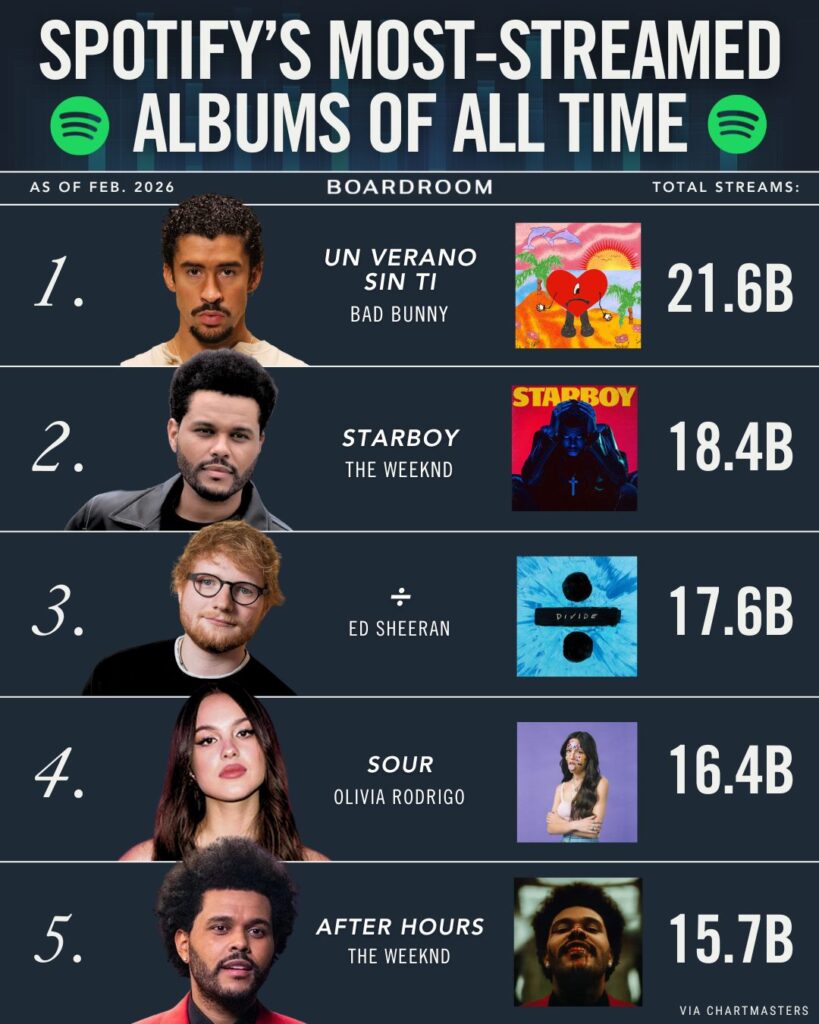
There has never been a moment like this. Within 14 days, an artist performs at the Super Bowl halftime show, wins a Grammy for Album of the Year, posts 170 million U.S. streams in seven days, holds six of the Top 10 streamed songs in America…and doesn’t have one song in the Top 40 on mainstream radio.
If you program pop radio in America and you’re not playing Bad Bunny, we need to talk.
The 170-Million-Ton Elephant in the Room
Let’s start with my least favorite subject: math.
170 million streams in one week in the United States (and not during Super Bowl week, for the doubters). Six of the Top 10 streamed songs in America. That’s mainstream. You know, the way your sales team describes your format.
Yet 222 reporting CHR stations have chosen to not give double digits spins to the biggest artist in America. Chosen to say, “not for us,” or “he doesn’t wave the Top 40 flag.” Maybe you missed that during the Super Bowl Halftime Show he had dozens of flags waving.
Maybe you think he’s not a pop artist. You must have forgotten that “pop” is short for popular (unless you’re in the Midwest).
Too Busy Playing What’s Being Worked & Not What’s Working
Radio has drifted from “what’s hot?” to “what’s being serviced?” The promo rep has become more effective than most programmers.
Programmers, in many cases, are reacting to label priorities, airplay pressure, comfort, fear, and corporate programming mandates (culpable de los cargos).
Instead of responding to actual demand, actual audiences, actual cultural relevance, and dare I say it, actual data. Ah, there’s that unarguable math thing again.
So what is it?
Is he underplayed because the songs are in Spanish?
Is it because he’s operating outside traditional label machinery?
Is it fear of alienating a perceived core demo?
Here’s what we know:
America is not confused.
America is not hesitant.
America is not waiting for the song to come back in your callout.
“But Phil, My Market Is Different.”
Ah yes. The classic: “My market is different.”
You’re right. Your market only has five Bad Bunny songs in its Top 10 streamed songs. The other market has six.
Pull the local streaming charts in almost any CHR market. You’ll find him at the top. Multiple times. Multiple titles. Multiple albums.
The audience already voted. You just haven’t counted the ballots (not that ballot boxes are ever rigged).
Those Who Get It
Let’s give credit where it’s due. Jazzy Jim Archer — I’m a fan — at KMVQ has Bad Bunny spinning 60+ times a week.
iHeart has well over a dozen mainstream Top 40 stations playing him in double digits, right in line with their newly announced podcast partnership with Bad Bunny. The types of people I heart are people who heart all types of people.
For the other 200+ Top 40 PDs not playing Benito, you are making your station’s relevance finito (and, yes, I know that’s Italian; “how dare he put three languages in the same article!”).
The Language Barrier
Yes, his songs are in Spanish. So?
Streaming eliminated language as a barrier. TikTok did that. Netflix did that. K-pop did that. Reggaeton did that. Heck, “Macarena,” “Gangnam Style,” “La Bamba,” and “99 Luftballons” did that, decades ago.
Remember when you played “Despacito” and “Gasolina”?
Sidenote: “Despacito” was the most-streamed song of 2017 and tied the record for most weeks at No. 1 on the Billboard Hot 100 (16 weeks). So there must be more at play here than the language objection.
The Political Climate Argument
“We don’t want to appear political.”
When did playing a global superstar become a political stance? Let’s not pretend neutrality is a strategy.
Taylor has a political view. Bono has a political view. Bruce Springsteen has a political view. Nicki Minaj has a view. Right Said Fred has a political view. Do we need to stop playing them?
The Independent Label Theory
Another theory: he’s not being pushed in traditional ways.
No promo army.
No call blitz.
No coordinated “add week” theatrics.
Translation: programmers have to make an independent decision. That’s uncomfortable for some. We’ve built a system where “worked” often trumps “wanted” (no pun intended).
The Real Risk
Every time you ignore an artist this big, you train your audience to go somewhere else.
When a listener opens Spotify or Apple Music and hears what they want immediately, then gets in the car and doesn’t hear it, you’ve just reinforced the perceptual idea that radio is behind.
This is bigger than Bad Bunny. This is about programming philosophy, you know, that thing you used to have to submit with your resume when you were looking for a job.
Have we reached a point where politics matter more than product? Where labels matter more than listeners? Where traditional matters more than remarkable?
I don’t believe programmers are ignorant. I don’t believe they’re arrogant. But I do think some are trapped inside systems built for a different era.
Not Playing Bad Bunny Is Bad Programming
When 170 million weekly streams say “play this,” and the programmer says, “we’re not sure,” the audience answers, “cool! We’ll go somewhere that is.”
And that, my friends, is how $20 at a time terrestrial radio funds its own competition.
Barrett Media produces daily content on the music, news, and sports media industries. Sign up for our newsletters to stay updated and get the latest information right in your inbox.