

There’s a lot of debate about the accuracy, importance, and methodology of the Nielsen PPM ratings system. I’ve been in too many debates with talent and fellow sports radio programmers about what to judge regarding the output of the data itself. In a day and age when digital metrics are becoming the goal, the traditional system Nielsen provides remains the report card by which sports radio is judged.
When Nielsen first introduced the shift from a five-minute to a three-minute threshold for credit, many labeled it a boost for radio broadcasters. During a Nielsen webinar in September 2024, the company disclosed that initial research showed average quarter-hour ratings for all stations increasing by an estimated 26%. With the change, the belief was that more stations could see significant gains, benefiting formats that skew younger and appeal to shrinking attention spans.
Now, a year later, sports radio’s share percentage among significant demographics is down. Not just down, but down in every demo measured in a recent Inside Radio analysis. If the three-minute rule was designed to reflect changing audience habits, sports radio must adjust its content approach as well.
I’m not naive enough to believe that every situation applies to every sports radio station across the country. There are surely examples where the three-minute rule benefited certain stations more than others. However, in conversations with programmers nationwide, very few, if any, coached talent or adjusted clock structure to adapt to the new rule.
A year later, the results are in, and the data shows it’s time for change. First, let’s revisit why Nielsen shifted from five minutes to three.
The decision stemmed from Nielsen recognizing that listener attention spans were shrinking amid a growing variety of content options. According to Jacobs Media, Nielsen reported that half of all radio listening at the time fell short of the five-minute threshold. By reducing the threshold to three minutes, more stations could capture credit for shorter listening occasions, helping companies secure better ad buys and drive revenue.
In May of last year, Nielsen Managing Director Rich Tunkel and VP of Research Jon Miller held an online seminar examining the impact of the change. Their biggest takeaway: audience levels in the first quarter of 2025 were the highest since 2022 and approximately 15% higher than in the fourth quarter of 2024.
Logically, when you lower the threshold for credit, audience metrics should rise. That doesn’t necessarily mean more people are listening; it simply means more quarter-hours are being captured.
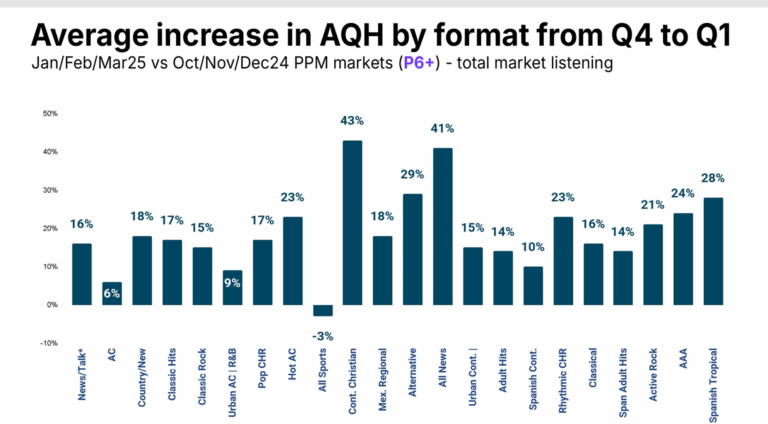
Yet when that research was presented, all twenty-two formats represented posted gains except sports radio. Granted, the comparison involved fourth-quarter 2024 results under the five-minute rule during the NFL season versus first-quarter 2025 results under the three-minute rule without NFL football. Anyone in sports radio knows the first quarter is typically the most challenging stretch of the year.
Still, the decline appeared then and persisted throughout the calendar year. According to an Inside Radio analysis released this week, sports radio was one of three formats that saw year-over-year share declines from January 2025 to January 2026. The findings covered persons 6+, persons 18-34, and persons 25-54.
Nationally, sports radio shares were down 11% among persons 6+, down 12% among persons 18-34, and down 6% among persons 25-54. In short, sports radio is losing the format battle under a three-minute qualifier.
So what can be done?
With more listening occasions now counted, sports radio must adapt. If less listening qualifies for the same credit, sports radio talent must adjust. Three keys can help reclaim those quarter-hours.
First, stop wasting the listener’s time. When I survey sports radio across the country, I too often hear talent easing into segments with call letters, phone numbers, text lines, social plugs, YouTube chats, and general small talk instead of getting directly to the topic. The listener chooses to come to you for entertainment and insight. Yet many hosts offer connection options before providing a compelling reason to stay.
It’s an old phrase, but it rings truer than ever: get to the meat and don’t leave them waiting. Why are Instagram Reels and TikTok so popular with these same demos? They’re short, direct, and respectful of the user’s time. Sports radio must operate the same way.
Second, combine strong, engaging content with more commercial breaks. Yes, more breaks. Every hour has its own clock, but more breaks mean shorter breaks. The era of four long breaks per hour must end if sports radio wants to compete in a shortened-attention-span world.
If Nielsen found last July that 23% of PPM listening occasions lasted three or four minutes, spot breaks cannot exceed what the research supports. Two- to three-minute breaks, strategically placed to maximize quarter-hour retention, represent a smarter approach for 2026.
Third, master effective forward promotion. Telling your audience about an interview two hours from now makes little sense in an on-demand world with limited patience. Instead, promote what’s happening next. More importantly, explain why it matters. What makes the upcoming segment, interview, or giveaway something I can’t miss?
Daily routines often dull urgency for sports talk talent. When urgency fades, so does the audience’s desire to stick around. The stage is yours, and listeners expect immediate payoff. A lack of energy is no different than refusing to play the hit record of the day.
Sports radio doesn’t face the same challenges as music radio. Local voices discussing local games offer something audiences can’t find elsewhere. Unfortunately, too many shows settle into routine without enough coaching or feedback to improve. Rather than accepting the three-minute rule’s results, the format should treat them as a challenge to evolve—meaningful change that drives impact.
The three-minute rule isn’t the villain. It’s the mirror.
For years, sports radio leaned on longer listening occasions, habitual quarter-hour patterns, and the gravitational pull of live games to mask inefficiencies in content structure. That luxury no longer exists. If a listener only needs to give you three minutes to count, those three minutes must be compelling, urgent, and impossible to abandon.
This isn’t about blaming Nielsen. It’s about accepting the environment we’re in. Digital platforms didn’t wait for radio to adjust. They trained audiences to expect immediacy. They reward speed, clarity, and payoff. Now traditional measurement reflects those expectations.
Sports radio still holds every competitive advantage: live emotion, local credibility, trusted personalities, and community connection. But advantages only matter when executed with intention. Structure matters. Pacing matters. Coaching matters. Energy matters.
If shares decline across demos even with a shorter threshold, that signals a content problem—not a measurement problem.
The three-minute rule should serve as a wake-up call, not a complaint. Win the first 30 seconds. Deliver substance before housekeeping. Respect the listener’s time. Shorten the breaks. Promote with urgency. Coach with purpose.
The formats that adapt will stabilize. Those that don’t will continue debating methodology while the audience moves on.
The clock has changed. The audience has changed. Now the content must change too.
Barrett Media produces daily content on the music, news, and sports media industries. Sign up for our newsletters to stay updated and get the latest information right in your inbox.
