

There are both positives and negatives for sports radio brands when it comes to properly using social media. With each passing day, there’s a high probability that what worked yesterday won’t work today—and may never work again tomorrow. However, the real challenge lies in the strategy. If you focus only on limited platforms, you risk missing potential audience. Conversely, if you try to be everywhere, you risk diluting your overall impact.
However, what most sports radio brands miss is how to adapt to platform-specific trends. What works on one platform doesn’t necessarily work on another. With limited staff, resources, and time, it’s nearly impossible for many brands to keep their social strategy performing at peak levels every day of the week.
That’s why sports radio needs to work smarter, not harder, when it comes to social media. Relying on platforms that place your content into a bucket for an algorithm to determine reach later isn’t a winning approach. Instead, sports radio needs to shift its strategy from the written word to real-time engagement—the kind that YouTube provides.
Since COVID, sports radio has appeared on YouTube more than ever before. The pandemic showed that when you remove the car, you must find ways to penetrate the home. Ask yourself: when was the last time you saw an AM/FM radio in a home? Most have been replaced by smart speakers or smart TVs with streaming apps serving as the primary distribution model.
Additionally, COVID accelerated video consumption across platforms like YouTube and Twitch. YouTube’s global traffic increased by 15% during lockdowns, making it one of the most visited sites worldwide. In 2020, 64% of social media users reported using YouTube more frequently while confined at home.
Video First Content Economy
Over the past five years, podcasts have evolved from audio-first to video-first products. Netflix is now investing millions of dollars in top podcasts, securing exclusive access to video audiences originally built on YouTube.
Sports radio needed to adapt—and it did. Many stations now distribute video through YouTube, thanks to forward-thinking executives who recognize that traditional radio may no longer be the primary destination for sports content. However, many stations still miss the point of being on YouTube. As a result, they lose potential reach, engagement, and key metrics that matter to advertisers seeking digital opportunities.
So, does sports radio actually use YouTube as social media? Or does the format still view it primarily as a consumption platform? Consider your own local sports radio station and how it approaches social media.
Most strategies still begin with X, where many brands have long established their presence. It’s where Adam Schefter breaks news and where Pat McAfee streams his show.
However, despite continued investment in the platform, returns are far from guaranteed—and are less reliable than ever. There is little growth potential on a platform that deprioritizes links to external sites or live streams. Furthermore, expanding reach without significant sharing provides minimal value.
Meanwhile, Facebook has largely been neglected by many sports radio brands. Instead, stations lean on centrally generated content to stay “up-to-date” or use it as a secondary dumping ground for Instagram Reels. However, the same principle applies: without a clear strategy, there’s no reason to expect growth or engagement.
Then there’s Instagram, TikTok, and LinkedIn. Nearly every sports radio brand lacks a meaningful presence on LinkedIn, while many use Instagram primarily for clips that are later repurposed for TikTok in hopes of generating engagement.
YouTube Is Social Media
However, what all of these platforms lack—compared to YouTube—is consistent user behavior. According to a recent survey by Crowd React Media, 83% of surveyed radio listeners say they use YouTube as a social media platform at least once a week. That’s higher than Instagram, Facebook, TikTok, and even X.
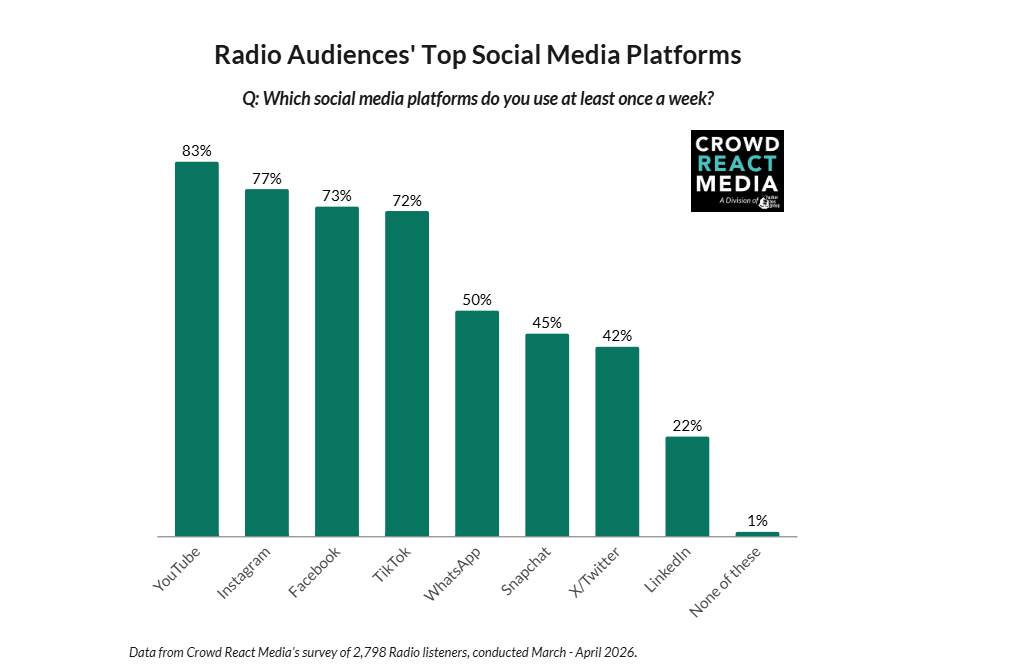
Shouldn’t that data send a clear message? If radio listeners are using YouTube as a social platform, they’re looking for engagement from the sports radio brands they love. Sports radio brands have become more accessible over the past six years, especially through live video in real time. So instead of posting another GIF on X with a “listen live” link, why not actively engage your audience on YouTube instead?
The tools are already in place, and the opportunities are significant. Rather than hoping for clicks from platforms that deprioritize your links, create a unique user experience where audiences are actively seeking interaction.
The days of equal investment across every social platform are over. Social platforms—and how they treat publishers (and yes, you are a publisher)—are not equal. Therefore, you must focus on where your audience actually spends time and build the skills necessary to maximize that opportunity.
That doesn’t mean abandoning other platforms. Instead, it’s time to reset priorities and focus on what drives digital growth. YouTube offers longer content windows, stronger discoverability, and audience behavior that aligns with how people consume sports radio. In other words, YouTube has the potential to become the new home for sports radio.
Or will that ground be ceded to podcasters once again?
Own Your Territory
The real risk isn’t that sports radio disappears—it’s that it gets outperformed in its own space.
Make no mistake: the next generation of sports fans isn’t choosing between AM, FM, or even streams. They’re choosing between personalities, access, and interaction. Increasingly, that decision is happening on YouTube—not on your frequency or your app.
Sports radio has always thrived on immediacy, reaction, and human connection. Those same qualities drive success on YouTube: live chats, real-time interaction, community building, and content that engages audiences rather than talks at them.
That’s not a new skill set for sports radio. It’s the original one. This isn’t about chasing trends—it’s about recognizing that the platform has finally caught up to what the format has always done best. It’s time for sports radio to cease leaning on what worked five years ago, and start building for tomorrow.
The question isn’t whether you should be on YouTube. It’s whether you’re willing to treat it like your home field—or continue playing road games while someone else builds the crowd.
Barrett Media produces daily content on the music, news, and sports media industries. Sign up for our newsletters to stay updated and get the latest information right in your inbox.
