A new study from Crowd React Media suggests radio listeners can’t reliably tell the difference between an AI-generated voice and a professional human voiceover — but the moment they find out which one they heard, their feelings change fast. The research, conducted by the Harker Bos Group’s research division, pits real audio clips against each other in a blind A/B test, and the results paint a nuanced picture for programmers weighing whether to bring AI into their production chain.
Crowd React Media Vice President of Strategy Katie Miller led the project alongside voiceover artist Neil Wilson. She recently sat down with Barrett Media to walk through how the study came together. The idea, she said, started as a casual conversation.
“Funny enough, the genesis of the idea actually came from Barrett Media,” Miller said. “Stephanie (Eads) introduced Neil Wilson and me at CRS, and we started talking about different ways we could collaborate.”
That conversation grew into a formal study built around a simple but pointed question: could listeners actually hear the difference between AI and human voice work? Miller and her team didn’t want to stop there, though. They also wanted to measure how listener sentiment shifted once the source of the voice became known, since raw identification alone wouldn’t capture the full story.
Why the Study Went Beyond a Simple Test
Miller explained that her team deliberately avoided hypothetical survey questions in favor of real audio comparisons. Listeners heard actual clips rather than answering abstract opinion questions about AI, which she said produces more honest data.
“We always try to avoid simple yes-or-no questions and opinions on hot-button topics when there’s a better way to measure real reactions,” Miller said.
The numbers back up her approach. Across the sample, roughly 57% of listeners believed they’d heard a human voice, while about 32% guessed AI, and the remaining 10% to 11% weren’t sure. When Crowd React Media split respondents by which version they’d actually heard, the identification rates still showed no statistical difference. In short, listeners guessed “human” most of the time regardless of what played in their ears.
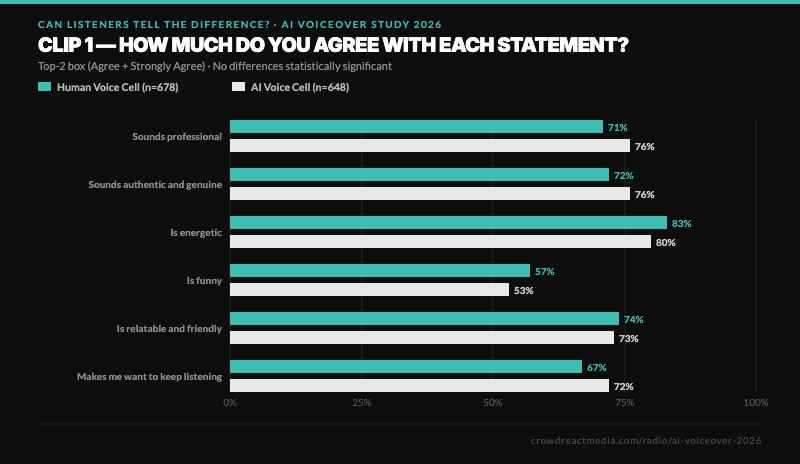
The attribute ratings told a similar story. Professionalism, authenticity, energy, relatability, and overall likability all came back statistically identical between the AI and human clips. Only one category separated the two: humor.
“That result makes intuitive sense,” said Miller. “At least today, humans are still better at comedic timing and delivery.”
The Reveal Changed Everything
Once researchers told participants which voice they’d actually heard, sentiment diverged sharply. Listeners who learned they’d heard a human voice reacted overwhelmingly well, and the numbers reflect that reaction clearly. Forty-eight percent said they felt more positive afterward, while only 4% felt worse.
The AI group responded very differently. About 25% felt more positive after the reveal, but 20% felt more negative, creating a far tighter — and less favorable — margin than the human voice group produced. According to the Harker Bos Group executive, that gap is the real headline of the study.
“There was a 23-point advantage in positive sentiment for the human voice compared to AI,” Miller said. “What that tells us is that performance was essentially the same, but perception changed dramatically once listeners knew the source.”
Open-ended comments reinforced the quantitative split. Listeners who’d heard a human voice praised companies for “still doing things professionally,” and several said they’d keep listening because a real person was behind the mic. Responses tied to the AI reveal clustered around three recurring concerns: deception, job loss, and a belief that radio should preserve genuine human connection.
“Listeners clearly expressed that they expect radio to be built around authentic relationships between broadcasters and audiences,” Miller said.
Wilson, the voice actor behind the study’s human-read clips, echoed that sentiment in comments shared with Barrett Media. His read on the data centers on trust rather than technical quality. He doesn’t mince words about what’s at stake for stations experimenting with synthetic voices.
“Listeners don’t hear the difference — until they do. And when they find out, the word that shows up repeatedly in their responses isn’t ‘disappointed.’ It’s ‘lying,'” Wilson said. “Radio is a trust platform. Always has been. The moment a listener feels deceived, you’ve broken something that’s very hard to rebuild … Radio is a human platform. It was built on the idea that a real person was talking to you. The data says your listeners still believe that — and still expect it.”
The Radio Reaction
Some took the study to mean that listeners overwhelmingly supported AI voices being heard on the air. Reactions poured in on social media, with many DJs, hosts, and voiceover artists arguing that the Crowd React Media study wasn’t true or credible.
However, the idea that listeners supported AI voices only tells part of the story.
Miller’s broader conclusion lands somewhere between reassurance and warning for the industry. AI, she said, has become “technically competitive” in short-form voiceover work, and that trend isn’t likely to reverse. Meanwhile, the emotional fallout from disclosure remains just as real, and stations can’t assume the two forces will cancel each other out.
“The concerns people expressed weren’t about audio quality,” Miller said. “They weren’t saying the voice sounded bad. Instead, they talked about trust, transparency, and feeling like they had been misled.”
Looking ahead, Miller said she’d welcome the chance to repeat the study on a regular basis, since attitudes toward AI are likely to keep shifting as the technology matures. She cautioned, however, against stretching the findings beyond their scope. The study focused strictly on short clips under 30 seconds, such as station imaging and liners, not full AI-hosted programming.
“I wouldn’t apply these findings to something like an AI radio host,” Miller said. “I suspect the results would be very different if listeners spent hours with an AI personality instead of hearing short imaging elements, but that’s outside the scope of this study.”
Barrett Media produces daily content on the music, news, and sports media industries. Sign up for our newsletters to stay updated and get the latest information right in your inbox.