I’m a firm believer that anyone who works in the sports radio business is an employee of the listener. They decide whether or not to consume our material, support our advertisers and interact with us and it’s our job to serve them the best content possible and keep them interested. While we all head to an office each day and have someone we report to, our performance is decided by the listeners in each of our respective markets.
 The hardest part of creating content is trying to juggle what we passionately care most about, what each listener wants and what the research in our market tells us the majority of people care about. While it’s great to be liked and use our best efforts to please every individual who listens to us, I believe the majority of people in your market will listen to you (even if they dislike you) if you present content with the broadest appeal. If a host delivers strong opinions and solid information on the subjects that matter most, they’ll earn the audience’s time.
This is supposed to matter because if you play the game correctly it should lead to ratings and as everyone knows, ratings dictate whether or not you and your brand are successful and what rates a client will pay to continue investing in your product. Only there’s one small problem to this equation – how do you really know if what you’re doing is right or not?
 I’ve been operating stations for 9 years since PPM became the new standard for audience measurement. During those 9 years I’ve programmed in 3 different markets. One was on the East Coast, one in the Midwest and one on the West Coast. During all 3 stops, I’ve never once met or seen a listener with a PPM meter. I’ve not received an email, tweet, facebook message or text into the company’s database from them and as far as I’m concerned, they’re ghosts. Do I believe they exist? Yes. However I don’t lose sleep at night worrying about where they are, who they are or how I’m going to satisfy 20 people who don’t provide me with feedback on how I can make their content experience more enjoyable on the radio station.
I love the radio business as much as anyone but you’d think that for the millions of dollars that numerous broadcasting companies, agencies and advertisers spend, that there would be stronger accountability and performance with audience measurement. It’s ludicrous that we can see the exact number of texts, tweets and facebook messages to our brands, the exact number of downloads our apps get, the number of streaming sessions and length of each person’s listen, yet we can’t show know how many people listen to our radio stations. Instead, less than 1,000 people form the opinions of what millions in a market listen to. And I’m saying this while in the midst of one of my best ratings runs ever.
 While it’s easy to be skeptical towards radio’s measurement system, I’m equally amazed at how so many people in radio will look at TV ratings as being a true reflection of the marketplace. A newsflash for my radio friends, TV has the same challenges with sample size, poor participation and inconsistency. It can be very frustrating to folks in the media business who’s performance and next contract is decided by such a small number of people but rather than complain about it, you can help yourself by playing the game the right way.
First, it’s important to recognize how PPM works when it comes to having ratings success. This means managing your content inside of a clock. If you need 5 minutes of listening time (it doesn’t need to be consecutive) inside of a quarter hour, don’t screw yourself up by breaking late or wasting time with minutia. The hour doesn’t extend and offer you extra minutes and the audience won’t sit through 2-3 minutes of meaningless crap. Dive head first into the content with a focused game plan and make the material mean something.
 Second, do some homework on what your market cares about. Too many hosts have the mindset of “If I care, they’ll care“. That may work sometimes, but if you’re playing a game of percentages I believe you’re going to win a lot more by playing to the audience’s needs than your own. Ask yourself this, if you went to see a famous comedian and couldn’t wait to hear them perform the jokes and stories you were familiar with, how would you feel if they didn’t deliver their most popular material? Would you stay? Even if you did, you’d likely remember it as a poor experience. If the audience tells you they want steak, give it to them. If you continue serving fish, don’t be surprised if you’re dealing with unhappy customers.
When I worked in St. Louis, a number of our shows were doing a lot of hockey interviews and when I told my crew that it was hurting us they didn’t want to hear it. Some guys loved the sport and the local team (The Blues) and they’d push back by telling me how the Blues had better support than other cities for hockey talk and with us operating on FM it would work out well. I disagreed and decided to do some homework to see if my feeling was correct.
 In our next staff meeting, I listed 20 different content items on the left side of a sheet of paper. 10 of them were hockey interviews we did on the station that month and the other 10 were open segments and interviews we conducted during the same month on the Cardinals, Rams and popular national stories. I then put 20 numbers on the right side of the paper and went around the room to see if the group could match up which ratings numbers lined up with each content piece. As it turned out, the 10 lowest rated content items were the hockey interviews.
After I showed them how the audience listening went down when we executed those content choices, they understood and went forward focusing on presenting subjects with broader appeal. Consequently we wound up surging in the ratings. That didn’t mean we never put another hockey guest on the air again. Instead we used better judgment of when it made sense to do so and we didn’t focus 50% of our content on it.
 The habits and interests of your audience are critical for you to know and often it’s not hard to figure out. Especially today when you can use social media to further help you. If you look at Facebook, Twitter and Instagram and see how many fans exist on each team’s page and then look at how much engagement takes place on each of their posts, that’s a good start. Then you can look at what the radio ratings in the market are for each team and do the same with TV. If you have a relationship with local newspapers or websites or if you have columnists working at your station, you can also find out which stories generate the most clicks. That type of research helps you in deciding which content to showcase.
In St. Louis for example, the Cardinals are the kings of the content circle. Their flagship station during the day delivers News Talk programming and the other sports stations in the market operate on very poor signals so when we launched 101 ESPN in January 2009 it was easy to see that the team’s fans were underserved during the day. By hiring people who the audience knew and trusted and by giving them a platform where they could be heard and offering the right content, we were able to build a dominant sports station.
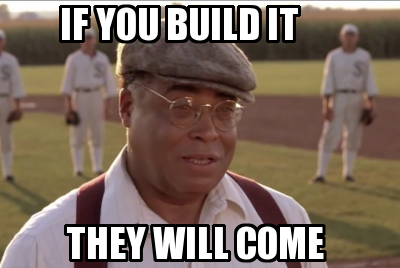 It wasn’t rocket science. I simply used the information available to me and recognized that while we couldn’t deliver the games to people due to not having the team’s rights, we could still be the market’s leader for Cardinals coverage throughout the day. By relaying that message to our audience through effective imaging and by getting the talent on board to make it part of their daily focus, we won a lot. In the movie “Field of Dreams“, James Earl Jones says “If you build it, they will come” and it works in radio too except I like to say “If you present the right content, they will listen to it“.
One article I enjoyed was published by the NY Times this past October. It was built around the MLB Playoffs and the neighborly feel that existed due to the involvement of teams who were rivals or inside the same market. By using Facebook data, the article showed which teams had the bigger pull in their regions and where the shift in fan bases occurred in each market. If you were programming or hosting a show in any of these markets in October and used this information to help you in deciding your branding and content execution, smart move.
 While PPM is not perfect, there are times where it works really well. Case in point, regular weekly guests, big games and other important events such as an introductory press conference usually show a change in listening patterns. For example, in January I carried Jim Tomsula’s press conference when he was named the new Head Coach for the 49ers. The presser ran 30-minutes long and was incredibly bizarre and considering that the 49ers had parted ways with popular Head Coach Jim Harbaugh, fans were not happy. The presser that day was carried by my station and my competitor (the home of the 49ers) and during the 30-minute time that we each carried it, we delivered a 6.5 and were 2nd in the market with Men 25-54 and my competitor produced a 4.8 and were 4th.
The presser delivered for both stations which showed that the content mattered to the audience. But why did we perform higher? Well, we are on FM and my competitor is not so maybe that could have been a factor and while that’s certainly possible, I have a different theory. In the San Francisco market, my brand is seen as the station that covers both teams and isn’t afraid to take teams to task when it’s warranted. My competitor meanwhile is the heritage sports station and play by play home for a number of local teams and they present a very positive presentation when discussing local teams. That formula works well when teams are winning but in this case, people were mad at the 49ers and wanted to know the other side of the story. That is why I believe they came to us to hear it.
 I saw the same thing take place in early March during Day 1 and 2 of NFL Free Agency. At my current radio station we were #1 overall with Men 25-54 both days delivering a 6.7 and 6.3 and our streaming sessions were up 250% over both days. Because we present ourselves as a strong football destination and employ people who have a passion for the sport, we performed well when big NFL news was taking place.
My competitor in the marketplace was 5th during these 2 days which is understandable because they present themselves strongly as a Giants baseball station. If the news for these 2 days was centered around the Giants or Major League Baseball, the positions would’ve likely been reversed. None the less, when big NFL news is happening you should see increased listening to sports radio stations and PPM captured it during both days.
If you’re a programmer or talent, be smart about your content choices and remember who you work for – the audience! Don’t worry about what the meters are doing, worry about what you’re presenting. A metered listener still has two ears to listen, a brain to form an opinion and a finger to push a button to listen to a particular radio station. If you’re a good talent delivering a good show and presenting the content that matters to the majority of the audience, they’ll find you. Just don’t expect to find them. Ghosts and PPM meters are usually undetectable.